The floor went down on Saturday, and by Sunday morning something about it felt off. In the Amsterdam living room described here, the boards look fine under the evening lamps and strangely printed by day. That doesn’t mean you chose badly or bought the wrong boards. Three separate causes make a laminate floor look artificial, and each has a visible symptom you can check yourself. A phone camera and a few minutes at floor level will test every one. Nearly every fix is free, and the few purchases are small ones that you can skip if the free steps are enough.
What Makes a Laminate Floor Look Artificial
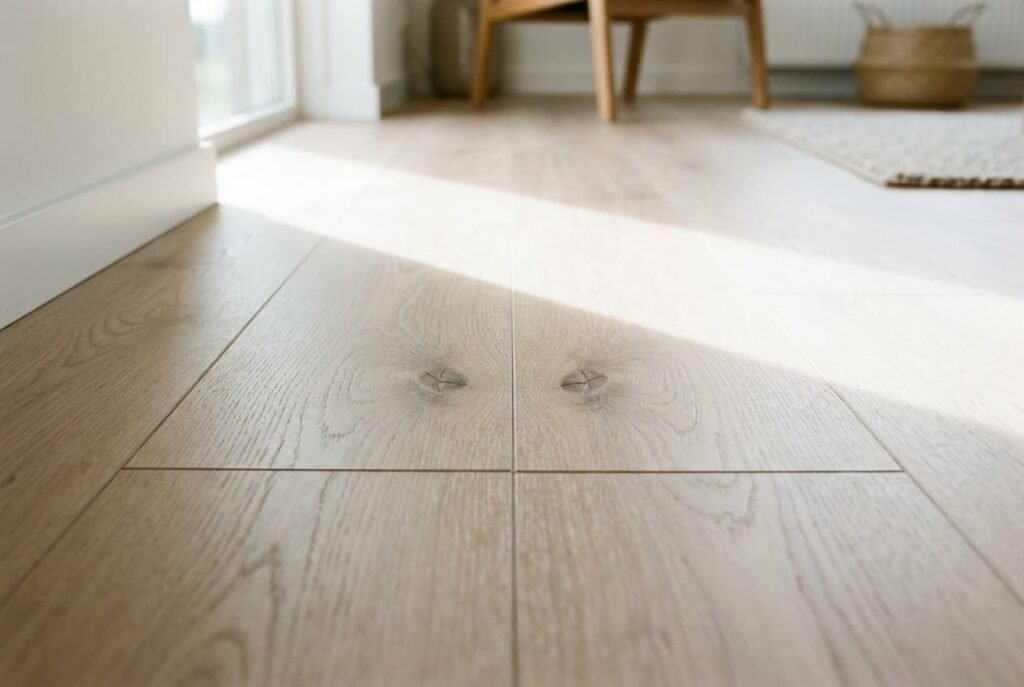
Natural wood varies in colour and pore depth. It also catches light unevenly. A laminate board carries a printed photograph of wood under a smooth, hard wear layer. The photograph can repeat, and the smooth layer reflects like plastic. Every printed knot has the same colour and depth, whereas real knots never do. On some boards the surface texture also sits slightly offset from the print, which adds to the effect.
Take the Amsterdam room, which measures 4.2 by 3.6 m and gives 15.12 m². Each board is 19 by 128 cm, an area of 0.2432 m², which means about 62 boards. Assume the pack holds 8 printed designs. Each design then appears about 8 times across the floor (62 ÷ 8 ≈ 7.8).
The smooth layer matters most by day. A plastic-like surface reflects only about 4% of light that arrives steeply from above. At 80 degrees from the vertical, which is the angle a low morning window gives you, that rises to roughly 35%. The streak is almost nine times brighter than the floor around it.
The usual misdiagnosis is polishing the boards to make them look richer, because polish adds gloss and lifts that low-angle reflection even higher.
A Floor-Level Test for Whether Laminate Looks Natural
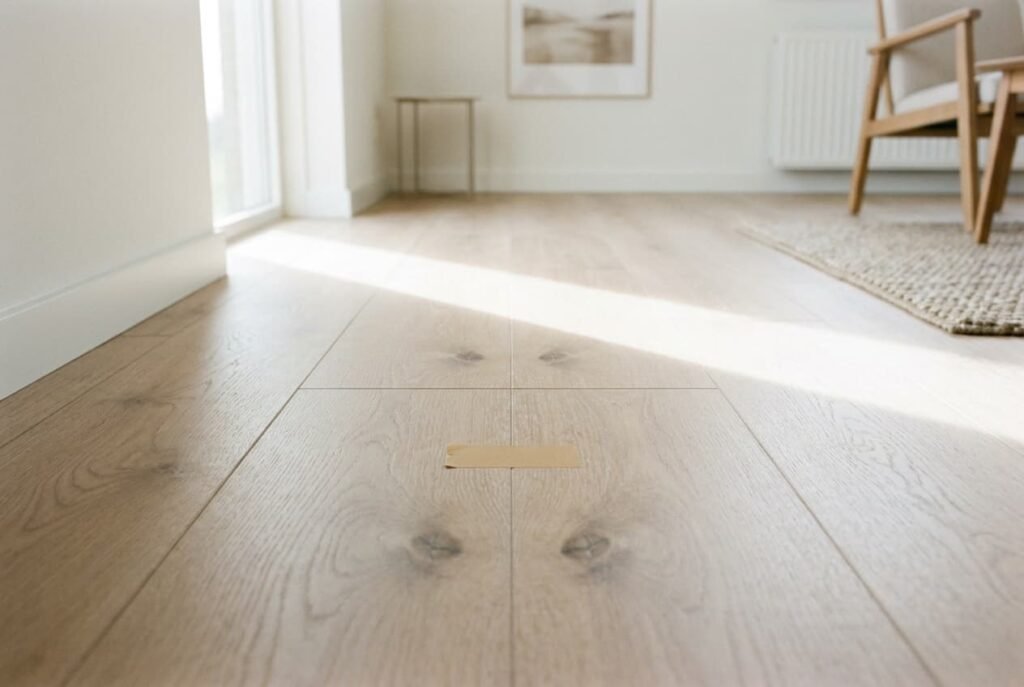
Crouch nearest the window until your eyes sit 30 cm over the boards, then look along them towards the far wall. A bright band across the floor means the cause is sheen. The same knot or swirl turning up again and again means the cause is repetition.
Put a small piece of tape on one distinctive board and count the boards until the same design appears. A count of eight or fewer is easy for the eye to catch. Take the same view in greyscale too. A streak and repeats that survive without colour point at sheen and pattern rather than tone. From the doorway, capture the floor at noon, then repeat the shot after dusk. Grey in the first but orange in the second points at the light itself.
Last, check the edges where boards meet. A hairline of shadow along each end joint tells you the light is grazing the surface.
Failing only one test means one fault, whereas failing all three means you’re dealing with all three.
Three Faults Behind the Printed Look
Almost every floor that looks artificial in daylight owes it to a handful of faults. Each is described below by its symptom and cause, then by fixes ordered by cost. Together they explain what makes a laminate floor look artificial in daylight.
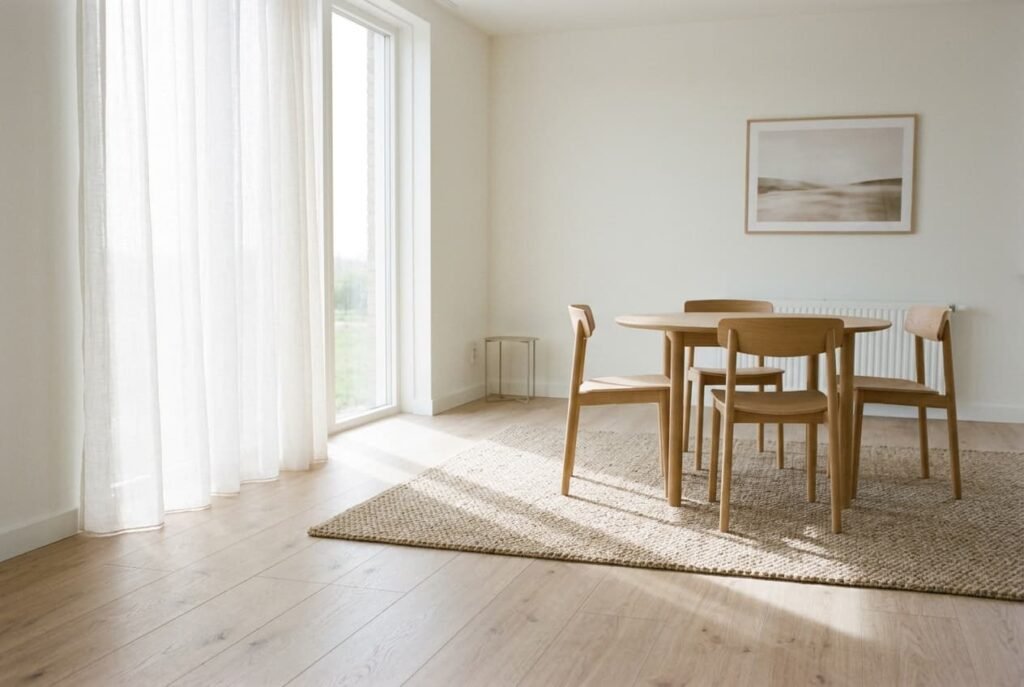
The same knots keep turning up. The cause is scale: 8 designs across 62 boards means each appears about 8 times, and the eye matches them across a floor with no clutter. Slide the dining table and its chairs towards the middle. That hides about 4 m² and leaves 11 m² bare. Then arrange the sofa and a side table so no stretch of bare floor runs unbroken for more than 2 m. If you buy anything, make it a rug measuring two metres by three. It covers 6 m² and leaves 9.12 m² bare, about 37 boards, which brings each design down to 4.7 appearances. A rug also adds texture, which the print can’t supply.
The floor turns orange at night. The cause is colour temperature. Daylight on an overcast morning sits near 6500 kelvin, while a warm bulb sits near 2700. A printed floor returns a narrow range of tones, and it drifts from grey to orange between the two. Switch off any cold overhead light at dusk and rely on the lamps. The cooler the bulb, the greyer the boards look beside it. Move one lamp to a corner so it washes the boards beside the sofa. Finally, fit warm 2700 kelvin bulbs in the lamps, which is the one small purchase. Then the boards match the sofa and the wood furniture after dark instead of fighting them.
A bright streak crosses the boards. The cause here is placement: the window faces down the room’s length, and morning light skims the floor, where the smooth surface returns about 35% of it. Close the sheer curtain while the sun sits low. Move the table across the streak, because the eye then settles on the table rather than on the shine. A rug across that path does the same job, though it’s a purchase. If it still bothers you, a voile curtain fitted at the window is the item to buy, and it scatters the light before it lands on the boards.
Choosing Boards That Look Real Next Time
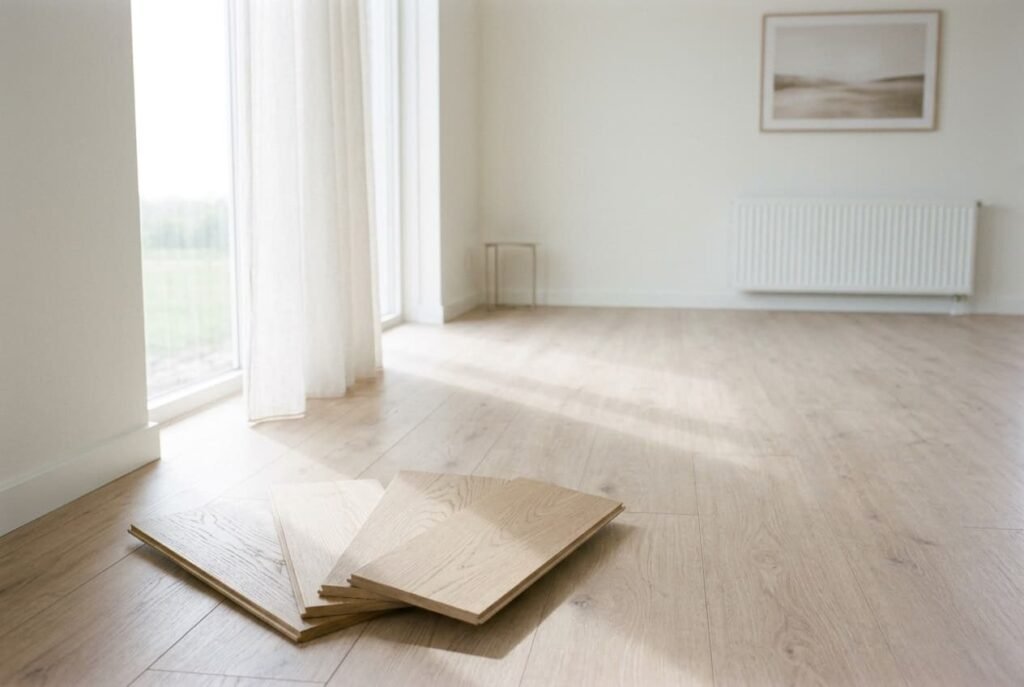
Ask for a sample of at least six boards taken from different packs. One board can’t show you repetition. View the samples in your own room at the hours you use it, since a showroom’s spotlights flatter any surface.
Check the pack for the number of printed designs, and shuffle boards from several packs when laying. More designs push repeats further apart. Pick a lower sheen if you have the choice, because a satin surface reflects less at a low angle than a glossy one. Lay the boards along the main window’s light where the room allows, as joints parallel to the light hide better than joints across it. Sampling and shuffling matter more than the name on the pack, since they decide what makes a laminate floor look artificial in your own room.
The Fix That Isn’t Worth Doing
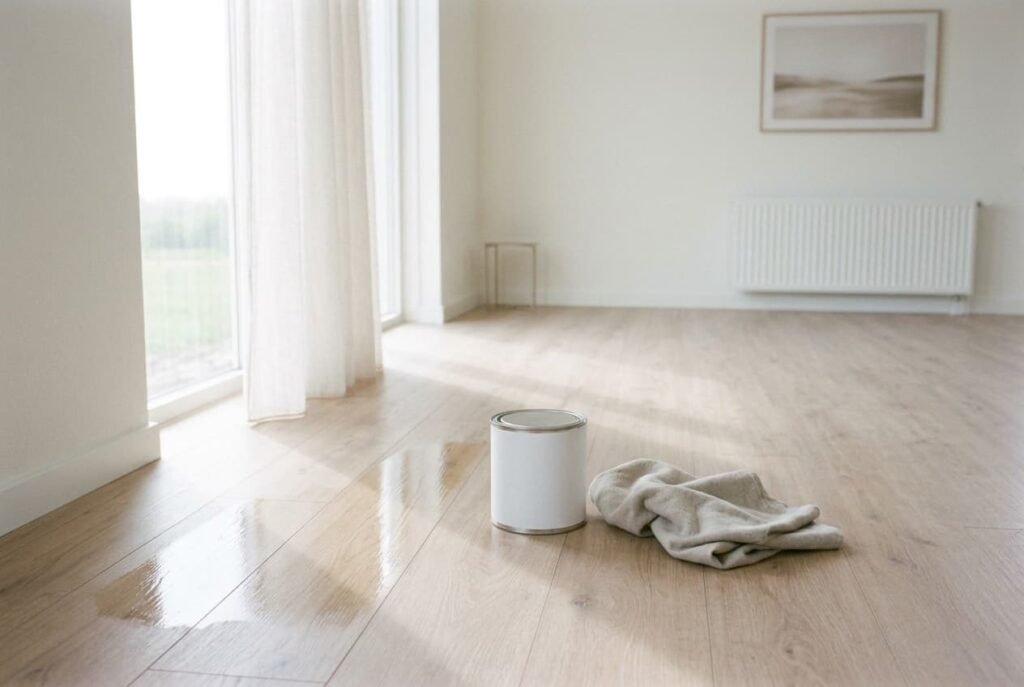
Many people try wiping on a wax or polish to restore a natural shine. It looks tempting for an hour and rarely helps. The wear layer is sealed. Wax can’t soak in and sits on top as a film. It smears, and it collects dust. It also leaves slippery patches on a floor that people cross in socks. Worst of all, it adds gloss. Gloss is what raises the low-angle streak. Stain or paint is worse again, because it flakes off a surface that was never meant to hold it. Nothing in a bottle changes a printed image, and in daylight the eye reads the print before anything else. What makes a laminate floor look artificial is the print and the sheen, and wax only strengthens the second. Plain water on a cloth wrung hard, plus the maker’s own cleaner, is all the floor needs.
Read all this as a diagnosis, not a verdict on your choice. Neither taste nor budget is at fault here, and the boards aren’t defective. Printed boards behave in a predictable way, and your task is to give the eye something better to land on. If you only do one thing this weekend, close the sheer curtain around ten o’clock and look again. That is free and needs under a minute. Then shoot the floor from the same spot and compare the two pictures, because a change that still looks right after a week is worth keeping for good.
Questions Readers Keep Asking
What actually causes the artificial look?
Three causes combine: a printed design that repeats about 8 times, a colour that shifts between daylight and lamps, and a smooth surface that returns about 35% of low light. Each cause can act alone. In the Amsterdam example all three were present.
Is there a quick fix?
Yes. Close the sheer curtain while the sun sits low and slide the dining table across the bright streak. Both take seconds and are free. If the effect remains, add warm bulbs to the lamps, and perhaps a larger rug.
Can this be fixed without renovation?
Mostly, yes. Furniture and curtains handle the first step for each fault, and lamps help too. Only a rug or a voile curtain needs buying, and both are optional. Tenants can leave the boards exactly as they are and still change how the room looks, because nothing here involves lifting them.