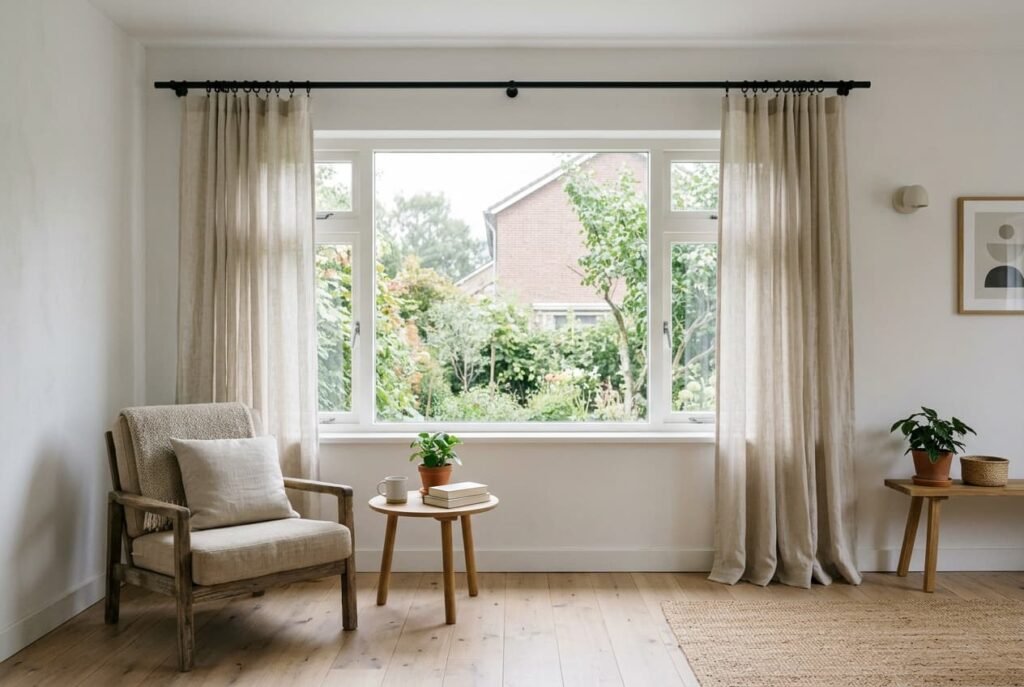
A pole carries rings that you slide along it, while a track carries gliders running inside a rail that’s fixed above the window. Weighing a curtain track or curtain pole therefore means weighing wall space against ceiling holes. We compare the wall each one takes and the cloth each one calls for. After that comes an alternative and a way to decide. One example window supplies the sums: 240 cm wide, set in a front wall 360 cm long, with 250 cm from floor to ceiling. Everything is in centimetres, the way Dutch flats are measured. Swap these numbers for your own, and keep a tape nearby.
Curtain Track or Curtain Pole: What Decides a Wide Window
Start with the fabric. A pair of curtains for a 240 cm window is made twice as wide as the glass. Each curtain therefore measures 240 cm flat. Opened, it gathers into a stack beside the window, and you want that stack on bare wall rather than across the glass. Assume rings stack each curtain at a fifth of that width and gliders at an eighth. The pole then has to span 240 + 2 × 48 = 336 cm, which we round to 340 cm. The track spans 240 + 2 × 30 = 300 cm.
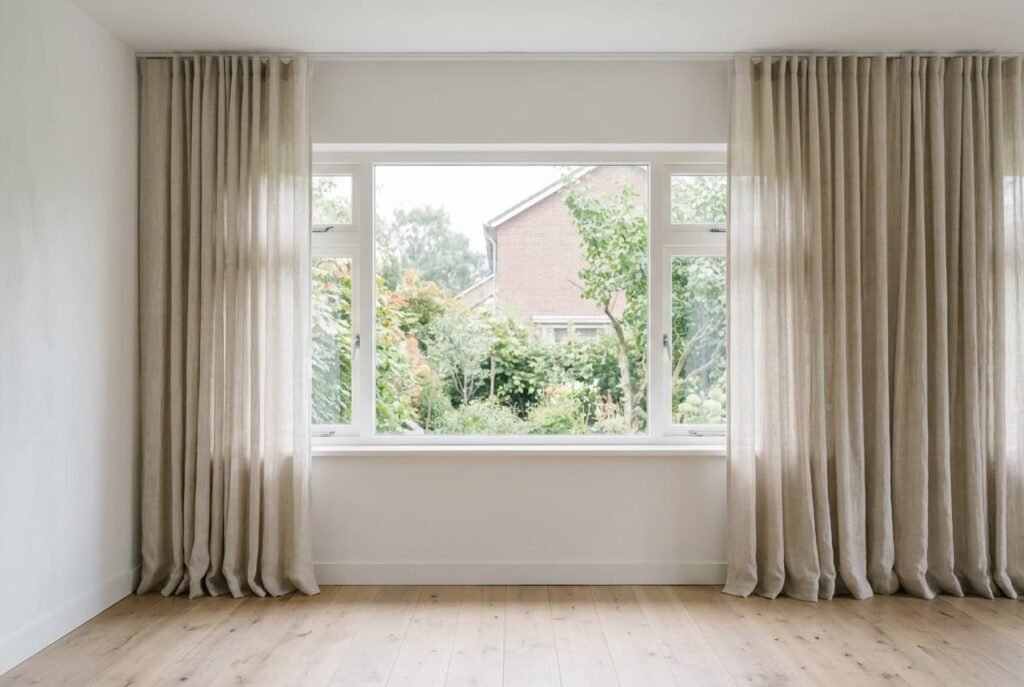
Height changes the sums too. Our frame top stands at 205 cm. Fixed 15 cm above it, a pole sits at 220 cm, and its rings hang the fabric from 216 cm. A curtain 215 cm long then clears the floor by 1 cm. On the ceiling, a track starts at 250 cm, and its gliders hang the fabric from 249 cm. That curtain is 248 cm long, which means 33 cm more cloth.
The deciding question is how much wall each takes beside the glass, set against the drop you can afford. A pole spends width and saves cloth. A track saves width and spends cloth.
The choice of curtain track or curtain pole stays open until you know your own wall and ceiling.
Pole or Track: The Two Compared
The figures below all come from our example window, with stacks of a fifth for rings and an eighth for gliders. Treat them as a worked sample, since your own heights will differ. Check any row with a tape; none needs a make or model.
| Point | Curtain pole | Curtain track |
|---|---|---|
| Length to clear the glass | 340 cm | 300 cm |
| Fixings | 3 brackets, 6 screws in the wall | about 7 fixings in the ceiling |
| Top of the fabric | 216 cm up | 249 cm up |
| Fabric per curtain | 2.4 × 2.15 = 5.16 m² | 2.4 × 2.48 = 5.95 m² |
| Moving a curtain | rings stop at the centre bracket | gliders run past every fixing |
| Curves | straight lengths only | follows a bay |
| Look | rod and finials on show | slim rail, easily hidden |
Assume cloth of 0.4 kg per square metre: a pair weighs about 4.1 kg on a pole and 4.8 kg on a track, and a well-fitted set of either carries that comfortably. It’s geometry that really separates them, because a pole costs you 40 cm more wall while a track costs you 33 cm more cloth. Weight doesn’t decide anything here.
Where the Pole Wins
A pole suits a rented front room, because its fixings go into the wall above the frame and the ceiling stays untouched. Three brackets leave six small holes, and filler hides them when you move out. The curtain is also shorter at 215 cm, which saves 0.79 m² of cloth per curtain compared with the track version and takes 0.6 kg off the load for the pair.
When you set a curtain track or curtain pole against the same window, the pole is the one that doubles as decoration. Rings and finials stay on show, and that’s what some people want. A span beyond about 180 cm needs a centre bracket, which our 340 cm pole gets. Each curtain then rides its own half. Since rings can’t slide past the bracket, the pair simply meets at the centre.
The drawbacks are real. The pole takes 50 cm of wall beside the glass on each side, and our front wall of 360 cm leaves just 10 cm to each corner. Rings also drag a little when you open the curtain, and a heavy fabric may need two hands.
Where the Track Wins
For an owner choosing a curtain track or curtain pole, the track usually wins, because the ceiling is yours to drill. Its gliders hang the fabric from 249 cm. The curtain climbs right to the ceiling line, making the window read taller. Gliders run past every fixing, which lets one hand open or close a whole curtain in a single smooth pull.
A track also follows curves. If the window ever becomes a bay, the same rail bends round it and the gliders keep running, whereas a straight pole needs a separate length for every flat section. A rail close to the ceiling also covers the gap above the cloth, which stops light leaking past.
The costs sit overhead. Our 300 cm of track needs about 7 fixings, and plasterboard takes different plugs from concrete. Check what’s above you before you buy any. The cloth is 33 cm longer as well, which adds 0.79 m² per curtain and 0.6 kg to the pair. Even a hidden rail leaves its holes in the ceiling when you move.
A Third Route Worth Weighing
Before buying either, check what is already up there. A working rail or pole above the window may need nothing but new cloth.
That route needs no new holes at all.
A second option suits renters who want the glide of a track without ceiling holes. Fix the same rail to the wall above the frame on brackets, 15 cm up, where pole brackets would go. The curtain is then 215 cm long, as it would be on a pole, and the glide of a track is kept. It still needs wall fixings, which your landlord must approve.
The wall-fixed track gets the movement of a track and the cloth length of a pole, though it leaves wall holes of its own. Try it only where the ceiling is off limits. Brick or block holds brackets well, while a stud partition needs the screws to land in the timber.
Which One to Pick
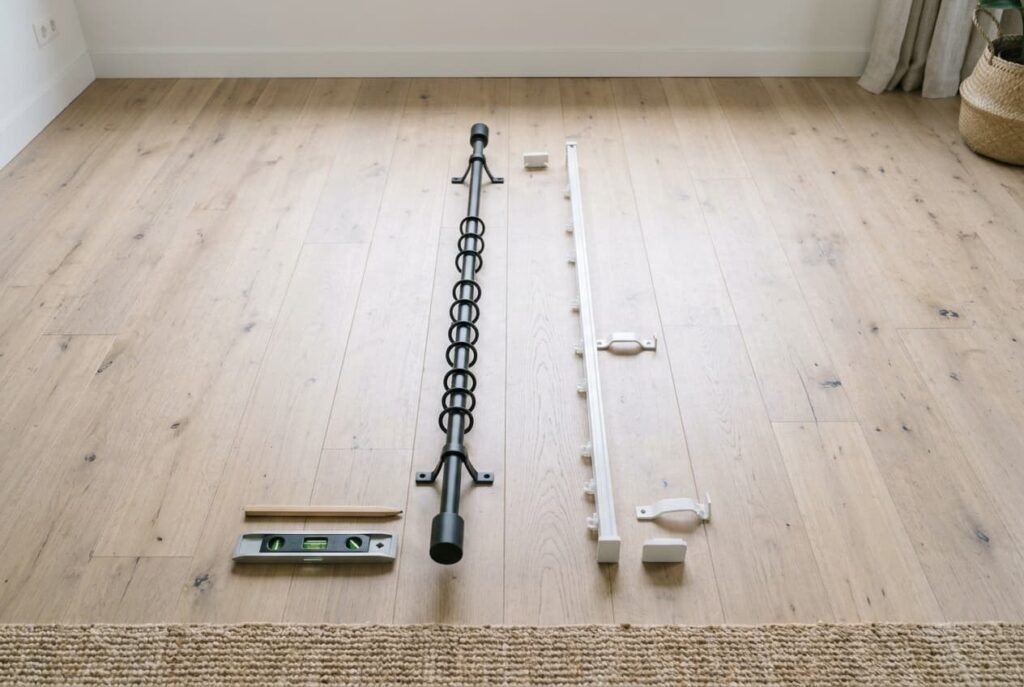
Two situations settle it. If you rent and the ceiling is off limits, choose the pole, because six wall holes are easier to fill than seven in the ceiling, and the shorter curtain saves 0.79 m² of cloth on each side. Check that the wall beside the glass can take the stack. Mark each bracket position with a level held against the wall.
If the flat is yours or a bay may come later, choose the track, because it glides smoothly and lets the cloth reach the ceiling on a span of just 300 cm. Fit plugs that match what the ceiling is made of, and space the fixings about 45 cm apart along the rail.
Measure the wall beside your window and mark where each stack would rest. Then redo the table with your own numbers and hang the winner for a fortnight. Should the curtains catch or leave a gap along the top, move the fixings, because nothing is final until the drill comes out. A fortnight of daily use will teach you things a sketch can’t.
Questions Readers Keep Asking
How long does each one last?
Either lasts for years if it’s fitted properly. On a track, gliders are what wears out soonest; a cracked one can be replaced alone. On a pole, rings scuff the finish over time, and a loose bracket screw is what you’ll notice first. Neither needs replacing until something actually fails.
How do I keep them clean?
Dust gathers where the cloth hides it. Wipe the top of a track and the upper face of a pole every few months with a dry cloth. Run the gliders along the rail now and then to confirm nothing catches. Tighten the bracket screws once a year, because they don’t stay tight forever.
Which suits a rented flat with a bay window?
A bay suits a track, because a flexible rail follows the curve. If the landlord forbids ceiling holes, fix that rail to the wall above the bay on brackets. A straight pole would need a separate length for each flat section, which leaves a gap at every corner.