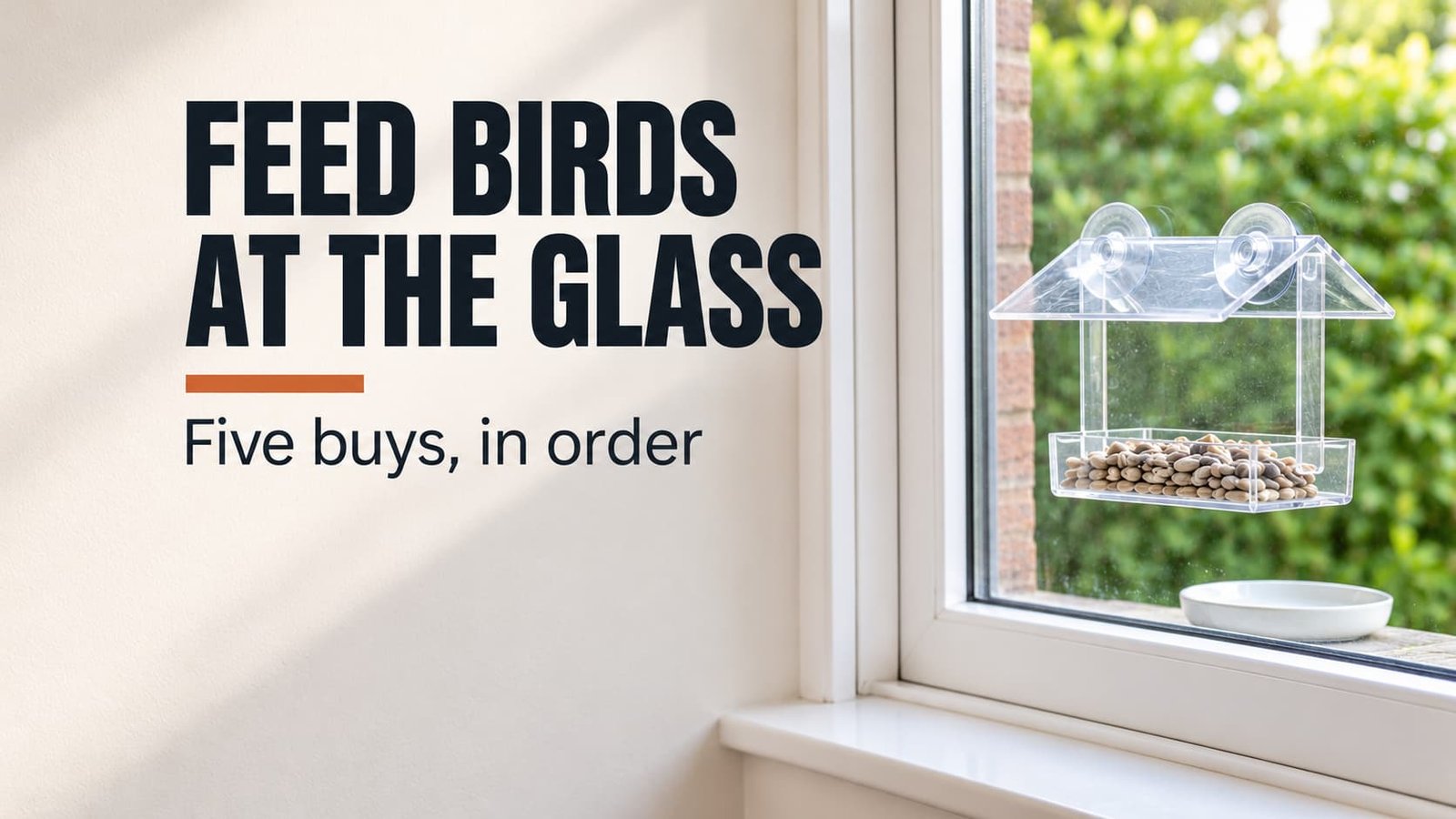
Setting up a bird feeding corner at a window means buying five things in a sensible order and adopting one weekly chore: washing the feeder. The sample is a back window in a Nijmegen terrace. The pane is 1.2 m across and 1.4 m high with an outer sill 20 cm deep, and a hedge stands 6 m off. Read these figures as examples; your own glass will give different ones. The order runs from the most important item to the least, and a skip list follows. Most of the advice concerns the glass rather than the birds. A garden isn’t required.
Why a Bird Feeding Corner at a Window Starts With the Glass
A window corner answers to two limits: the sill area it takes and the distance it keeps from the glass.
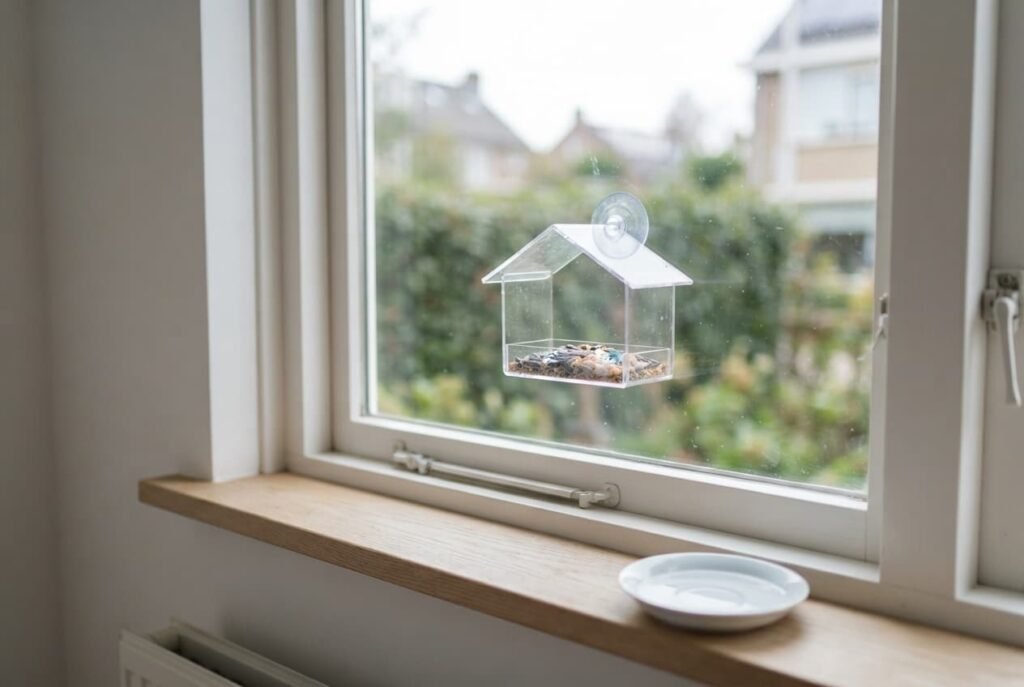
Outer sill area comes down to arithmetic. This sill gives 120 × 20 = 2,400 cm². A water dish 20 cm wide uses π × 10² = 314 cm², or 13%. A seed tin 15 cm wide uses 177 cm². Together they occupy 20% and leave room for a cloth and a brush. The feeder itself hangs on the glass and takes no sill at all, and what remains of the strip stays free for your elbow.
Distance matters more for the birds. One that flies at a pane from several metres away arrives at speed, and the glass doesn’t give. A feeder stuck to the pane offers no run-up, which turns a mistimed landing into a bump instead of a collision. For a bird feeding corner at a window, everything the birds touch should sit on or against the glass, while everything you handle should stay within reach of the sill.
Weight completes the picture. Sunflower hearts, the hulled seed, run to about 0.55 kg per litre, which puts a 0.5 L tray at roughly 275 g. Suction pads cope with that, unless a pad has stiffened in the cold.
Five Purchases in Order for a Bird Feeding Corner by the Window
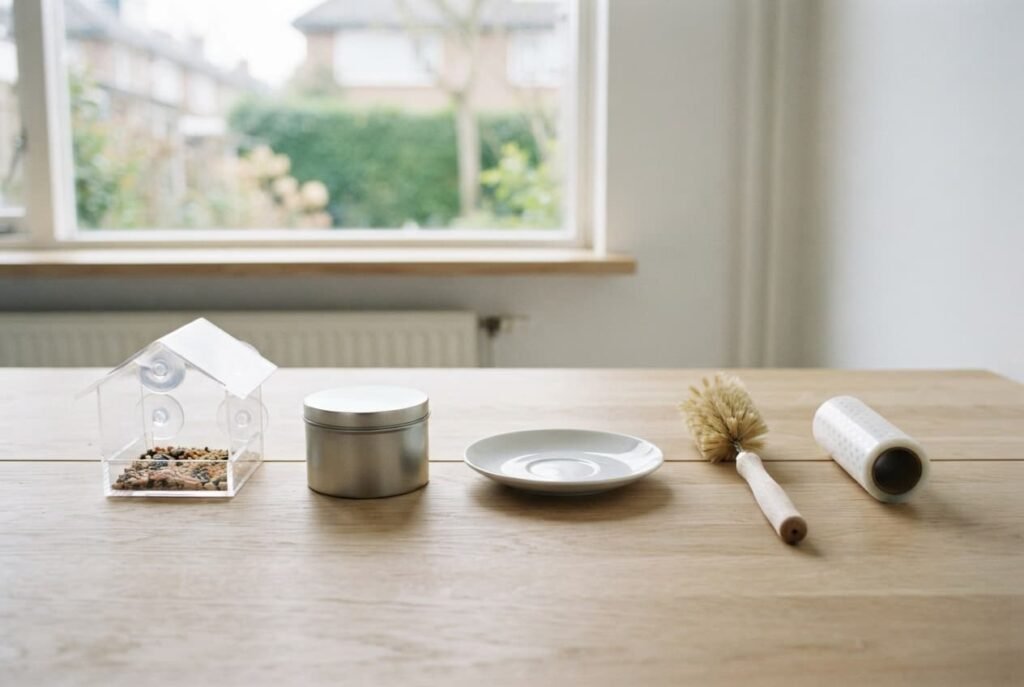
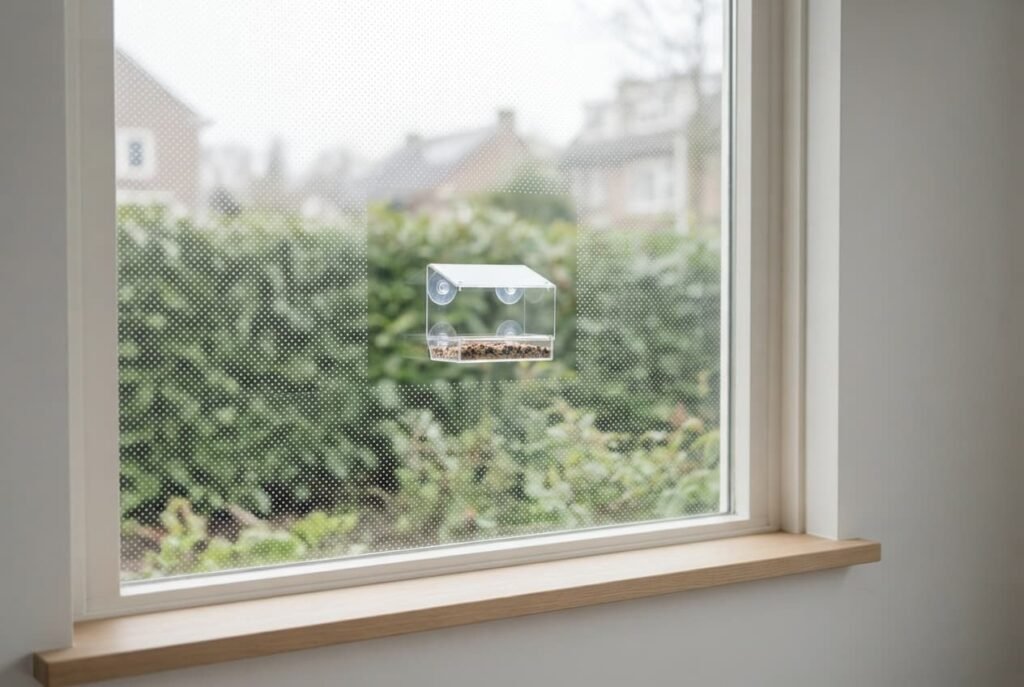
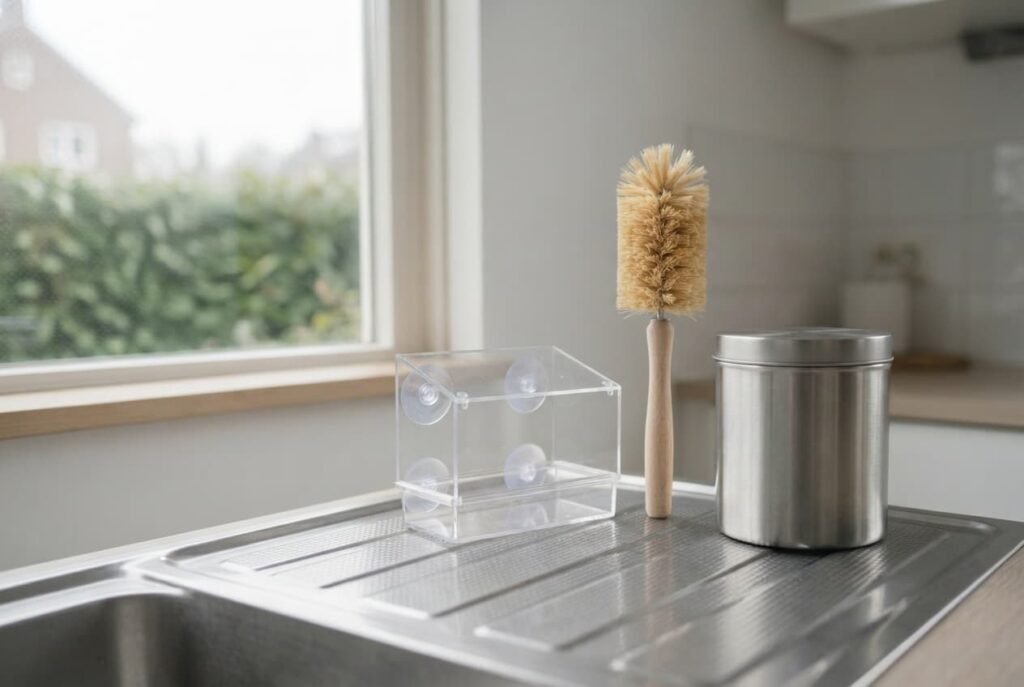
1. A window feeder with a roof and a 25 × 15 cm tray, held to the glass by three suction pads. It leads the order since every other purchase only supports it, and nothing downstream rescues a poor one. The tray takes 275 g of seed and the feeder itself weighs 0.15 kg, which puts 0.425 kg on the pads, or 0.14 kg each. Tier: BUY MID. Plastic at least 2 mm thick resists sun yellowing, and soft rubber pads grip cold glass. Weak point: a roof that stops flush with the tray, letting rain reach the seed.
2. A lidded seed tin that’s 15 cm across and 25 cm tall. Its volume is π × 7.5² × 25 ≈ 4.4 L, or roughly 2.4 kg of hearts. At a sample 40 g per day that lasts 60 days. Tier: BUY ONCE. Steel with a rolled seam resists gnawing and stays dry inside for years. Weak point: a lid fitting inside the rim instead of over it, which admits moisture.
3. A shallow water dish: a glazed saucer 20 cm wide and 3 cm deep. Filled to 2 cm it holds about 0.63 L. Tier: BUY CHEAP. Glazed ceramic wears slowly, and its weight keeps the wind from tipping it. Empty and rinse it every second day. Weak point: steep, polished sides, which give a small bird nothing to grip.
4. A stiff bottle brush and a lidded tub kept only for washing the feeder. Tier: BUY CHEAP. Stiff nylon bristles do the whole job, and a wash takes five minutes with hot water and a final rinse until no suds remain. Weak point: a bare wire core. It scratches plastic, and scratches hold dirt.
5. A dotted window film, 120 × 140 cm, which makes 1.68 m². Space the dots 5 cm apart at most, and leave a bare patch of 25 × 15 cm where the feeder’s pads will stick. Tier: BUY CHEAP. The film only has to stay stuck to the glass, and it still lets most daylight through. Weak point: wider gaps between dots, which a bird reads as open sky.
These five fit one sill and one shelf of a kitchen cupboard.
Why the Seed Tin Is the Item to Drop a Tier
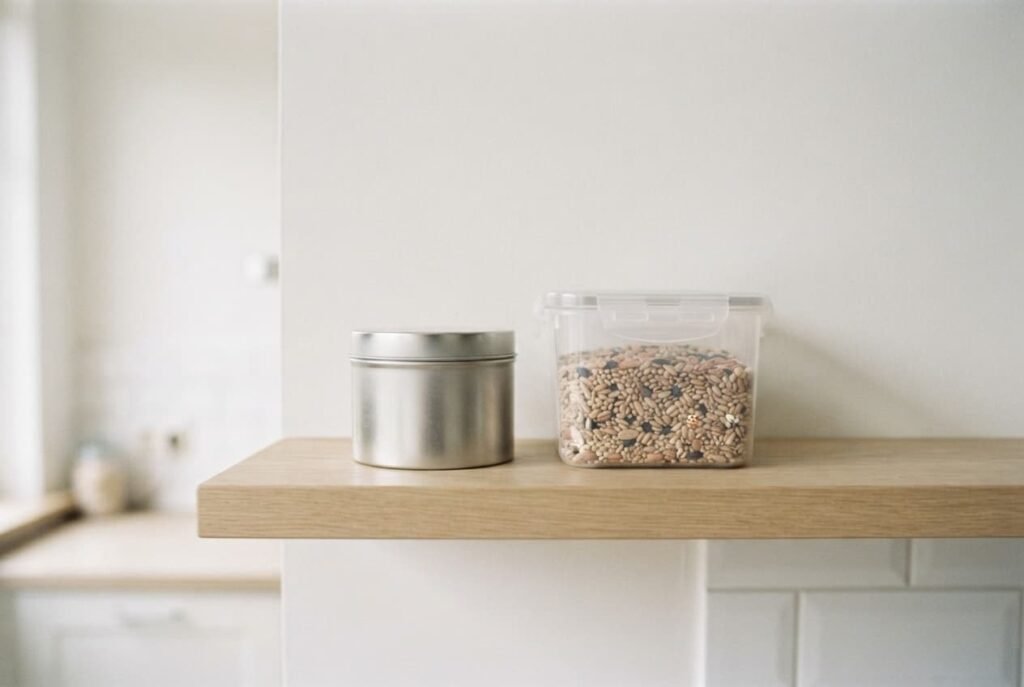
The tin takes the largest share of the money among the five, which marks it as the item to question. A bird feeding corner at a window doesn’t need steel. The seed lives indoors, a metre from the kettle, and a lidded plastic tub holds it just as well at a much lower cost.
Run the numbers. A 5 L tub holds 2.75 kg of hearts against the tin’s 2.4 kg, and a clip lid keeps them dry. It fits a shelf of 30 cm across with room beside it. At 40 g a day a full tub lasts about ten weeks, and dry hearts in a cool cupboard keep well for that long. Even at five refills a year across ten years, the plastic copes.
Gnawing is the single real difference. Mice chew plastic, and steel stops them. If you’ve found droppings in a kitchen cupboard, keep the tin. If you haven’t, use the saving on the feeder. That piece faces rain and sun daily, while the tub never leaves its shelf.
Test the lid whichever you choose: press it shut and tilt the tub over the sink. A trickle means the clips are loose.
Order and Timing for the Window Corner
Spread the setup over a week. For a bird feeding corner at a window, autumn is the natural start. Natural food thins then, and birds roam further for it, though a new feeder can still sit unnoticed for a few days.
Day one belongs to the film. Stick it to the outside face and let it settle, because a feeder on bare glass invites the strike you’re trying to avoid. On day two the feeder goes up, with a small handful of hearts in the tray. Press the tray gently to confirm the pads hold.
Day three brings the water dish, filled to 2 cm. When frost forms, tip the ice out. Then refill from the tap. The tin or tub and the brush can wait until a refill is due, which falls about a week in at 40 g a day.
Scribble the first wash date on the tub lid. A weekly clean takes five minutes, and the lid then tells you when the next is due.
What to Skip
Skip loose seed mixes padded with grain, because many birds flick the filler away and most of the sack ends up on the sill. Hearts leave no husk behind. Skip fat balls in plastic mesh too. Toes and beaks can catch in the net. One window needs one feeder, and a camera can wait until the regular visitors are known. Binoculars add little when the birds sit 40 cm from the glass. Bread fills a bird without feeding it, and a stand-alone bath needs more space than a sill gives. Leave out a nest box as well, since this corner exists for feeding. Skip window stickers shaped like a bird of prey too, because one silhouette leaves wide gaps between marks.
Let the first month show what’s missing. A tool you reach for twice without owning it is your sixth item. Record which species come and at what hour, and read the record after four weeks. Cut anything the birds ignore, and add a second dish only if the first is empty by noon. A sill that stays tidy is a sill you’ll keep servicing, and the birds reward that more than any gadget.
Questions and Answers
Do I need all five pieces from day one?
No. The feeder plus the film and some seed are enough for the first week. Add the water dish on day three, and buy the brush before the first wash. The tin or tub can wait until the first bag runs low, which at 40 g a day takes about a week.
When in the year should I start?
Autumn is the usual choice. Natural food thins then, and a new feeder gets noticed sooner. Spring works too. Once you start, keep the feeder filled through winter, since birds learn the spot and return daily. A pause of a few days is fine, though a long one sends them elsewhere.
How can I judge a window feeder in a shop?
Press a pad flat and see whether it springs back. Check that the roof overhangs the tray by at least 2 cm, and look for drain holes in the base. Plastic you can see through, free of cloudy patches, suggests good resistance to sun.