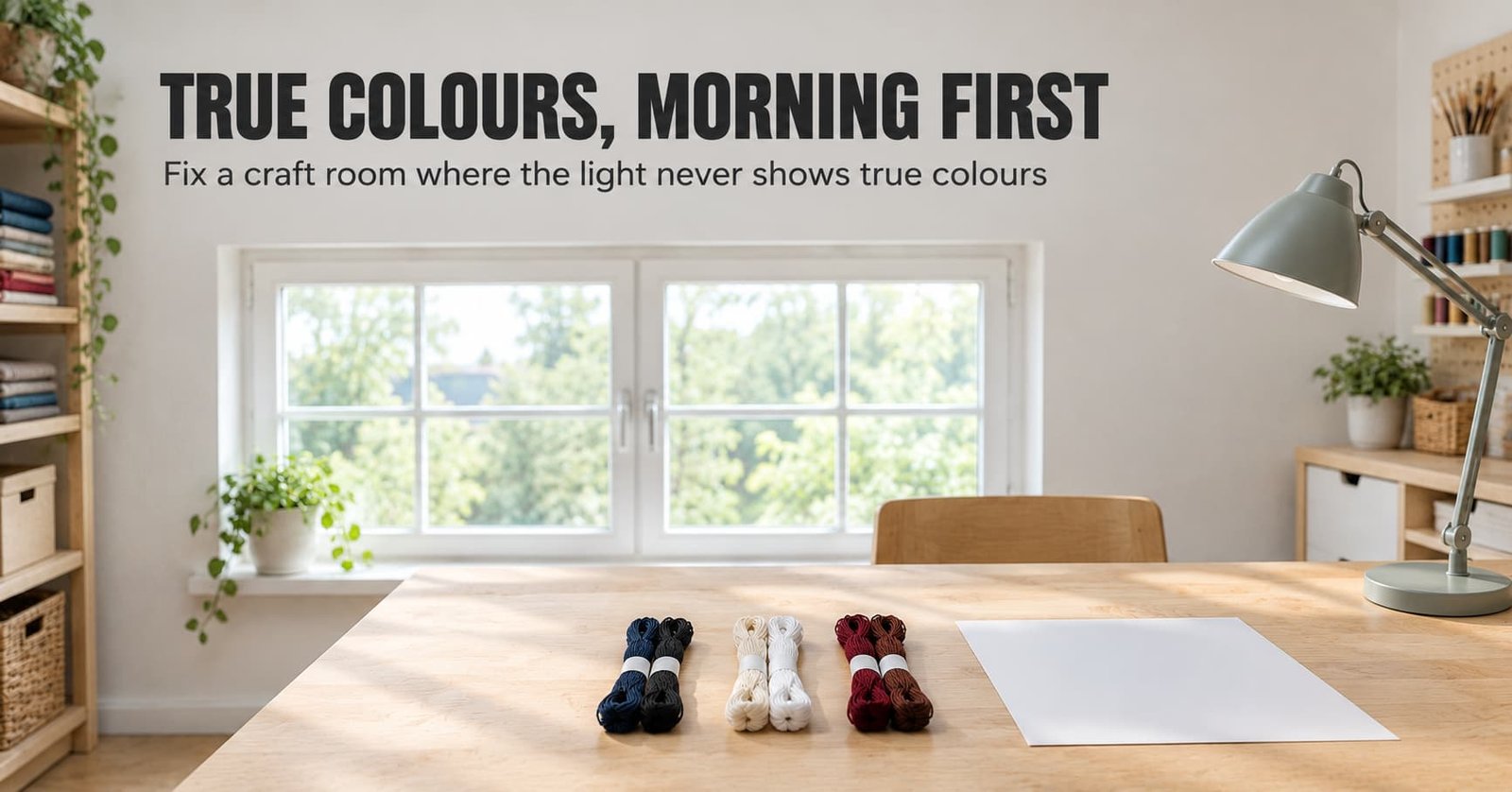
The common complaint is that thread matched in the shop looks different at the table. A colour chosen in the evening looks wrong by morning. Most often one change settles it: a fixed judging spot, used at one time of day.
In a craft room where the light never shows true colours, four separate causes are usually at work. The room here measures 300 by 350 cm, in the Netherlands, with one west-facing window of 130 by 140 cm. Find which cause is yours before you buy anything, because the fixes below differ in cost and each one answers a different mechanism.
What is happening when the light never shows true colours
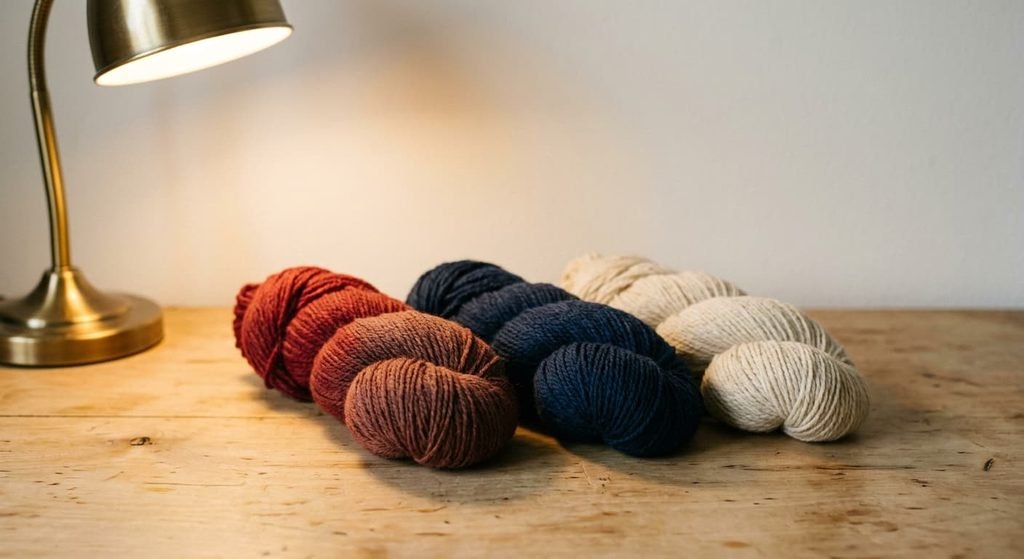
A colour isn’t a property of an object alone. A red thread looks red because it returns the long wavelengths and absorbs the rest, so it can only return what the lamp supplies. Your eye then judges the result against everything else in view. The room misleads through four mechanisms, two in the light itself (spectrum and adaptation) and two in the room (coloured surroundings and glare).
A lamp that supplies little deep red can’t show a deep red. The colour rendering index (CRI) scores a lamp from 0 to 100 against a reference light. It averages eight test colours, and saturated red isn’t one of them. A bulb can score 80 overall and still render red poorly, which the separate R9 figure reveals.
Your eye adjusts to the dominant light within minutes. A match made under a warm lamp looks right until you carry it to a window.
Walls return light tinted by their own colour, and the nearest large surface counts most. A glossy surface reflects a lamp like a mirror, at the same angle it arrives. Where your eyes sit in that path, you see the lamp instead of the colour.
Confirm which version you have: light that never shows colours true
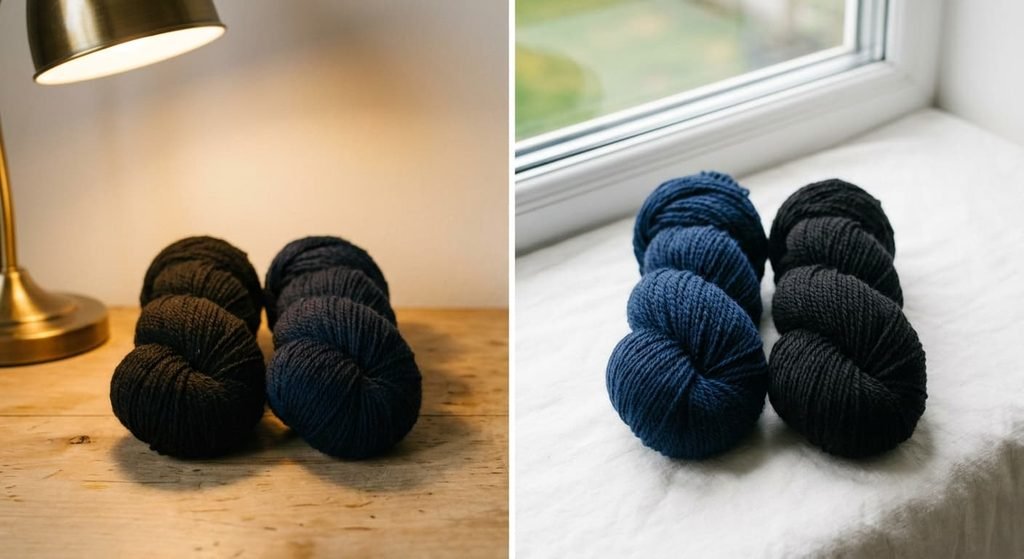
Gather three pairs that sit close in daylight. Navy and black make the first pair. Cream and white make the second pair. Dark red and brown make the third. Lay each pair side by side at your work spot in the evening, under the lamp you normally use. Can you tell each pair apart at a glance? Carry them to the window at midday, which is your control. Look again there.
A pair that separates at the window yet merges at the lamp points to the lamp: its spectrum or its position. Tilt a glossy sheet under the lamp. A bright patch of the bulb means glare is part of it. Repeat the evening look with the lamp moved 50 cm aside, which separates its position from its spectrum. If the pairs separate at midday but shift by late afternoon, the changing daylight is the cause. If cream and white show a tint of the wall’s colour at the table but not at the window, the surroundings are casting.
Match the result to the fix, and ignore the rest.
The fixes, in order
Judge colour in one place, at one time of day, which answers adaptation. Choose the end of the table nearest the window. Make every colour decision there in the morning, when a west window gives indirect light. Put the colour next to the one it must match instead of carrying a memory of it across the room. It’s free, though it takes a few days to become a habit. The evening lamp is unchanged, so a choice made at night still needs the morning look.
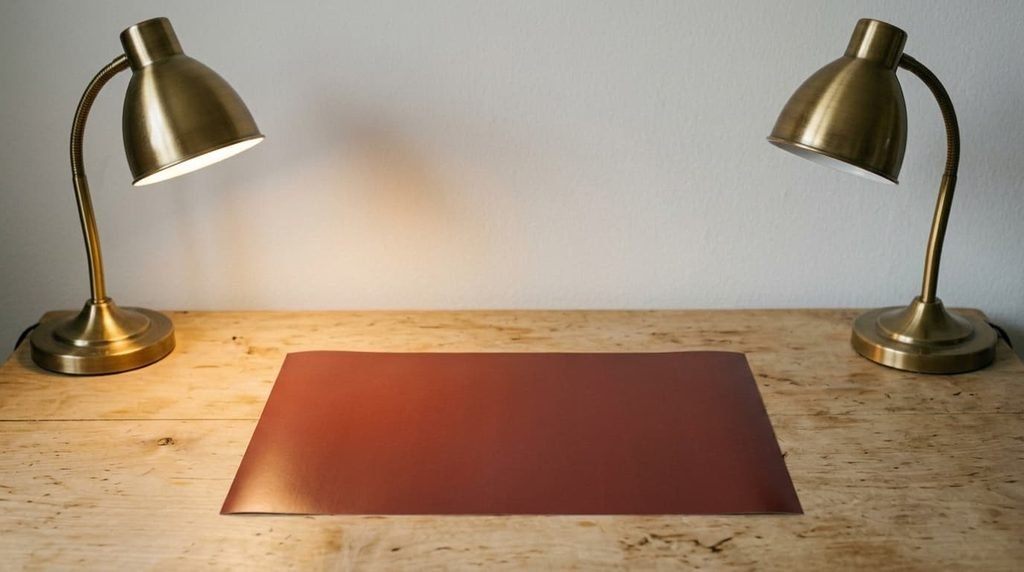
Move the lamp off the reflection path, which answers glare. Say your eyes are 40 cm above the table and 35 cm back from the work spot. A lamp 35 cm beyond the spot at 40 cm height shows as a white patch on glossy paper or foil. Place it about 50 cm to one side of that line. Tilt the sheet to confirm the patch has gone. It’s free. A lamp in the right place still shows a flat red if its spectrum is poor.
Fit one high-rendering bulb type in every fitting at the table, which answers lamp spectrum. A single colour temperature also stops two lamps pulling the eye in different directions. Look for a CRI of 90 or above, with an R9 figure listed on the box or the maker’s page. It’s a purchase, for the bulbs at the table and not the whole room. It won’t remove a wall’s cast or the afternoon sun. A brighter bulb isn’t a better-rendering one. Fit the same type at the task lamp and the ceiling point so the table doesn’t change colour as you lean in.
Repaint the wall behind and next to the table in a neutral matt finish, which answers coloured surroundings. Choose a light grey or an off-white with no yellow or pink in it. Hold a sample against white paper at the window to check for a tint. It costs paint and a weekend, or a decorator’s day if you’d rather hand it over. It removes the cast and leaves the lamp unchanged. Do it last, once the cheaper fixes show whether the wall is a cause.
What this room’s constraints mean for you
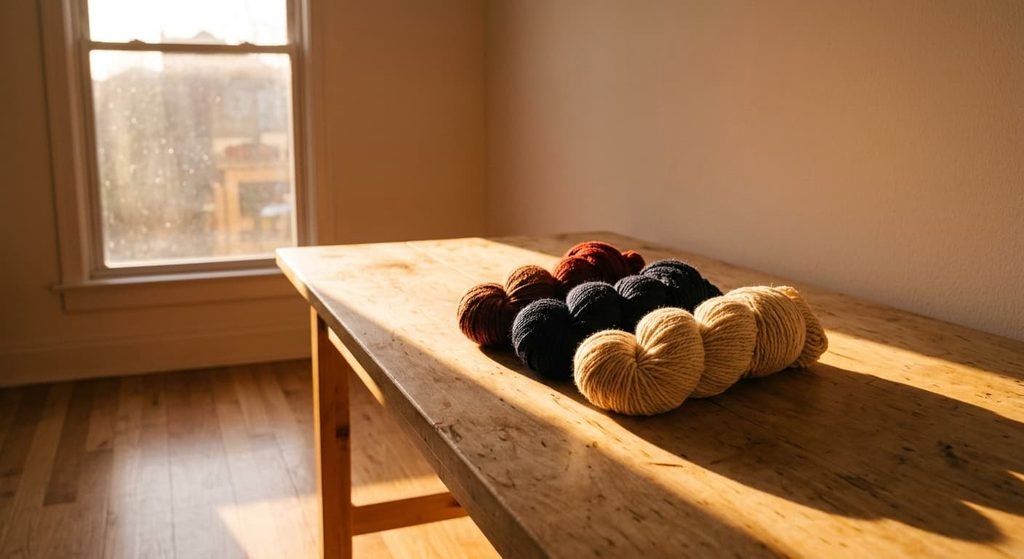
In a room where the light never shows true colours, the west window is fixed, and so are its size and the ceiling height of 250 cm. No styling turns it into a north window. Daylight is bluer around midday and redder late in the day. A west window gives direct sun at the table in the afternoon, so afternoon colour work will always be warmer than morning work.
As a rule of thumb, useful daylight reaches about one and a half to two times the window’s head height. For a head at 210 cm that is roughly 3.2 to 4.2 m. A table within 1.5 m of the window sits well inside it.
I can’t see which way your window faces. A north window gives steady cool light all day. A south window gives the longest direct sun, and an east window mirrors the west one.
The fix that doesn’t work
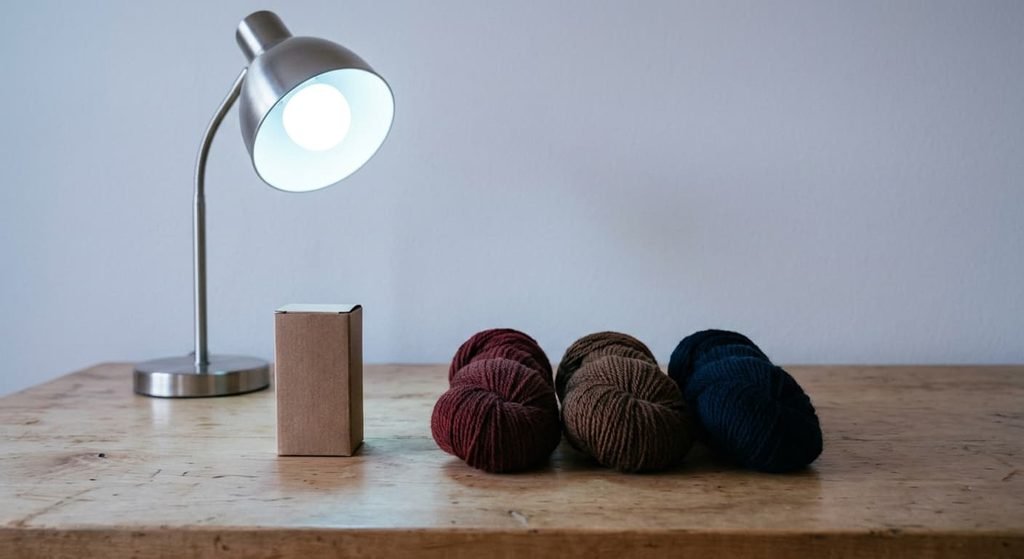
Where the light never shows true colours, buying a bulb sold as daylight and chosen by its colour temperature fails to fix the problem. Colour temperature describes the tint of the white a lamp gives, from warm to cool. It says nothing about how fully the lamp fills in reds and deep blues. Two lamps can look equally white while one flattens red and the other doesn’t.
A lamp described only as daylight or cool white tells you the tint and nothing about rendering. Check for a CRI figure and an R9 figure on the box or the maker’s page. A lamp that lists neither is leaving you to guess. A cool bulb also makes the evening harder. Your eye adapts to it, so warm yarn looks different the next morning.
My firm rule is to read the rendering score before the temperature, because the temperature is a tint and the score is a promise.
Where the light never shows true colours, the culprit is a short list of four: the lamp’s spectrum, the time you judge, the wall beside the work and a reflection. The pair test tells you which. The fastest fix is the free one. Decide colours at the window in the morning and move the lamp off the reflection path before you spend anything on bulbs or paint.
Questions readers keep asking
Can a craft room with a west-facing window show true colours?
Yes, in the morning. In a room where the light never shows true colours, a west window still works then, because it gives indirect light, so colours read steadily near it. By late afternoon the sun turns the light redder and brighter. Choose colours at the window before midday, and use a high-rendering bulb to match them after dark.
What does it cost to fix craft room lighting?
Start at nothing. Move your colour decisions to the window and move the lamp off the reflection path. Only then buy bulbs for the table, not the room. Repaint last. Do it only if cream and white still show a tint of the wall at the table.
Why do thread colours look different in the shop and at home?
Shop lamps differ from yours in spectrum and level, and your eye adapts to each within minutes. A colour matched there is judged against a different light at home. Carry the thread to a window before you buy, and compare it with a thread you already own.