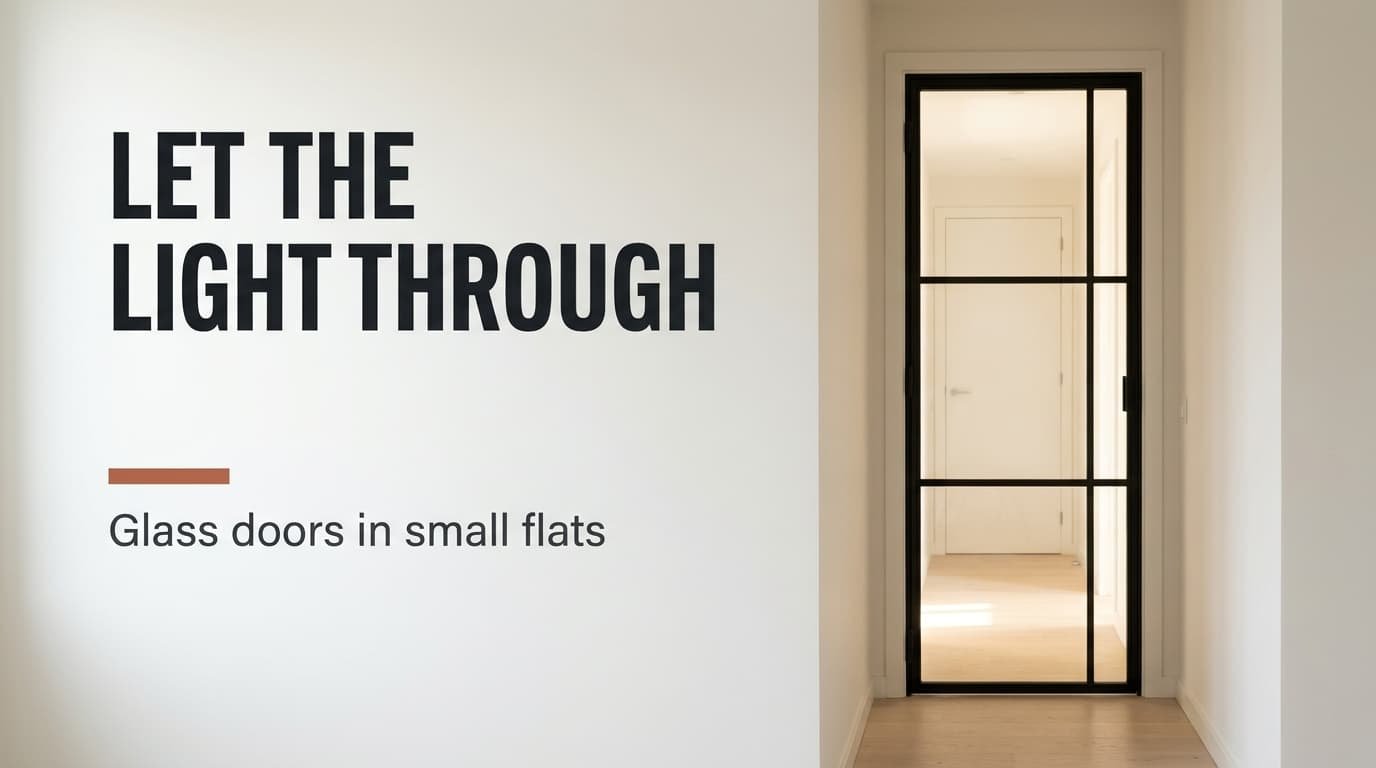
Your hall stays dark at noon, and you blame the bulb. The door is the problem. Glass doors are replacing solid internal doors in small Dutch flats because a solid leaf passes almost no light, while a glazed one passes about 70% of what an open door does. The sums use a made-up flat with a hall of 110 × 320 cm and six doors of 83 × 201 cm. Test the numbers at your own doorway before you rely on them. Leave brands and showrooms aside, since prices stay out too. That one swap changes more about a small flat than a new lamp does.
Where solid internal doors came from
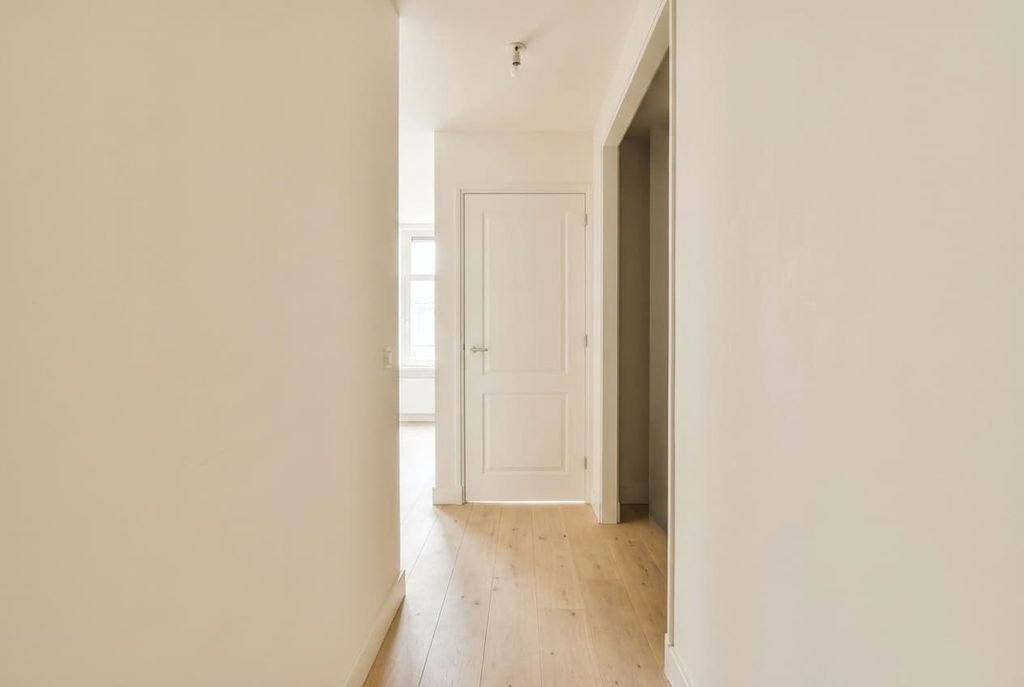
Solid doors did two jobs. They held heat in the room with the stove. They also kept sound and sight where they belonged. A flat today has central heating and no stove, so the heat job has mostly gone. The leaf stayed as thick as ever.
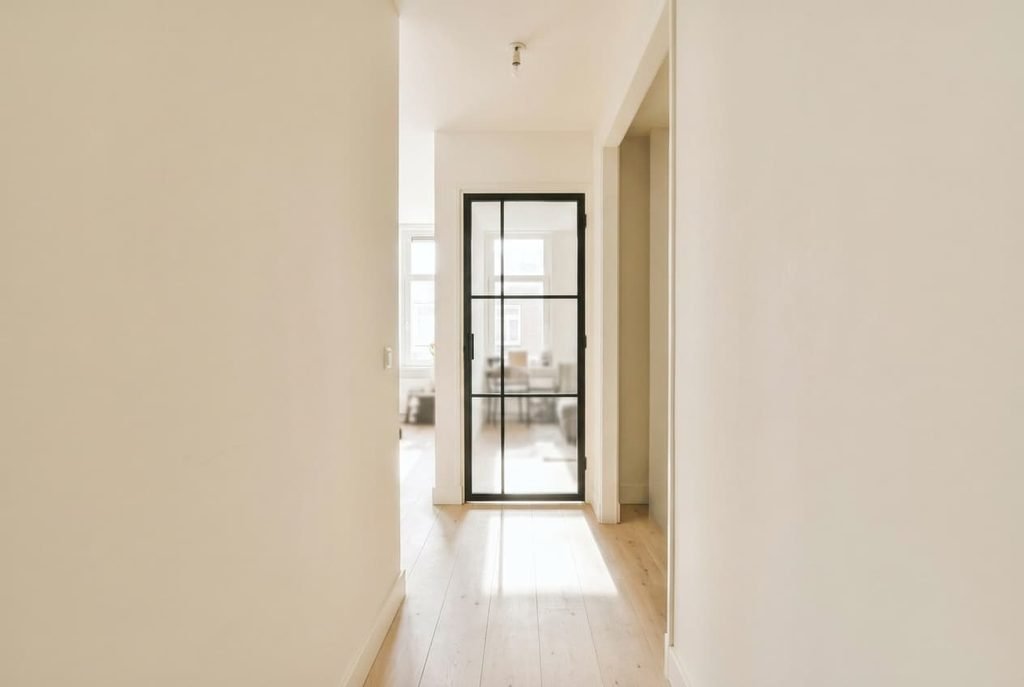
Steel and glass came from workshops and shop fronts, where a thin frame carried big panes across a wide opening. In homes it first appeared as a partition between a dining room and a kitchen, and later as a door. Slim steel sections let a pane stand 193 cm high inside a frame only 4 cm wide. Glass cut to size then arrived from the factories that already made windows.
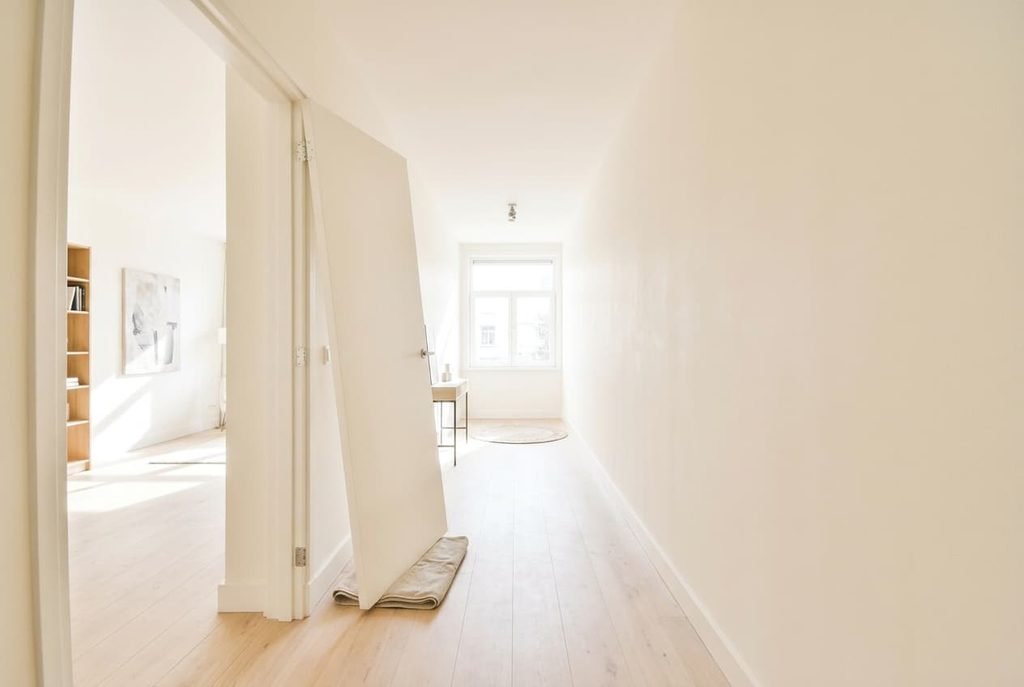
The solid leaf kept one weakness. It turns an inner hall into a box. Whatever light reaches the hall must slip through a gap of 2 cm under the door, and for a leaf 83 cm wide that gap is 83 × 2 = 166 cm². Glass doors are replacing solid internal doors where that gap is the only daylight the hall gets.
What actually changed now glass doors are replacing solid internal doors
Three things shift when a glazed door takes the place of a solid one in the same opening. Light is the first. The leaf covers 83 × 201 = 16,683 cm². Assume glass fills 82% of it, which is 13,680 cm², and that clear glass passes 85%, so 11,628 cm² of light gets through. The measurable change is light passing the doorway rising from 166 cm² to about 11,600 cm², a factor of 70.
Sound is the second. Assume a solid leaf blocks 28 dB and a single pane in a steel frame blocks 22 dB. A drop of 6 dB lets through about four times the sound energy, because 10^(6 ÷ 10) is 3.98. A radio next door goes from muffled to plainly audible. Speech at 60 dB reaches the hall at 32 dB through the solid leaf and 38 dB through the glass.
Warmth is the third, and it’s smaller than it sounds. Assume the glazed part loses heat at 5.8 W per m² for each degree and the remaining 0.3 m² of the door at 3. Then the whole door passes 1.368 × 5.8 + 0.3 × 3 = 8.8 W per degree, against 3.3 for a solid leaf. With a 5-degree gap between room and hall, that’s 44 W against 17 W. The heat moves into your own hall, so it’s a comfort matter and no extra bill.
A glass door lets in light and lets out sound.
Who a glass door suits, and who it doesn’t
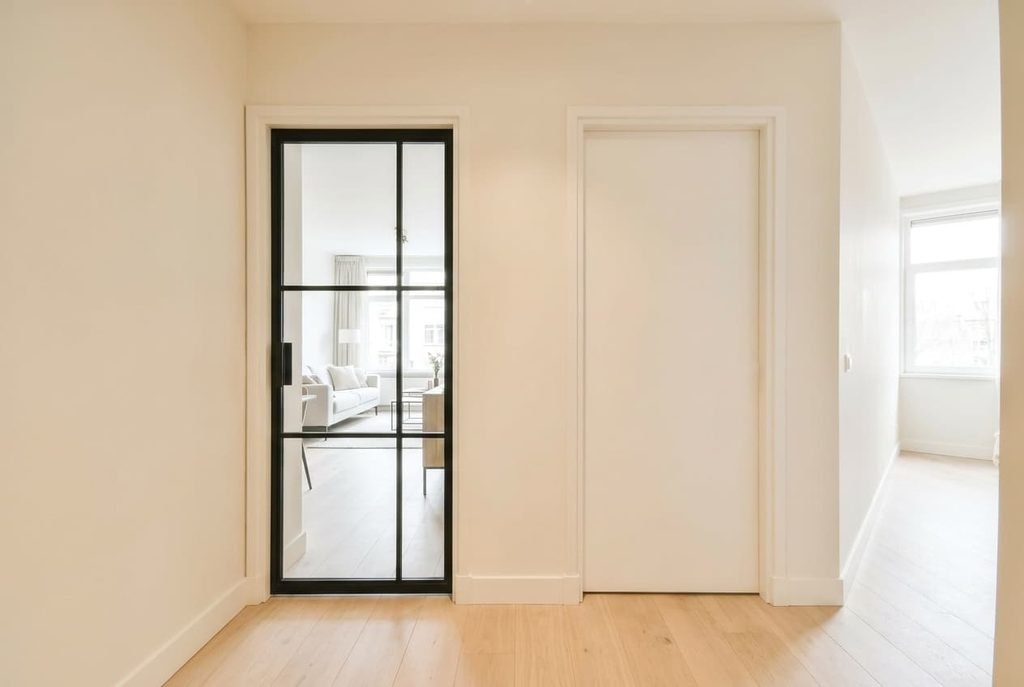
It suits a hall with no window of its own. Glass doors are replacing solid internal doors first in flats where one door leads from the living room into a windowless hall, because that door becomes the hall’s only source of daylight. It suits anyone who likes to see across a flat. A thin frame also saves floor area, since a door that stays open for the sake of light needs no swing space.
It suits poorly a household that needs sound to stay put. A bedroom door sits across the corridor from a kitchen, and 6 dB makes the clatter of dishes four times as strong. A flat where someone works from home loses the same quiet. Cooking smells pass a glazed door as easily as they pass a gap, and a glass door has a lot of seams.
The saving in lamp energy is tiny. A hall lamp of 8 W that burns 6 hours a day for 150 days uses 7.2 kWh, and glass saves part of that. Fitting a glass door for the electricity bill makes no sense. Fit it for the daylight.
Glass also weighs more than you’d think. At 15 kg per m², the 1.368 m² of glass in one leaf is 20.5 kg. The hinges and the frame must carry that. Check with a fitter that the existing frame was built for that.
Are glass doors replacing solid internal ones, and is it worth adopting
Weigh the three changes against each other. Light rises 70 times, which is a large gain in a dark hall. Sound passes four times as strongly, which is a large loss near a bedroom. Warmth moves 27 W faster, a small change that matters little.
Our verdict is that glaze only the doors that face a dark hall, and keep solid doors on bedrooms. In our flat the living-room door and the kitchen door qualify, which makes two glazed doors of 83 × 201 cm and four solid ones. The hall gains 2 × 11,628 = 23,256 cm² of daylight openings, about 2.3 m². The bedrooms keep their 28 dB.
If a hall already has a window, keep the solid doors, since the gain disappears when the hall is bright and only the sound loss remains.
The version that will date fastest
The extreme version is clear glass on every internal door in the flat. Spot it by these signs: six glazed leaves, clear panes, a bathroom door you can see through, and one steel profile repeated throughout. Our flat would carry 6 × 1.368 = 8.2 m² of glass weighing 123 kg. It would also present 16.4 m² of surface to wipe for fingerprints, since both faces count.
Privacy is where this version breaks. A bathroom door that shows the room beyond forces a curtain or a film. The film turns the glass back into a solid leaf cheaply, and the look fades quickly. Nobody enjoys wiping 16.4 m² of marks every month.
The moderate route glazes two doors and leaves four. That’s 2 × 1.368 = 2.7 m² of glass, one third of the extreme total. It lights the hall while the rooms stay private, and either door can be swapped later without touching the rest.
How to try it without committing
Take a dark afternoon and prop the solid door fully open for the whole of it. Note whether the hall still needs its lamp. An open door passes the full 16,683 cm². A glazed door passes 70% of that, so if the hall stays gloomy with the door open, glass won’t fix it.
Then test the sound. Play a radio at conversation level in the room beyond and close the door. Open it one third of the way and listen again. That gap is close to the 6 dB you’d gain or lose. If it bothers you at one third, it will bother you at full glass.
Glass doors are replacing solid internal doors because a hall deserves daylight, and the sums show the price is sound. Try the open door first, then the budget. Pick the doors that face a dark hall and glaze only those. Keep the bedrooms solid. A week of an open door teaches more than any shop visit. Then decide, and keep the first door as your control.
Questions readers keep asking
Should I replace a working solid door with glass?
Only if the hall needs the light. A sound solid door still does its job, and daylight is the main benefit here. Do it when you replace the frame anyway, because the old leaf comes out with the frame. Choose glass only for hall-facing doors.
Does a glass door suit a small bedroom?
Rarely. It lets through four times the sound energy of a solid leaf, and the room beside it is usually where you want quiet. A small bedroom also needs its privacy. Keep that door solid and glaze the one between the living room and the hall instead.
How long does a steel-framed glass door last?
Frames outlast most flats if the finish stays sound, since the coating protects the metal. A scratch down to bare steel lets rust start, so touch it up early. Only the fashion is in doubt. A scheme limited to two doors ages quietly, while a clear-glass flat is the one that ages badly.