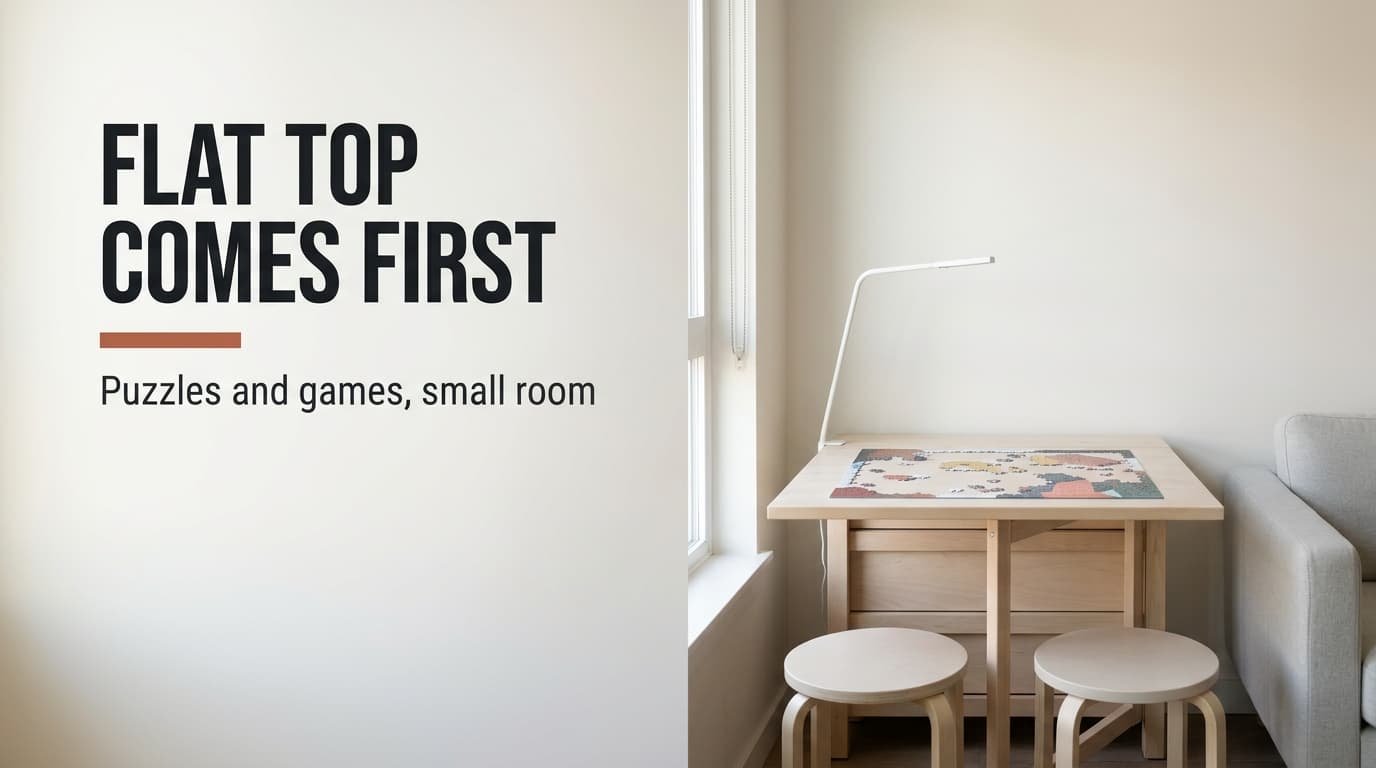
A puzzle and games table pays off the moment pieces stop going missing, and the first purchase decides whether they do. Picture a 330 × 410 cm living room in the Netherlands, 13.53 m² in all, with a work surface of 100 × 70 cm taking 0.70 m² of it, or 5% of the floor. Five purchases build the setup. They’re ranked by what a mistake costs you, from the most expensive downwards. Stop buying as soon as the table serves you well. Use each number as a starting point, then take your own wall measurements along when you shop.
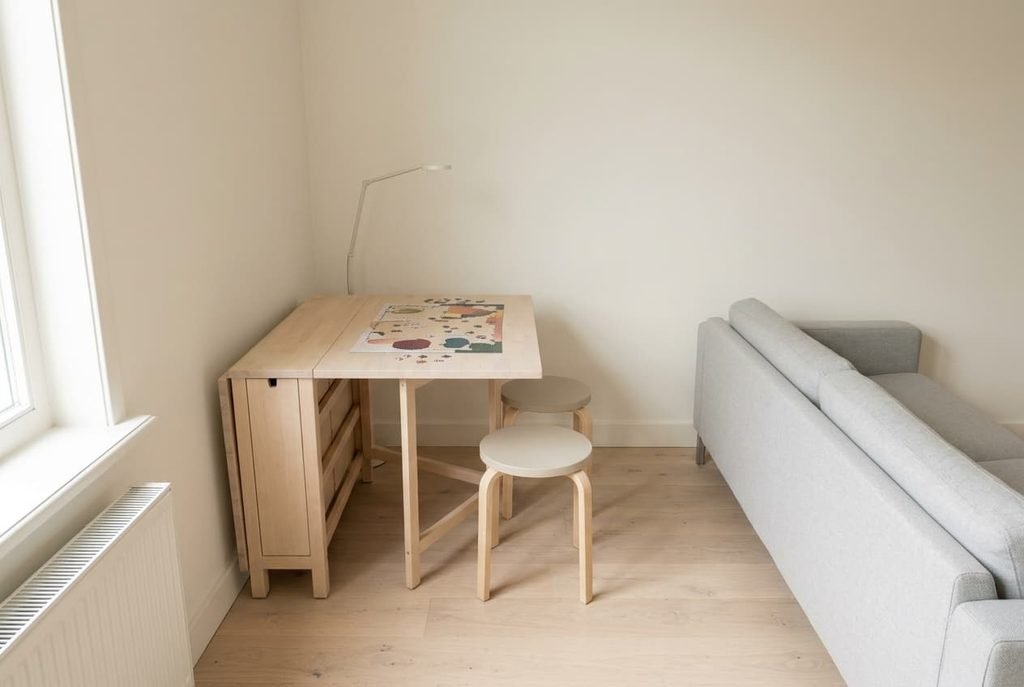
What makes a puzzle and games table work in a small living room
Lost pieces cost more than lost square metres. Once finished, a 2,000-piece jigsaw measures about 100 × 70 cm. A top of that size leaves almost no margin, so one piece nudged off the edge may never come back. Anyone who has crawled under a sofa at midnight with a torch knows the feeling. A flat, rigid top has to arrive before any accessory, because a sagging surface lets pieces creep towards the middle and a bumped table drops them on the floor.
Lamps and trays tempt you first, since each feels like progress. Yet a lamp above a rocking table only lights the rocking. Trays on a top that tilts by a few millimetres tip their contents out. The table leads for that reason, and every later item assumes it holds still. A level surface also makes the later checks, such as the board’s dip, mean something.
Board games ask for less. Four players fit round a 90 cm square, so the same top covers both hobbies. What differs is the evening after. A game ends when the lid goes on, whereas a puzzle needs to survive overnight, and that question shapes the last two purchases.
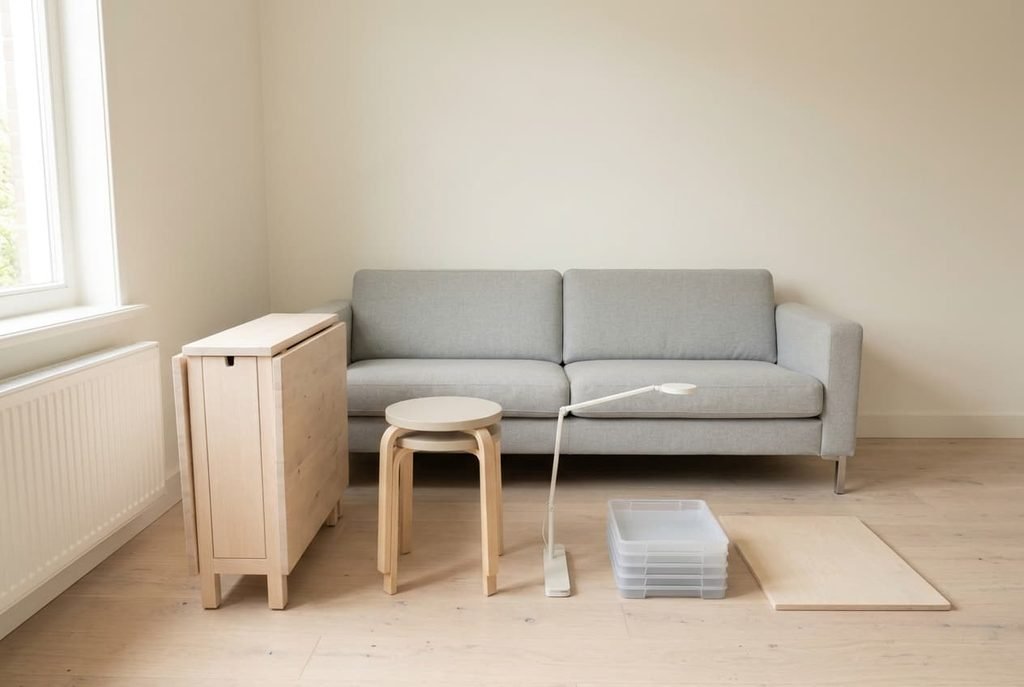
Five purchases for a table where puzzles and games happen
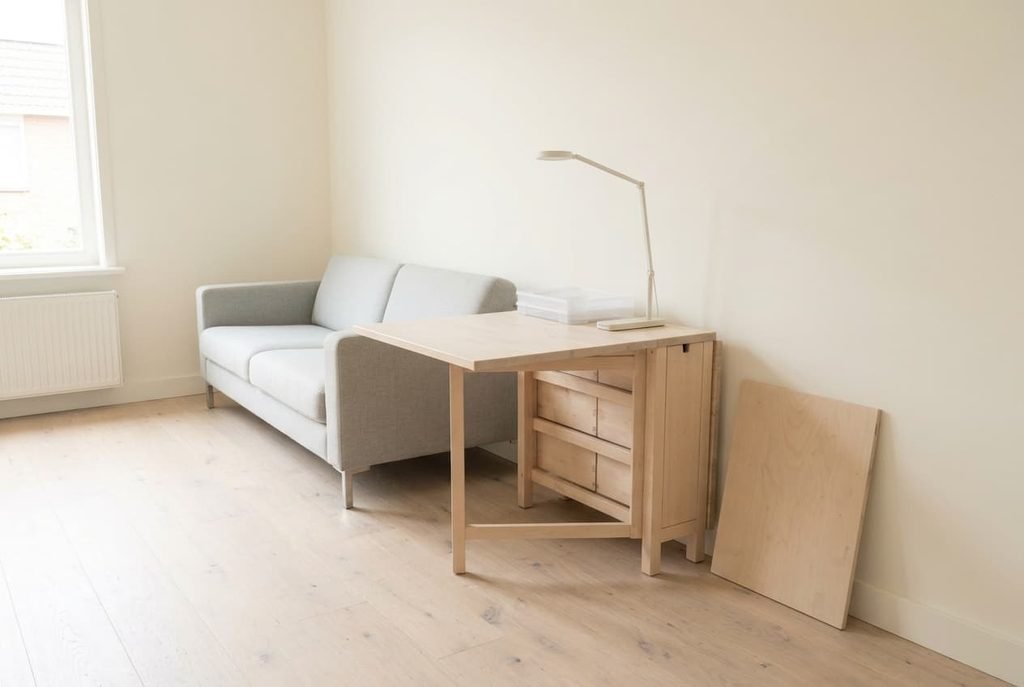
1. A folding or drop-leaf table, 100 × 70 cm and 74 cm high, leads because everything else sits on it. At 74 cm it leaves about 29 cm above a 45 cm seat for knees and elbows. Tier: BUY ONCE. Welded or bolted leg joints keep their angle for years, where pressed-in pegs work loose. Wobble at the hinge is the usual flaw, so lean your full weight on one corner in the shop and look for play beyond 3 mm.
2. Two stools with a 45 cm seat and a 32 cm top come second, since chairs that won’t slide under the table end up blocking the walkway. Tier: MID. Four splayed legs resist tipping where three may not, particularly on boards. Rock one on your own floor, because a stool that rocks there will rock under you too.
3. An arm lamp reaching 40 cm, with a bulb near 800 lumens at 4000 K, takes third place. Matching colours is where puzzles stall, and a yellow bulb flattens two similar blues. Tier: BUY CHEAP. An arm lamp is two springs and a base, so little can go wrong. A drooping arm shows itself inside a day, so hold it at full reach for a minute before paying.
4. Five shallow trays, each about 20 × 15 cm and 3 cm deep, hold the edge pieces in one and the half-sorted groups in the others. Tier: BUY CHEAP, since moulded plastic has no moving parts. Corners crack first, so squeeze every rim with a thumb and put back any that clicks. A tray that flexes by more than a finger’s width under that pressure will split within a year of daily use.
5. A 12 mm plywood board, 100 × 70 cm, slides beneath the sofa with a half-built puzzle on it. It ranks last because the puzzle can stay on the table for a week before storage matters. Tier: MID. Plywood stays flat across 70 cm where 6 mm hardboard bows. Rest it on two supports 60 cm apart and press the middle. Expect a dip under 2 mm, and check the thickness stamped on the edge.
Why the table is the item to scale down
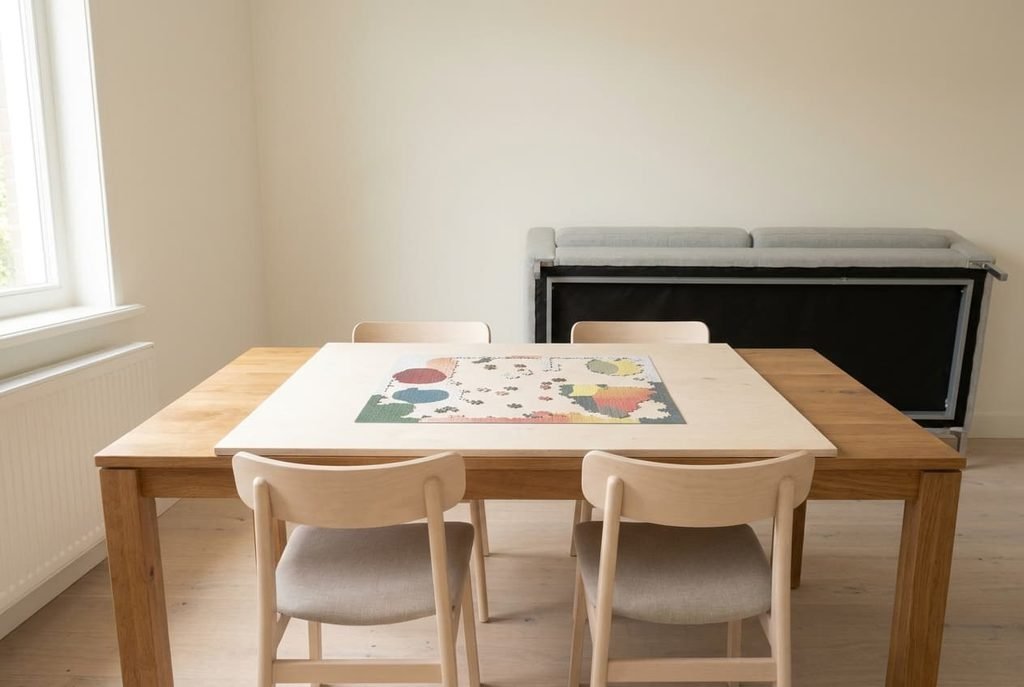
One purchase on that list can shrink. The table takes 0.70 m² all year for a hobby that runs a few evenings a month. A board of 100 × 70 cm laid across the dining table does the same work and claims no floor, so buy the board from step five first and borrow a table you already own.
Little is lost in the swap. A dining table already stands near 74 cm, which matches the folding table from step one. The stools then turn into extra dining chairs for the days when guests come. The board brings the thing a dining table can’t offer, a surface you lift away with the puzzle still on it. It slides under the sofa in ten seconds, and dinner can go ahead. Put a bath towel on the dining table first if the wood is polished, because a bare plywood edge can leave a pale line across the finish.
A puzzle and games table of its own only makes sense when the dining table is under 100 cm long. It also makes sense when a household eats there every evening without fail.
What changes when the living room is shared
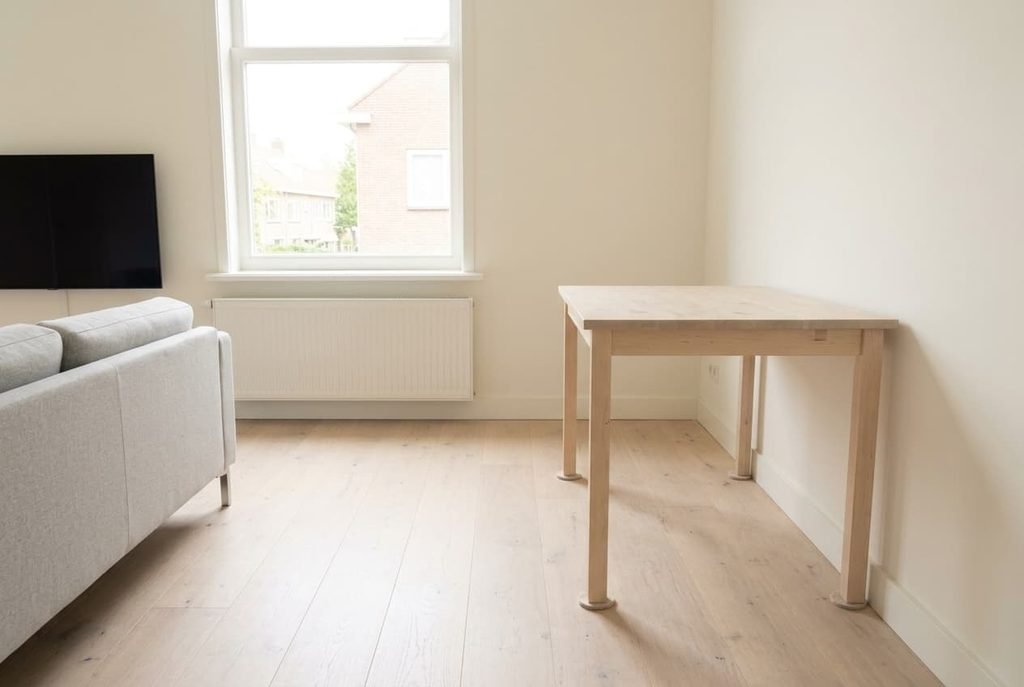
A living room that also holds a sofa and a television leaves less slack than a spare room does. Keep a walkway of 80 cm beside the table, so run the 100 × 70 cm top along a wall instead of across the middle. Leave 15 cm between the top and any radiator, because rising heat dries the board’s surface and curls loose cardboard pieces.
A rented floor needs 3 mm felt pads on every leg and on the corners of the board. They cost very little and protect a wooden floor from the scratches that a deposit check might notice.
Think about the evening too. Lamp light bounces off a television screen if the table faces it, so turn the top until players look at a side wall. A puzzle and games table placed across the room from a window also loses daylight in winter.
The lamp does more of the work than you’d expect.
What to skip
Skip any lamp that changes colour or tint. Coloured light shifts every blue and green you’re trying to separate, so it undoes the lamp’s one job. A neutral bulb is the only kind that helps here.
Leave out a table with a felt top built in, too. It can’t fold, and the felt traps small pieces in its weave, where a vacuum will often swallow them. A plain top plus a loose board cleans up faster, and the board’s surface can be wiped with a barely damp cloth.
A sixth tray adds nothing either. Past five, arranging the trays takes longer than the sorting saves, and the extra plastic ends up stacked on the floor.
Two stools and a board go a long way.
Buy in the sequence above and stop wherever a puzzle comes together without frustration, because every extra item must earn its square of floor. In most flats you stop after the board and a lamp, with the dining table filling the other role. A puzzle and games table you can clear in ten seconds gets used far more often than one that needs a big tidy first, and that habit outweighs any single piece of furniture.
Questions readers keep asking
How many pieces can this setup handle?
A 100 × 70 cm top suits puzzles up to about 2,000 pieces, which finish near that size. Larger ones outgrow the board, so you’d need a second board or a bigger table. A 1,000-piece puzzle needs only 70 × 50 cm, and that board slides under almost any sofa with room to spare.
Does the order change if I already own a table?
Yes. If your table measures 100 × 70 cm or more and stands near 74 cm, skip step one. Start with whichever item removes your biggest annoyance. Dim light is one candidate, and spilled pieces another. The rest follow the same ranking as before.
How do I know a board is flat enough?
Rest it on two supports 60 cm apart and press the middle with a firm hand. A dip under 2 mm is fine for a puzzle. More than that lets pieces roll towards the centre, and a thin board bows further once a heavy puzzle has sat on it for several days.