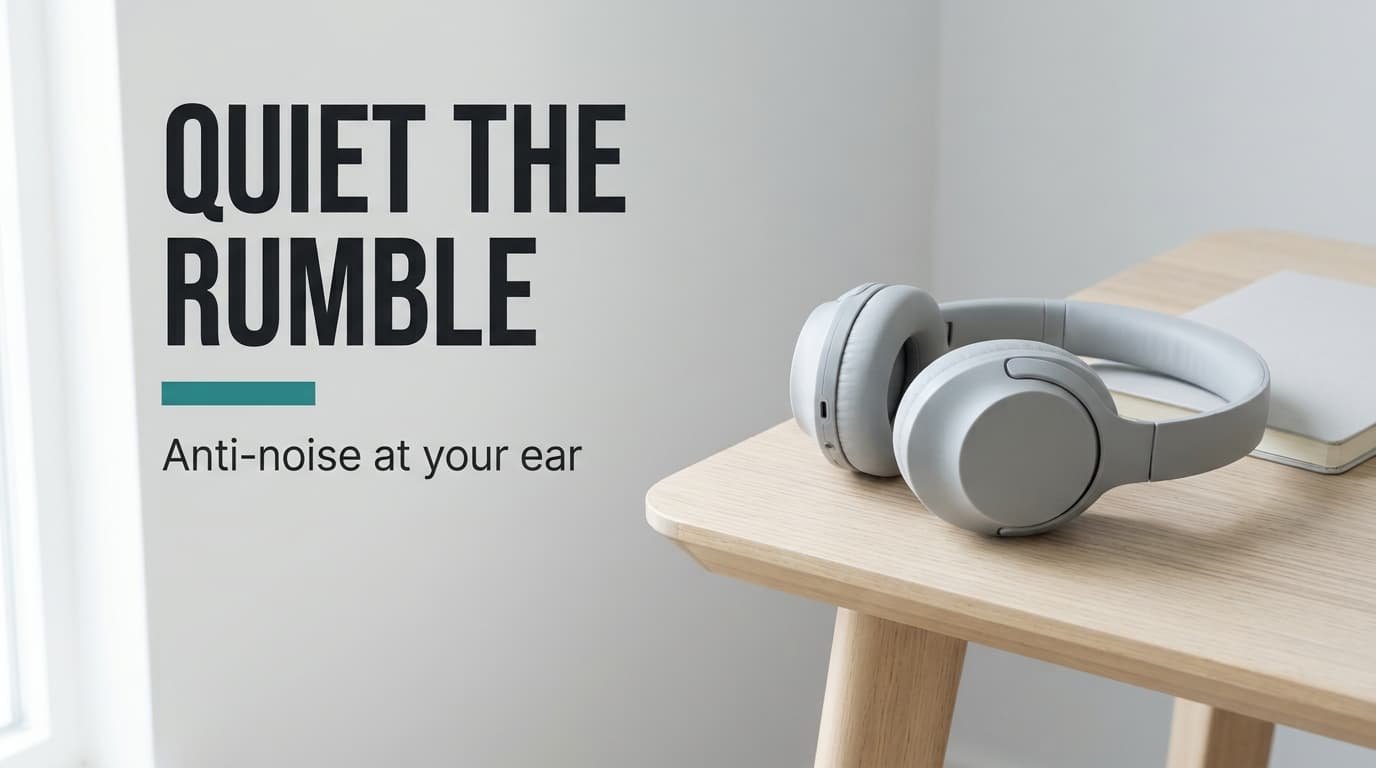
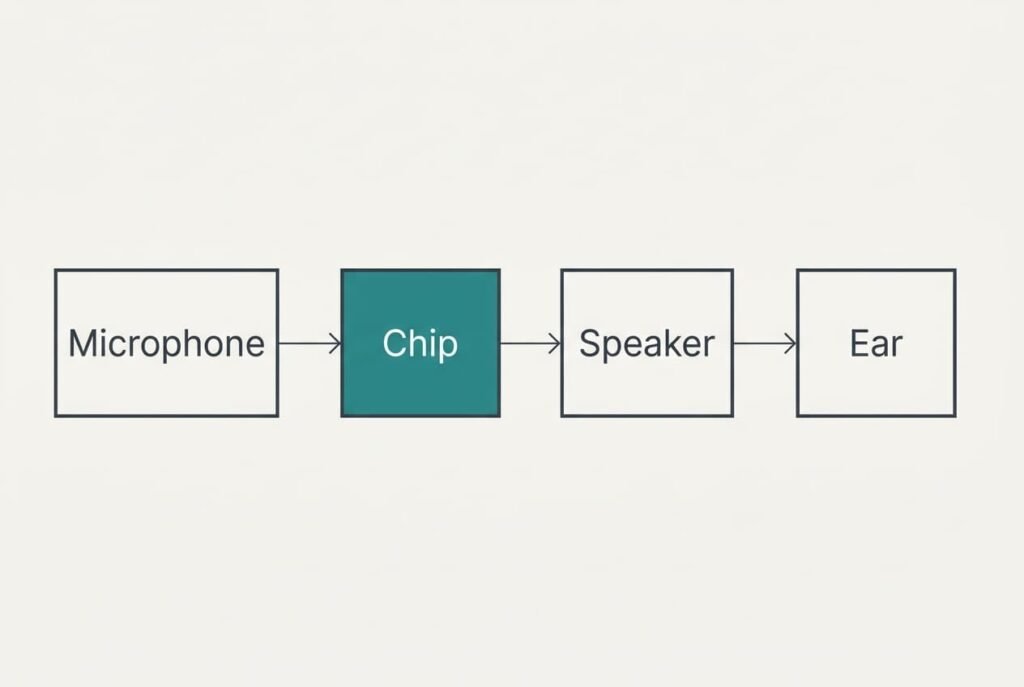
How can a pair of headphones make a train quieter by adding more sound? A microphone listens to the noise, a small chip plays an upside-down copy, and the two cancel at your ear, while the music, which the chip already knows, passes through untouched. That’s how headphones cancel sound but keep your music, and it works best on a steady low rumble. The figures below are illustrative, and no product is named. They follow a commuter on a train in northern England, whose journey shows the whole idea in a few minutes of reading. You won’t need any equipment to follow it.
How Headphones Cancel Sound but Keep Your Music: The Short Answer
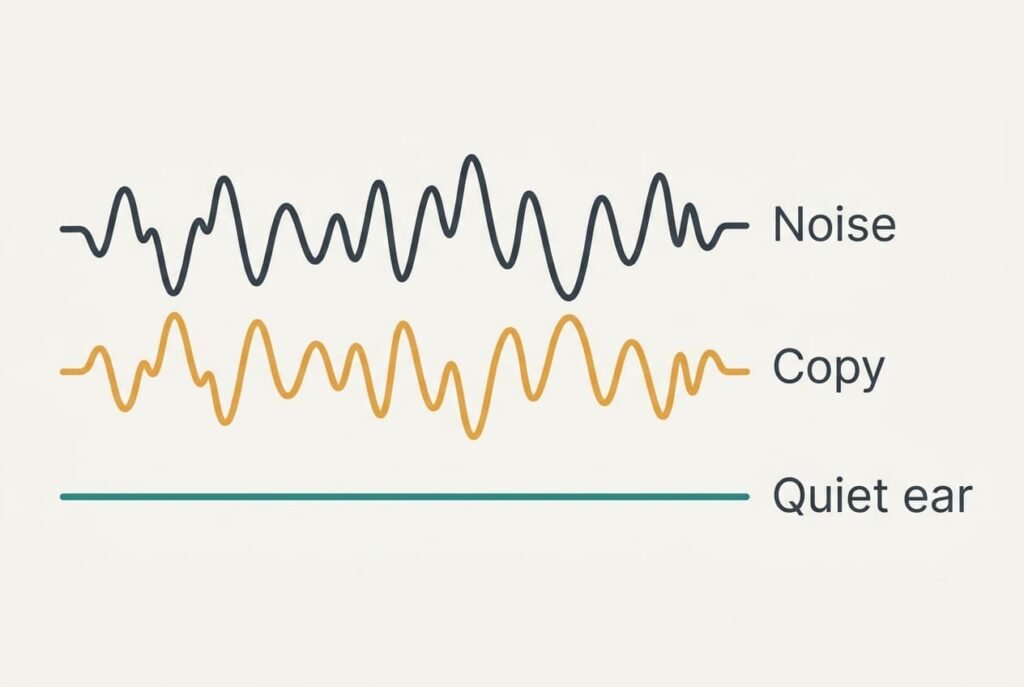
Headphones play the noise back upside down at your ear, and the two sounds cancel while the music, already known to the chip, is left alone.
Sound is a rapid push and pull on the air, and the eardrum moves with it.
A copy that pulls exactly when the noise pushes leaves the drum almost nothing to move.
The short version leaves things out. The copy has to arrive at the right instant, and it has to match the level. A tiny delay is harmless for a deep rumble and ruinous for a hiss. That’s why the method works on some sounds and fails on others, and why it’s no use as a blanket cure. The music escapes because it’s played through the same speaker. The chip therefore knows what it sounds like and takes it out of what the inner microphone hears. Only the leftover noise gets cancelled. Cushions on the ear cups do part of the job as well, and they cover the high sounds that the electronics leave alone. That is the trick behind how headphones cancel sound but keep your music in the same breath.
Following One Train Journey From Microphone to Ear
Our commuter sits in a carriage with a steady drone at 100 Hz, which reaches 70 dB outside the headphones. Music plays at 65 dB. Here is the path of one second of that drone.
An outer microphone hears the drone first. It sits about 1 cm from the cup, which lets it hear the noise slightly before the ear does. The chip flips the signal upside down and adjusts its level to match what leaks past the cushion, which we assume is a 5 dB loss at this pitch. That leaves a leaked drone of 65 dB. Next the speaker plays the flipped copy.
Everything takes time. Each stage in the chain adds a few microseconds, and the total is the figure that matters. We assume the whole chain, from microphone to speaker, takes 50 microseconds. A 100 Hz wave repeats every 10 milliseconds. Fifty microseconds is therefore half a percent of one cycle, or a lag of 1.8°. A copy that lags by 1.8° cancels all but 3% of the drone, which is a drop of 30 dB. The drone at the ear falls from 65 dB to about 35.
Next, the inner microphone listens at the ear. It hears the leftover drone plus the music. The chip knows the music because it’s sending it. It subtracts the music and treats only the remainder as noise. The music stays at 65 dB.
Now an announcement at 1,000 Hz arrives. The same 50 microseconds is now 18° of lag, and the copy cancels only 10 dB. Speech varies from moment to moment, which gives the chip no steady pattern to follow. With a cushion loss of 15 dB at this pitch, speech of 60 dB gets to the ear at 45 dB, then falls to about 35. At 5,000 Hz a hiss lags by 90°, and the copy would add 3 dB. So the chip stops cancelling there and leaves the hiss to the cushion.
A Pond Analogy for How Headphones Cancel Sound and Keep Your Music
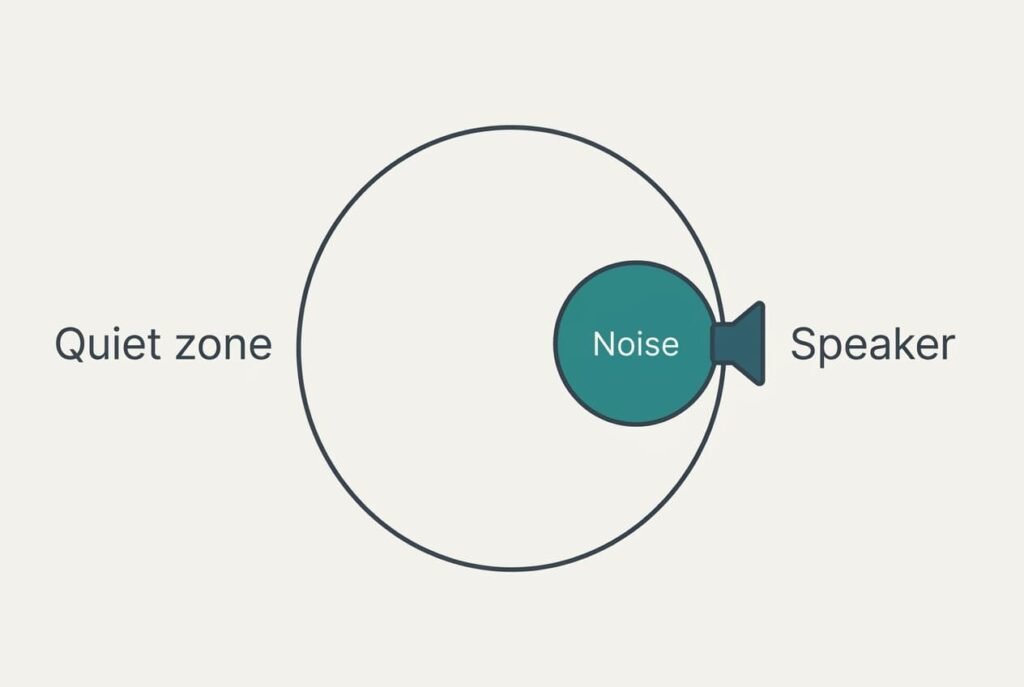
Drop two pebbles in a pond and watch the ripples meet. Where a peak from one lands on a trough from the other, the water goes still. Noise cancelling does the same with sound: the chip makes the second ripple.
The analogy breaks in one important place. On a pond the still patch spreads along the whole line where the ripples meet. In air the quiet only holds in a small bubble, about a tenth of a wavelength across. At 100 Hz that bubble is 34 cm wide, at 1,000 Hz it shrinks to 3.4 cm, and at 5,000 Hz it measures 0.7 cm. The speaker sits just two or three centimetres from the ear. It manages 1,000 Hz and nothing higher. Outside the bubble, the copy adds noise instead of removing it.
Where Noise Cancelling Stops Helping
The limit most readers miss is that a headphone can only cancel what its microphone hears early enough and what repeats long enough to learn. A steady drone repeats, and the chip tunes itself to it within moments. A door slam never repeats. It arrives and ends before any copy is ready.
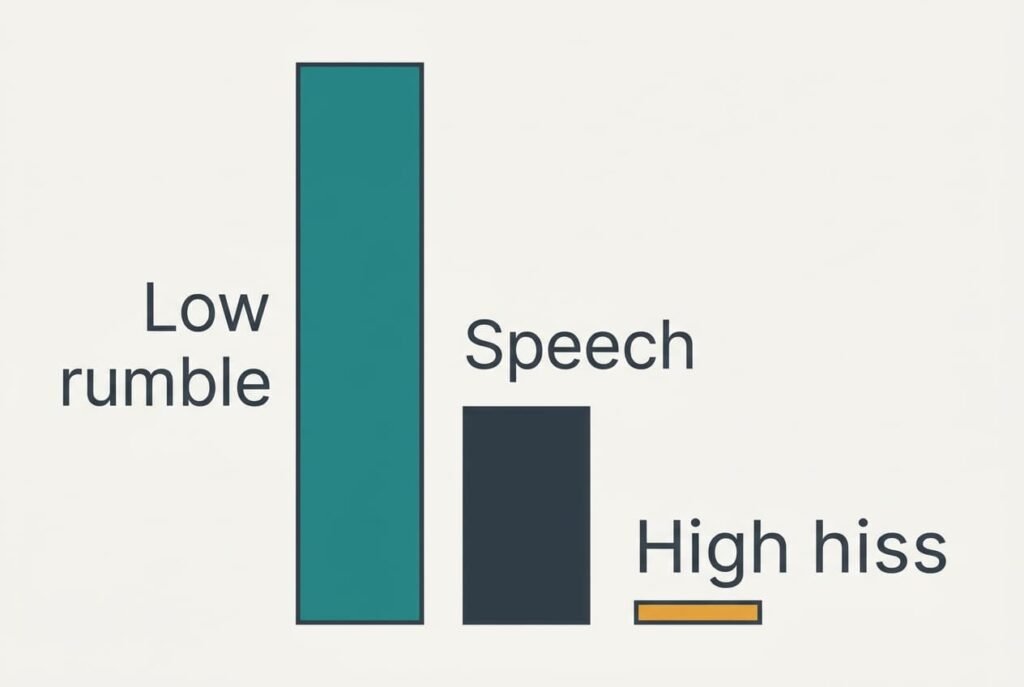
Frequency is a second limit. Our figures show 30 dB at 100 Hz, 10 dB at 1,000 Hz and a loss above that. Speech sits mostly in the middle. Conversation in an office is therefore reduced less than a motorway hum. Wind is a third. A breeze across the outer microphone produces a rush of its own, and the chip may play that rush into your ear.
Power is the last limit. The chip needs a battery. A flat pair still blocks some sound through the cushions but doesn’t cancel the drone any more. Headphones cancel sound but keep your music only while the battery lasts.
Two Wrong Beliefs About Noise Cancelling
“It drowns the noise out with something louder.” That belief formed because turning up music really does mask noise. The copy is as loud as the noise, not louder, and two equal sounds that push in opposite directions add up to almost nothing. The result is quieter air at the ear, and the chip adds no extra volume to fight the drone.
“It silences everything.” Advertising talks about silence, and the first impression on a train is dramatic, since the drone is the loudest sound there. Whether headphones cancel sound but keep your music in a busy office turns far more on the pitch of the chatter than on the brand of the chip. In our model the drone falls by 30 dB and speech by 10 dB, while a hiss falls by none. The quiet you notice is the rumble disappearing, while a conversation two seats away stays as clear as before.
A Decision Rule: Do You Need It?
Count the noise in your day. If most of it sits below about 500 Hz (a train or a plane, for example), cancelling will earn its keep, because those are the pitches the electronics handle best. Add up the hours you spend in that noise. An hour or more a day is where it pays off, because a short trip hardly gives the chip time to matter.
If your noise is chatter or traffic with sudden horns, the cushions matter more than the chip. That’s the mirror image of the rule above. In a quiet home the feature will rarely have much to do.
A simple test settles it. Wear a pair for ten minutes on your usual journey. Compare cancelling on and off at the same music volume. If you can turn the volume down and still hear every word, cancelling has earned its cost. If the two settings feel identical, you don’t need it. A pair with good cushions will do as well, and you’ll have lost nothing by testing. Borrow a pair from a friend if you can.
Questions Readers Keep Asking
Does noise cancelling have any drawbacks?
A few. It uses battery, a breeze can make the outer microphones rush, and some listeners notice a faint hiss in a silent room. Steady noise is handled well, while sudden sounds slip through. None of these is a deal-breaker for most listeners, and the trade is mostly convenience.
Do I need it for working at home?
Usually not. Home noise tends to be speech or a passing van, which sits in the pitches cancelling handles worst. Good cushions and a closed door will do more. It earns its place if your home has a steady hum, such as a boiler.
How does it compare with plain earplugs?
Earplugs block by sealing, which works best on high pitches. Cancelling works best on low ones. Together they cover more of the range than either does alone. A pair of cushioned cups gives some of both, and earplugs cost far less, which is why people on a budget often start with those.