Choosing a video call platform genuinely suited to your team comes down to a handful of criteria you can evaluate on any platform in front of you, not simply which one has the most impressive feature list on paper. A platform chosen purely for its extensive capabilities often disappoints once your team’s actual daily use pattern reveals which features genuinely matter and which ones go largely unused.
What actually decides this
The deciding factor is how well a platform supports your team’s genuine specific needs – meeting size, typical call duration, integration with tools you already use – not simply how many total features it offers. A platform with an enormous feature set provides little practical value if your team’s actual daily use only ever touches a small portion of what’s technically available.
This matters because most platform marketing emphasises comprehensive capability, while your team’s actual daily use pattern – specific meeting sizes, specific existing tools, specific technical comfort levels – behaves meaningfully differently from a generic, one-size-fits-all assumption most comparisons are built around.

The criteria that actually matter, in order
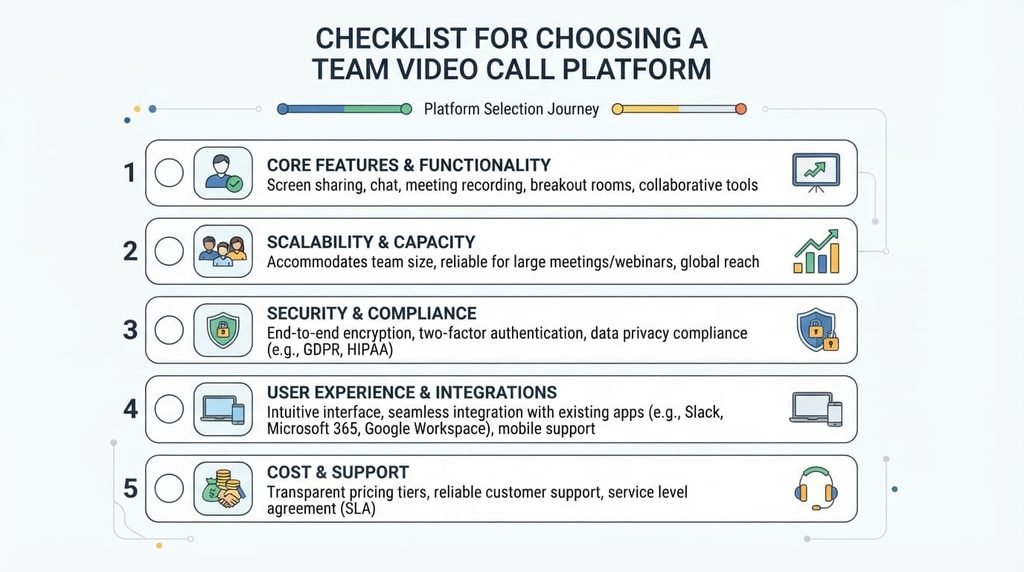
1. Genuine reliability for your team’s typical meeting size and duration. Look specifically for a platform that performs consistently well for the meeting sizes and lengths your team genuinely holds regularly, since a platform excelling at large webinars but struggling with small, frequent daily meetings doesn’t serve a team whose actual pattern is the latter.
2. Genuine integration with tools your team already actively uses. A platform requiring your team to switch between several separate tools throughout a typical day creates friction that a well-integrated alternative avoids, mattering more for daily workflow than any single impressive standalone feature.
3. Reasonably simple, low-friction joining process for both team members and external participants. A platform with a confusing or lengthy joining process creates recurring friction, particularly for participants outside your organisation who aren’t already familiar with your specific setup.
4. Genuine reliability of core features your team actually uses regularly – screen sharing, recording, whatever matters most to your specific workflow. A platform’s core, frequently used features working reliably matters more day to day than advanced features your team might use only occasionally, if at all.
5. Pricing that genuinely reflects your team’s actual size and usage pattern. A team shouldn’t pay for capacity or features they don’t actually use, nor should they undershoot a tier that leaves genuine daily friction – matching the specific tier to your actual team size and needs matters more than defaulting to either the cheapest or most expensive option.
What doesn’t matter as much as it’s made out to
The single most extensive feature list is oversold for typical team use specifically, and it’s the specification many comparisons lead with. A platform with an enormous feature set that your team never actually uses beyond its core functions provides little practical daily value compared to one with a more modest but genuinely reliable set of features your team actually relies on regularly.
Impressive-sounding advanced capabilities – elaborate virtual backgrounds, extensive customisation options – get more attention in platform marketing than they deserve relative to the basic reliability criteria above for typical team use. These features matter less day to day than whether your team can reliably join, be heard clearly, and share screens without recurring technical friction.
Matching the choice to your situation
If your team regularly includes external participants unfamiliar with your specific setup, prioritise a genuinely low-friction joining process more heavily, since this specific factor matters more for your particular situation than it would for a team holding primarily internal-only meetings.
If your team relies heavily on one particular existing tool ecosystem, prioritise genuine integration with that specific ecosystem more heavily, since friction from switching between disconnected tools compounds considerably across a team’s typical regular workflow.

What to walk away from
Any platform whose reviews consistently mention unreliable core functionality – frequent disconnections, unreliable screen sharing – during typical everyday use, should end your interest regardless of how appealing its broader feature list otherwise appears.
A feature list doesn’t reveal genuine daily reliability the way consistent reviewer and user experience does, and a platform with a known, unaddressed reliability issue in core functionality will likely create recurring team friction regardless of how extensive its other capabilities are on paper.

The check before you commit
Before finalising any platform choice, run a genuine trial with your actual team specifically, testing the exact meeting patterns and tools your team genuinely uses regularly, rather than relying solely on a feature comparison chart that may not reflect your particular real-world use.
This single check reveals genuine team-specific performance far more reliably than marketing materials or general reviews do, since a platform’s overall reputation doesn’t guarantee it performs equally well for your team’s own specific meeting patterns and existing tool ecosystem.
Does the number of available integrations matter more than integration quality with the specific tools we already use?
Quality and depth of integration with your team’s specific existing tools matters considerably more than a large total count of available integrations, since a platform offering many shallow integrations provides less genuine daily value than one offering deep, reliable integration with the handful of tools your team actually depends on regularly.

What people get wrong about choosing a platform for a team
The most common mistake is letting one particularly vocal team member’s personal platform preference drive the decision, without genuinely considering the full team’s actual combined needs and existing workflow. A platform perfectly suited to one person’s specific habits can still poorly serve a team overall if it doesn’t support the broader group’s genuine collective patterns.
A second common mistake is assuming a platform chosen once will remain the right choice indefinitely without ever revisiting the decision. A team’s size, tool ecosystem, and meeting patterns genuinely evolve over time, making periodic reassessment worthwhile rather than assuming an initial choice remains optimal indefinitely as the team’s actual needs change.
Questions readers keep asking
Does a more expensive platform always provide meaningfully better reliability?
Not necessarily in every respect – price correlates broadly with feature breadth, but core reliability doesn’t always scale directly with price the way some other features do, meaning a less expensive platform genuinely strong in reliability specifically can outperform a pricier one focused more on extensive feature breadth.
Is it worth using multiple different platforms for different specific purposes?
For some teams, yes – using one platform genuinely strong for internal quick meetings and another better suited for external client calls, for instance, can serve a team’s varied needs better than forcing every use case through one single platform not equally well-suited to all of them.
Is it worth involving the whole team in the platform decision, or should one person choose?
Involving at least a brief check with team members about their genuine daily workflow and preferences tends to produce a more satisfying overall choice than one person deciding unilaterally, since a platform chosen without input from the full team risks poorly matching workflow needs you weren’t fully aware of when deciding alone.
How long should a platform trial period genuinely run before committing?
Running a trial across a genuinely representative range of your team’s typical meeting types and sizes, rather than a single brief test, provides considerably more reliable insight into how the platform actually performs across your team’s real, varied regular use pattern.