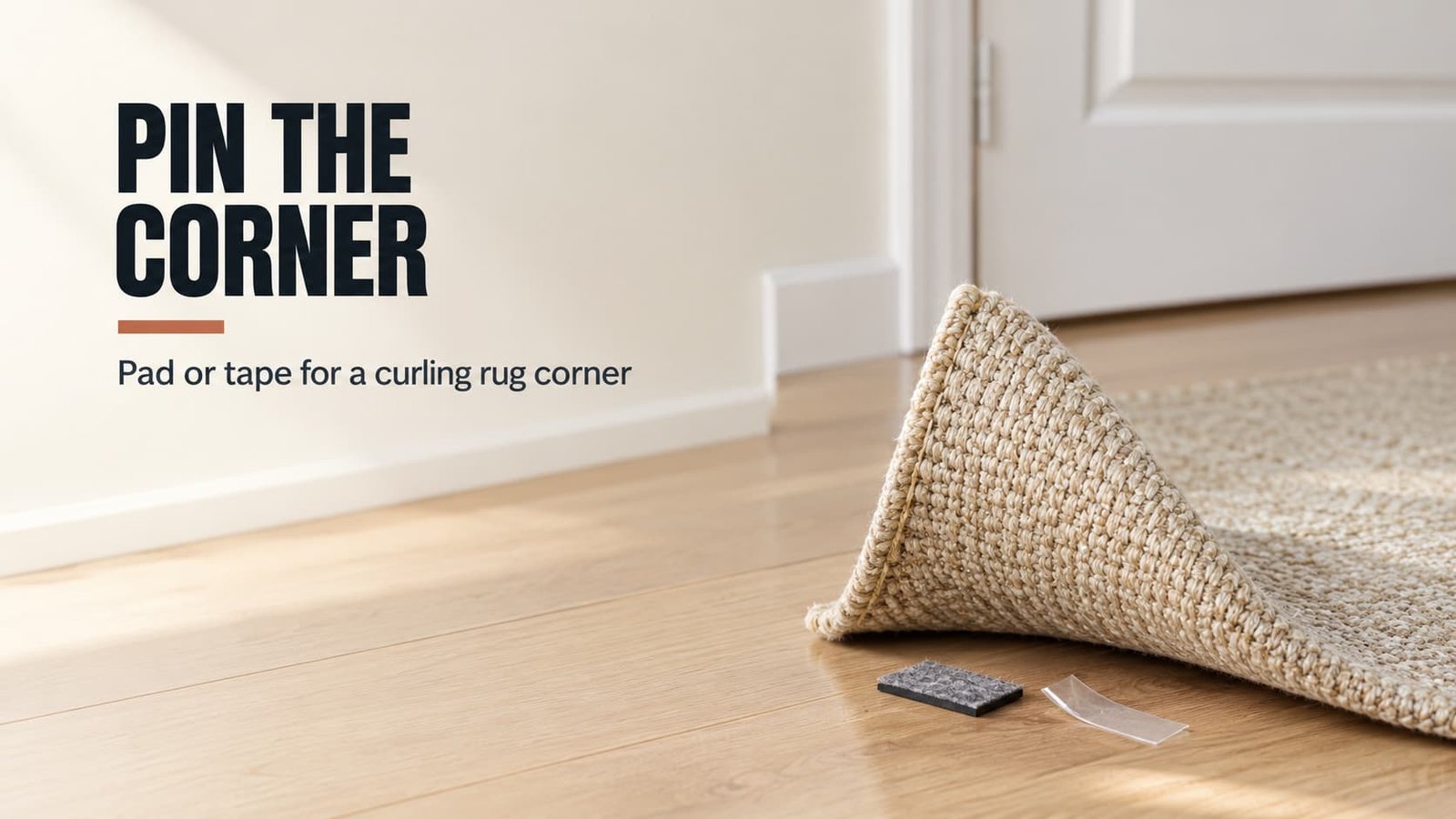
Does a corner of your hall runner stand up after you flatten it? That lift is what a rug gripper pad or double-sided tape has to cure, and each cures a different half. Take tape if the corner lifts and the runner stays put. Take a pad if the runner creeps along the laminate while the corners lie flat. Choose wrongly and you’ve bought a fix that leaves the fault in place.
The test room is an invented Dutch flat. Its hall measures 120 cm across and 400 cm along, with a lacquered laminate floor. The runner is 80 by 300 cm and 7 mm thick, and each rate below is only a placeholder for your own measurements.
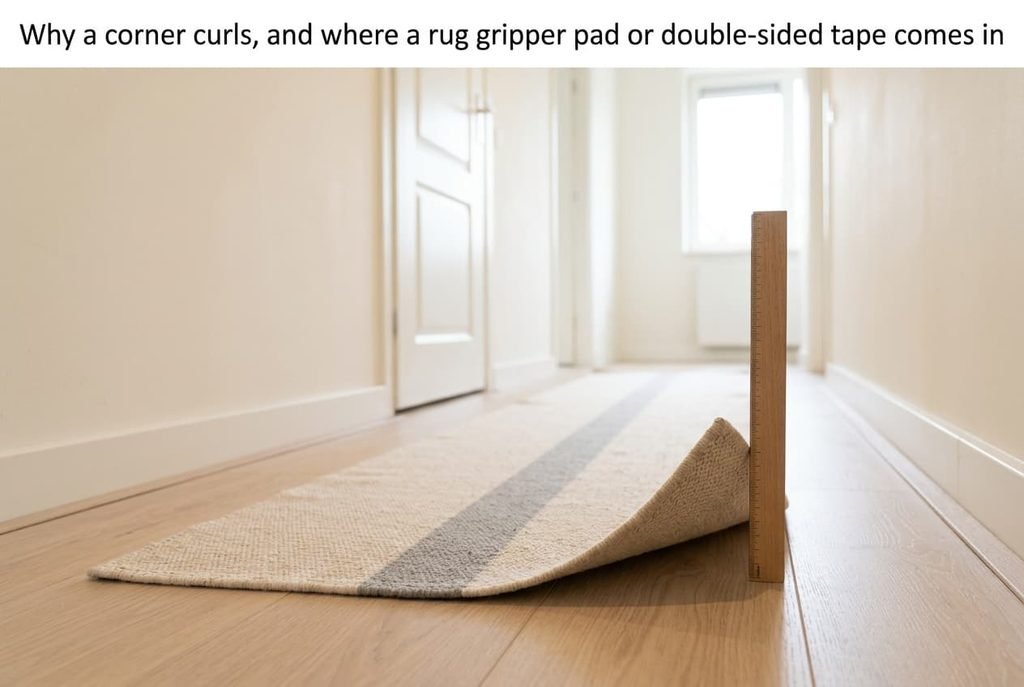
Why a corner curls, and where a rug gripper pad or double-sided tape comes in
A runner spends weeks rolled in a box, and its backing remembers the roll. Flatten it and the backing tries to return to a curve, strongest at the corners where two edges bend at once. Treat that memory as a radius. Assume the box held it at 50 cm, and that the corner bends over a 20 cm length. A bend lifts its far end by length squared divided by twice the radius, so 20 × 20 ÷ (2 × 50) = 4 cm.
Four centimetres is plenty of trouble.
The living-room door clears the floor by 12 mm, so a corner standing 40 mm high meets it every time it opens. A robot vacuum climbs about 15 mm before it stalls, and the brush catches the rest.
The figure to measure in your own hall is how high each corner stands after a night lying flat. Hold a ruler upright beside it. Under 1 cm the lift is cosmetic, and over 2 cm it needs pinning.
The runner covers 2.4 m², half of the 4.8 m² floor. A cotton flatweave like this weighs about 3.6 kg, far too little to press its own corners down. A rug gripper pad or double-sided tape adds what the weight can’t, though each adds it somewhere different.
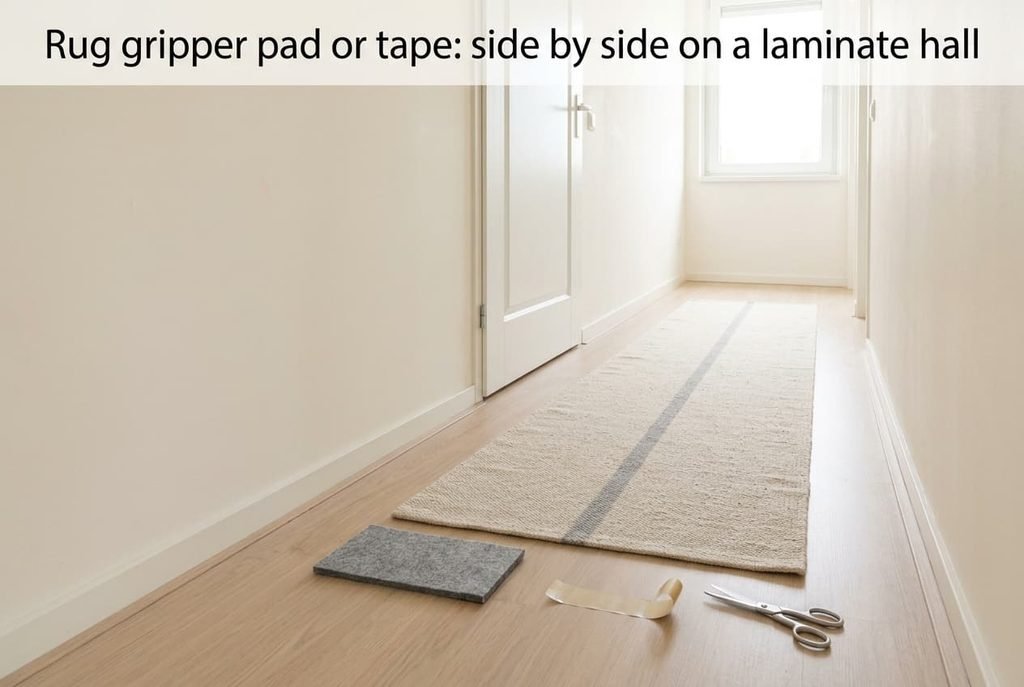
Rug gripper pad or tape: side by side on a laminate hall
You can test most rows with an offcut and ten minutes of patience. No option wins everywhere, and the rows that decide it depend on your floor and your door.
| Situation | Gripper pad | Double-sided tape |
|---|---|---|
| Corner standing 4 cm high | Eases the lift a little through added weight and grip | Pins the corner flat once pressed down |
| Runner creeping underfoot | Stops it across the whole underside | Stops it only where strips sit |
| Door with 12 mm of clearance | Adds 3 to 6 mm and can catch | Adds under 1 mm |
| Lifting the runner after a year | Comes up clean, though some rubbers mark lacquer | May leave a sticky band that needs solvent |
| Vacuuming over it | Stays put beneath the runner | Strips hold while the rest can flap |
| Wet shoes dripping on it | Can trap damp against the laminate | Leaves most of the underside open to air |
| Cutting to size | Scissors and a straight edge | A knife and a ruler |
The door row catches most readers out. A pad that suits a 5 mm runner in a lounge turns into a catch once the clearance beneath the door is only 12 mm, so check that figure before anything is bought for the corners.
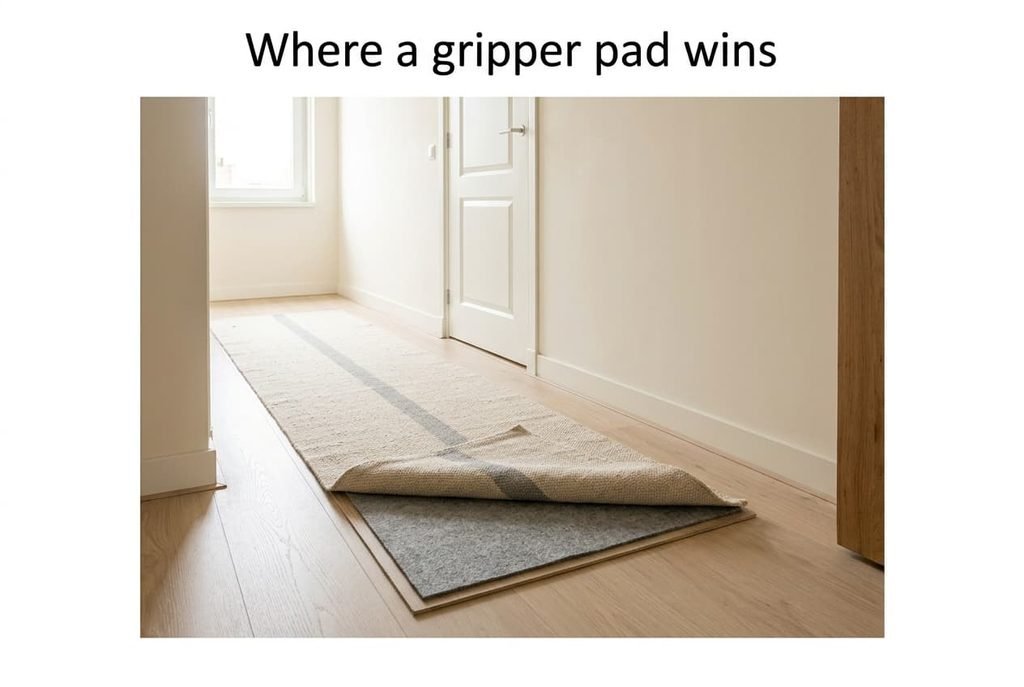
Where a gripper pad wins
In the contest of a rug gripper pad or double-sided tape, the pad wins when the runner moves and the corners already lie flat. Take 40 passes a day, each nudging the runner forward by a hair. Assume it drifts 3 mm a day, which is 9 cm after a month and enough to leave one end off the mat.
A pad cut to 76 × 296 cm sits wholly under the runner, 2 cm short of every edge, so nobody sees its rim. That covers 22,500 cm², or 94% of the runner’s underside. It cushions every step too, and it quiets the thud of shoes on laminate.
A pad is thickness first and grip second.
Add the pad to the runner and check the door. A 7 mm runner on a 6 mm pad stands 13 mm high, so the door drags by 1 mm. A 3 mm pad leaves 2 mm to spare. Plain rubber can mark some lacquered or vinyl floors over many months, so lay an offcut in a hidden corner for a week first.
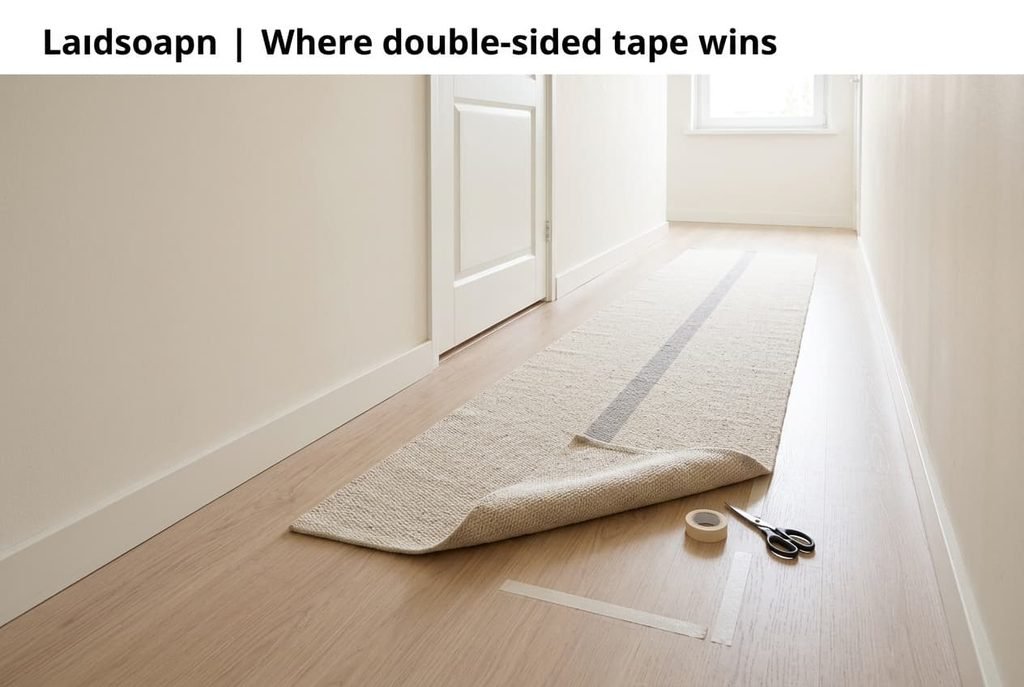
Where double-sided tape wins
Tape wins when a corner stands up and the runner stays where you put it. Four corners with two edges each, at 25 cm per edge, take 200 cm of tape. A strip 2.5 cm wide gives 500 cm² of bond, only 2% of the pad’s contact area. It works because it sits exactly where the curl pulls.
Tape adds under 1 mm, so the door never notices it. It also holds in place through vacuuming, because nothing rides up at the edge to be caught by the brush.
The price is the floor. Adhesive grips lacquer well enough to lift a poorly bonded patch when you peel it, and a rented flat has a deposit to protect. Warm the strip with a hairdryer and peel at a low angle to keep the damage down. Press each new strip onto clean, dry laminate, then stand on it for a minute, because dust under the adhesive weakens the bond.
Tape also can’t be moved. If the runner shifts 5 cm, the old strips are spent. You then need fresh ones at every corner.
When neither is right
The third route costs nothing. It attacks the memory in the backing, so little is left to pin. Roll the runner against its curl and weigh it flat to wipe most of the memory out. Roll it tight around a 10 cm tube with the backing on the outside, and leave it for 48 hours. Then lay it out and put three hardbacks of about 1 kg on every corner for 72 hours.
Assume the stored radius grows from 50 cm to 150 cm. The same 20 cm bend now lifts 20 × 20 ÷ (2 × 150) = 1.3 cm, which is under your 2 cm limit.
The trick does nothing for creep. A runner that wanders will still wander after a good flattening, so measure the drift before you decide it has done its job. Give it a week before you judge, since the memory in the backing returns slowly in a cold hall.
How to choose in two minutes
Measure two things. Lay the runner flat overnight and read the corner height with a ruler, since an hour can understate the lift. Then measure the clearance beneath the door and subtract the runner’s thickness. Check it with the door open flat to the wall as well, because hinges sag a little and the clearance shrinks at the far edge.
If a corner stands over 2 cm and the runner holds its place, take tape on the corners only. If the runner creeps and every corner stays under 1 cm, take a pad no thicker than the door gap minus the runner and 2 mm, which is 3 mm in our hall.
You can’t know what your floor does until you test it. Finishes behave differently, so lay a test patch first. A rug gripper pad or double-sided tape solves one fault each. Your corner height and door gap tell you which fault you have. If both faults show up, treat the corner first, because a lifted edge does the damage fastest and a drifting runner doesn’t. That’s why the ruler comes out before the shop trip.
Questions readers keep asking
Will double-sided tape damage a laminate floor?
It can. The adhesive bonds hard to a lacquered surface, and a weak patch of lacquer may lift when you peel the strip. Test a short length in a hidden spot for a week first. Warm the strip with a hairdryer before removing it, and peel slowly at a low angle.
How long does a gripper pad last under a runner?
That depends on the material. Felt and rubber pads usually outlast the runner on top. Plain foam crumbles within a few years. Lift one corner every spring and press the pad with your thumb. If it feels brittle or leaves dust on the floor, replace it.
Which suits a hall where wet shoes come in?
Tape, usually. A pad can hold moisture against the floor and dry slowly, while narrow strips keep most of the underside open to air. Whichever you pick, lift the runner once a week for an hour so the laminate underneath can dry.