What lets a phone name a song is a fingerprint, a few hundred of them cut from ten seconds of sound and checked with a library of tracks it already holds. Noise ruins some of those fingerprints but not all. A match needs only enough of them to agree on one timing. We follow a single clip recorded in a busy Manchester café, where a speaker plays a studio track over the clatter of cups. All figures are assumed samples. No service or brand appears. You’ll see why a loud room costs the phone accuracy but rarely the answer.

How Does a Phone Name a Song? The Short Answer
The phone reduces the sound to the pattern of its loudest points, and the library recognises that pattern rather than the audio.
Pattern and timing carry the whole identity of a track.
The short version skips three things. The phone never needs the whole song, because the clip can start at any moment and the library finds where it fits. It also has no grasp of lyrics or mood, since the pattern carries no meaning. Because each fingerprint records its own place in the track, a clip that starts mid-chorus fits the library as well as one that starts on the first note. And in the design described here, only compact fingerprints travel to the library, which makes them far smaller than the recording. This is the step that lets a phone name a song from a few seconds of music.
The library is built in advance. Each known track was cut into the same kind of fingerprints, and every one was filed with its track of origin and the moment it occurs. The phone’s job is therefore a lookup and a count, which a small device can finish in a second or two.
One Café Recording Traced From Sound to Answer
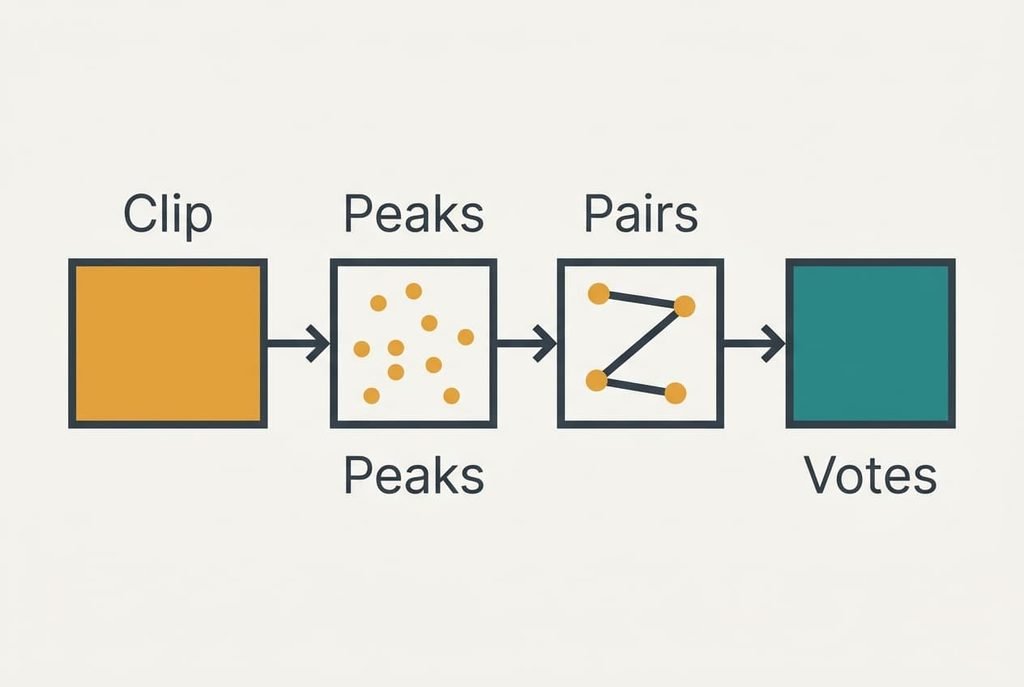
Hold the phone near the speaker for ten seconds. The microphone takes 44,100 readings a second. That makes 441,000 readings in the clip.
The phone slices those readings into windows of 2,048 samples, about 46 ms each. It steps forward 1,024 samples at a time, which yields roughly 430 windows. Each window becomes a ladder of 1,025 frequency steps of about 21.5 Hz, showing how loud each pitch is at that moment. Stack the ladders side by side and you have a picture with time across and pitch up.
Most of that picture is clutter. The phone keeps only the points louder than everything around them. We assume about 30 survive each second. Ten seconds therefore leave 300 peaks.
A single peak says little. The phone therefore pairs each peak with the five that follow within 1.5 s, giving 300 × 5 = 1,500 pairs. Each pair is squeezed into one number built from the first pitch (10 bits), the second pitch (10 bits) and the time gap (6 bits). Twenty-six bits allow 2^26 = 67,108,864 values.
Café noise buries some peaks. Assume half survive. A pair needs both of its peaks. Only one pair in four lasts: 1,500 × 0.25 = 375 numbers remain.
Suppose the library holds a billion entries. Each lookup returns about 1,000,000,000 ÷ 67,108,864 = 15 entries, and most are strangers from other tracks. For every entry the phone subtracts the position in the clip from the position in the track. The right track gives the same answer each time, say 83.2 s. All 375 survivors sit at that one offset.
The 5,625 stray entries scatter over millions of combinations, and rarely do two land together. A decision needs only 20 agreeing votes. The tally here is 375, nearly twenty times that.
The Skyline Comparison and Where It Breaks
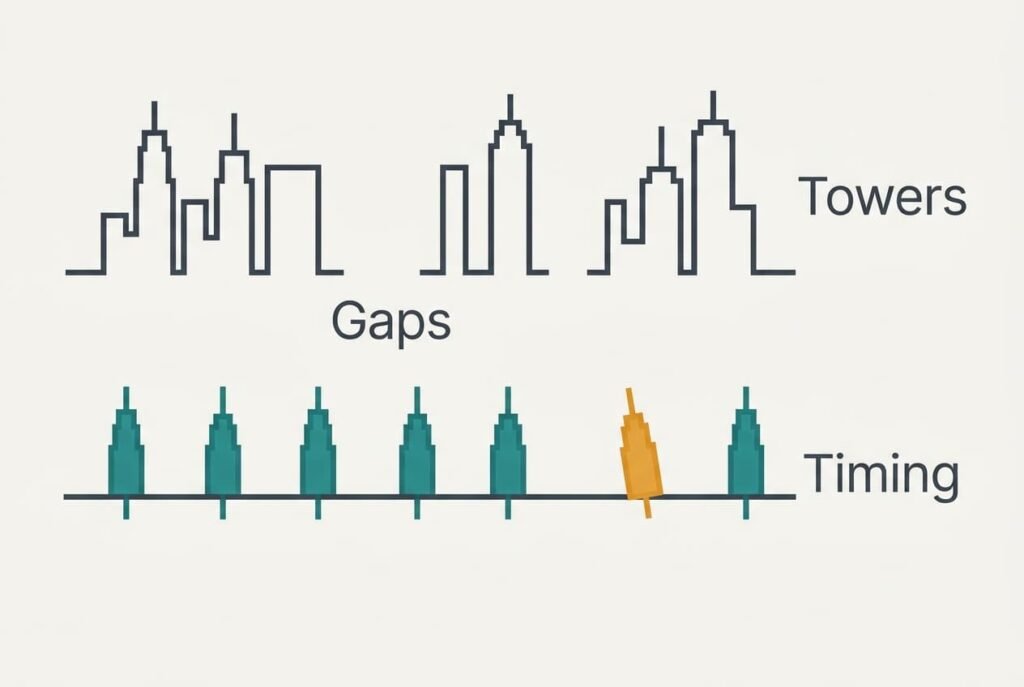
Naming a city from its skyline mirrors the matching step. You don’t remember every window. You remember the tallest towers and the spaces separating them, and a few of those name the city even if cloud hides half the view.
Two differences matter. A skyline stands still, while a song unfolds in time. The phone must therefore also check that the towers appear in the right order at the right spacing. And your eye judges a skyline by feel. The phone insists on a count of agreeing votes before it answers.
Keep hold of that second difference. Two cities can share a few similar towers. Only the demand for many votes at one offset protects the phone from such coincidences.
What a Phone Can’t Name: Where the Match Stops
Noise is the first limit. Pair survival is the square of peak survival. The votes fall quickly. We need 1,500 × s² ≥ 20, which gives s ≥ 0.115. Below about 12% of peaks surviving, the count drops under 20 and the phone says nothing.
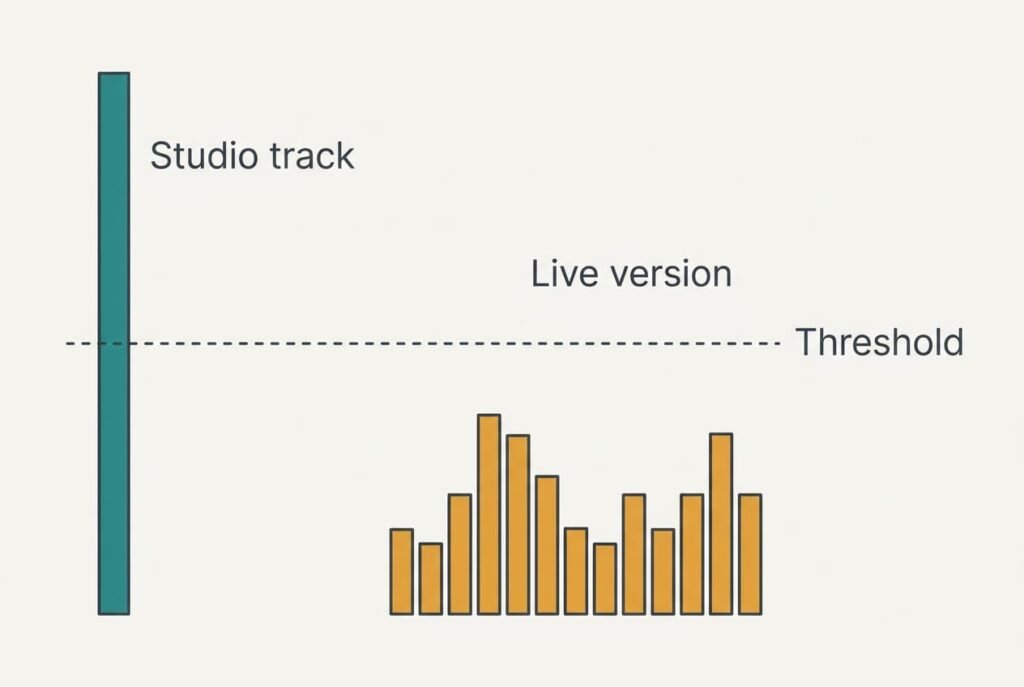
The deepest limit is that it recognises recordings the library already holds and nothing it understands. A new release that hasn’t been added returns no answer. A live performance rarely matches either. The timing of its peaks wanders from the studio version, and the votes spread across many offsets instead of piling on one. That is why the trick that lets a phone name a song works reliably only when the recording matches the library’s copy.
Humming is a third limit. A hummed tune has no studio peaks to match, and a different method is needed for it.
Distance is the last. Halving the distance to the speaker lifts the music’s level by about 6 dB against the café, and that keeps more peaks alive.
Three Beliefs That Sound Right but Aren’t
“It listens to the melody and the words.” It formed because that’s how people recognise songs, and the feature behaves like a quick listener. The phone ignores both. That pattern of loud points and timings is what lets a phone name a song at all.
“It sends a recording of the café to a company.” That belief formed since the phone clearly records. The design here sends fingerprints, not your audio, and the fingerprints are about 1,500 numbers, far less than ten seconds of sound. Read the privacy notes of the service you use, since designs differ.
“A louder phone volume gives a better result.” It formed because loud sounds are easier for people to hear. The microphone sets the limit rather than the speaker volume, and a speaker turned up too far distorts the peaks worth keeping. A steady, moderate level near the speaker works better than a loud one across the room.
A Rule for Deciding Whether You Need It
Before a phone can name a song, a library must hold its fingerprints. Reach for the feature when a studio recording is playing close to the speaker, a few metres at most, and move closer and try again if the first clip fails. That rule covers shops and car radios as well as cafés. Pair it with a second habit: switch off a running tap if it’s yours to switch off. Hold the phone so the microphone faces the speaker. A live band or a hummed tune suits a lyric search better, and so does a half-remembered song.
One failed attempt costs you ten seconds.
Treat the feature as a convenience for recorded music in the room, and measure it by how often it answers rather than by how clever it sounds. A feature that names four songs in five attempts has earned its place on the home screen. If it fails twice from close range, the track is probably missing from the library and more tries won’t help. Note the time and the setting, and look the song up by its lyrics later when you’re at a desk.
Questions Readers Keep Asking
Why does it fail on a live version of a song?
The timing of a live performance drifts away from the studio recording. The votes then spread over many offsets and none reaches the 20 needed. A studio track lands at a single offset, and that pile-up is the clue the phone looks for.
Do I need it if I can search the lyrics?
Only when you can’t hear the words clearly or the track has none. The fingerprint method works on the sound itself and needs no lyrics. A lyric search is better for a live band or a song you only half remember.
How does it compare with humming to search?
Humming has no studio peaks to match. It relies on the shape of the tune and gives looser, less certain results. Fingerprints are exact and quick, but only for recordings the library holds. Choose by whether a recording is playing nearby.