Choosing a portable speaker that copes with both places starts with one number, the hours it plays at the loudness you’ll actually use. Quoted hours are usually measured quietly. They overstate the evening you’ll get: our sample drops from 8 hours to 4 at high volume. Our sample household lives in Bristol, and has a kitchen used daily and a small garden used on summer evenings. The numbers below are illustrative and unmeasured. No model or cost is named, and you’ll finish with four checks in the right order plus one headline spec that deserves to be ignored.
How Choosing a Portable Speaker That Copes Is Decided
A speaker has two jobs in two very different places. In the kitchen it needs to rise above an extractor fan and a running tap. In the garden it needs to carry across open air with nothing to bounce the sound back. Both jobs draw on the same battery.
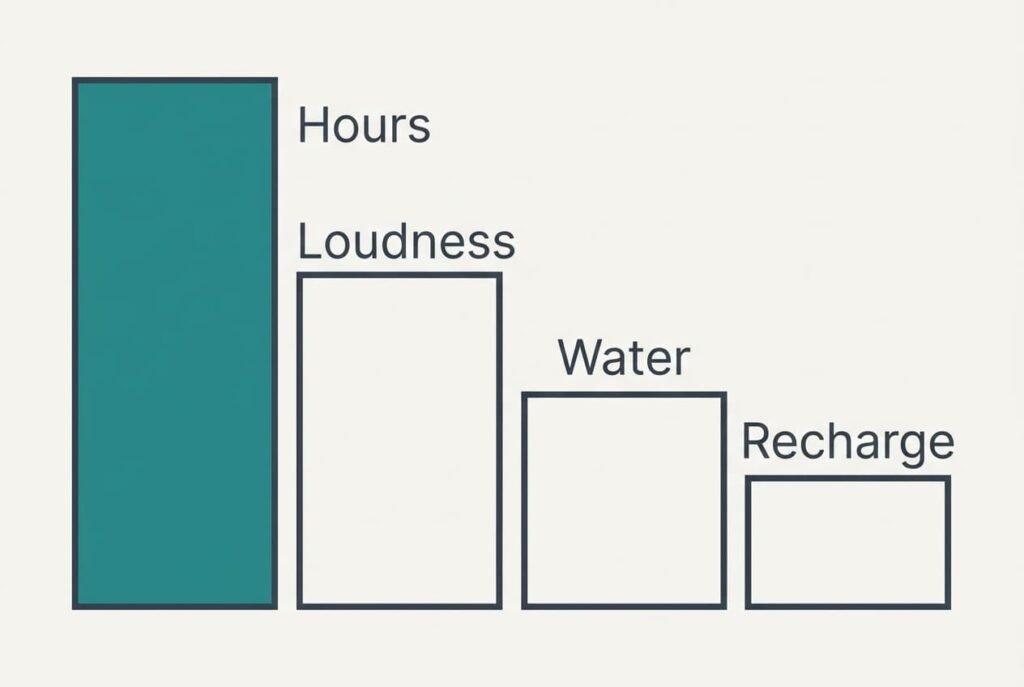
The deciding criterion is hours of play at your real volume, because everything else matters less to a speaker that goes quiet halfway through the evening. Hours equal battery capacity divided by the power the speaker draws. Draw rises with volume, and loud listening empties the battery faster than the quoted figure suggests.
Assume a sample speaker with a 20 Wh battery. At moderate volume it draws about 2.5 W, which gives 20 ÷ 2.5 = 8 hours. At high volume it draws 5 W, which gives 4 hours. The same speaker is an all-day companion in one case and an evening one in the other. Choosing a portable speaker that copes with both places is therefore mostly a sum.
Three more checks follow from that number, and the list below puts them in order.
Four Checks for Choosing a Portable Speaker, in Priority Order
1. Real hours at your volume. Find the battery capacity in watt-hours on the casing or in the manual. If only milliamp-hours appear, multiply by the cell voltage, 3.7 V in our sample: 5,400 mAh × 3.7 V ≈ 20 Wh. Divide by 2.5 W for a quiet kitchen and by 5 W for a garden evening. If the hours fall short, the speaker dies before the guests leave and you’ll be carrying a charger outdoors.
2. Loudness at your listening distance. In open air, each step that doubles the distance removes about 6 dB. A speaker reaching 80 dB at one metre gives 74 dB at 2 m, 68 dB at 4 m and 62 dB at 8 m. An extractor fan at 60 dB then sits just 2 dB below the music at the back fence. Judge it by playing music at the distance you’ll sit, not at arm’s length, because a speaker that sounds loud on the shelf can fade by the back fence. If it’s too quiet there, no setting rescues the evening.
3. Water rating for the room. A rating such as IPX4 covers splashes from any direction, which suits a worktop. IPX7 survives a dunk of up to 1 m for 30 minutes, which suits a pool-side table. Ratings test water and not steam, and they assume the port cover is shut. Read the cover, because a loose flap voids the rating. If it’s wrong, one spilled mug can end the speaker.
4. Recharge speed, the one almost nobody checks. Recharge time is roughly capacity divided by charger power, plus about a quarter for losses. A 20 Wh battery on a 10 W charger needs 20 ÷ 10 × 1.25 = 2.5 hours. On an old 5 W charger it needs 5 hours. If the input is slow, a speaker emptied at nine o’clock isn’t ready for the next day.
Specs That Are Oversold for a Portable Speaker
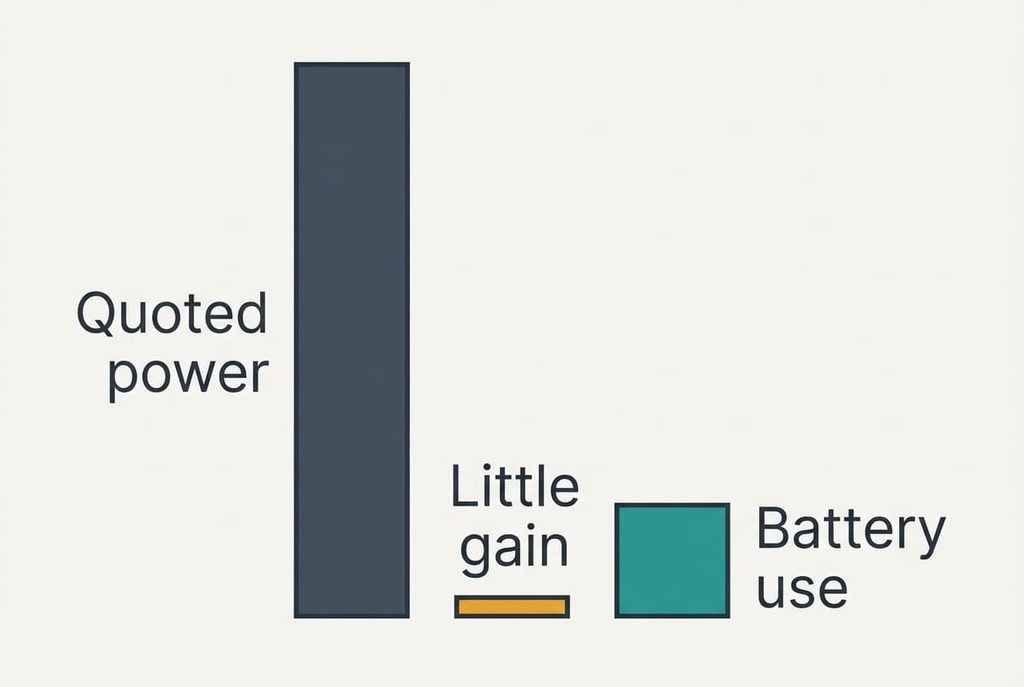
Total quoted watts is the number sold hardest, and it’s the least useful. Doubling the quoted power adds only 3 dB, a step few listeners would notice. To sound twice as loud you need roughly ten times the power. A speaker advertised at 40 W isn’t twice as loud as one at 20 W, and when choosing a portable speaker that copes with a full evening, the larger amplifier only drains the battery faster.
Bass boost is promoted for the same reason. A small enclosure can’t move much air. A boosted setting therefore adds distortion before it adds depth. Rated hours without a stated volume are the third oversold figure. A number with no volume attached is a best case, and you should ask what level it was measured at.
Colour options and lighting effects add nothing to the four checks. They can add weight, and weight matters when the speaker moves between rooms several times a week.
Which Checks Move for Which Reader
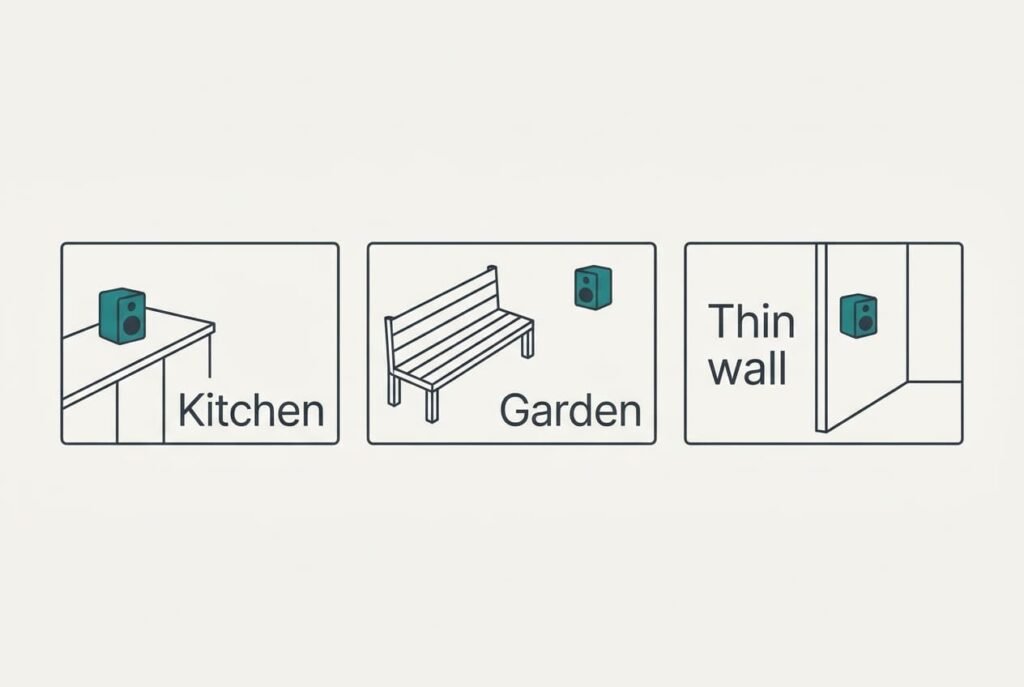
A kitchen-only listener who charges nightly can drop battery hours to second place. Splash protection and loudness over the fan matter more, because the speaker lives by the worktop and the extractor runs most evenings. A speaker within 1 m of your ear needs no distance margin at all.
Choosing a portable speaker that copes with a garden host’s evenings moves battery and distance to the top. Four hours at high volume needs 20 Wh, and the seat at 8 m sits near 62 dB. Next comes the water rating. Dew and showers arrive without notice.
A reader with thin walls and close neighbours changes everything. Minimum volume matters here, because some speakers jump from silent to loud in one step. Hours barely matter at low draw, and quality at 55 dB does.
When to Walk Away
Walk away from any speaker whose battery is stated in hours with no volume, or in no unit at all. You can’t judge a number that has no condition attached. Take a quoted 20 hours. At our moderate 2.5 W that needs 20 × 2.5 = 50 Wh, 2.5 times the sample’s 20 Wh battery. Either the speaker is far bigger or the test was far quieter.
A missing water rating is the same warning.
Without a rating, assume no protection at all, and keep the speaker away from the sink. Walk away too if the charging port has no cover and the rating claims splash protection, because the rating assumes sealed openings.
Don’t pay for features the sample household can’t use. A stereo pair needs two speakers and two charges, and a flat with one kitchen gains little from it. Walking away takes minutes of looking; a wrong buy means a whole summer of silent evenings.
Two Minutes With a Portable Speaker That Copes or Doesn’t
Play it for two minutes at the volume and distance you’ll really use, with the tap running. Stand 3 m away and see whether the words stay clear. Look at the battery label and work out the hours. Close the port cover and press it with a thumb. Then read the charger input on the label.
If a quiet pop or crackle appears at that level, it will be there all evening. If you can’t hear it clearly over the tap, the garden will be worse. Try a second track with plenty of low notes, since weak speakers often rattle on bass.
Write the four answers on a note and compare two speakers on it, not on the box. The speaker that passes more of them stays. If the evening sound turns out thinner than the test suggested, return it while the shop will still take it back and try the next one against the same note.
Questions Readers Keep Asking
What battery capacity should I look for?
Aim for 20 Wh if you want 4 hours at high volume, or 10 Wh for 4 hours at moderate volume. The sums are capacity divided by power draw. Add a quarter on top for a margin, since batteries lose capacity as they age.
How much should I spend?
Spend on capacity and a stated water rating, with a decent charger input as a bonus. Those decide whether the speaker survives an evening. Extra money for lights or bass boost buys features the four checks never use. Skip them.
How long will the battery last over the years?
Lithium cells lose capacity with each full charge. A common assumption is about 80% left after 500 full cycles, which is well over a year of daily charging. A 25% capacity margin at purchase leaves a speaker that still manages the evening after those 500 cycles.