Buying a turntable for records you already own comes down to one match: whether your amplifier or speakers can take the very weak signal that a turntable sends out. Miss it and even a good deck sounds faint and thin. Four checks come below, ranked by how much each one can spoil the purchase, for readers in Britain who own a shelf of 80 records and no deck yet. All figures here are sample values, and the labels printed on your own equipment hold the real ones. No brand or model is named, and no costs appear.
What decides buying a turntable for records you own
Sam lives in Norwich and has inherited 80 records and a small stereo amplifier. The amplifier’s sockets carry the labels CD and AUX, and none says PHONO.
That one fact steers the whole purchase.
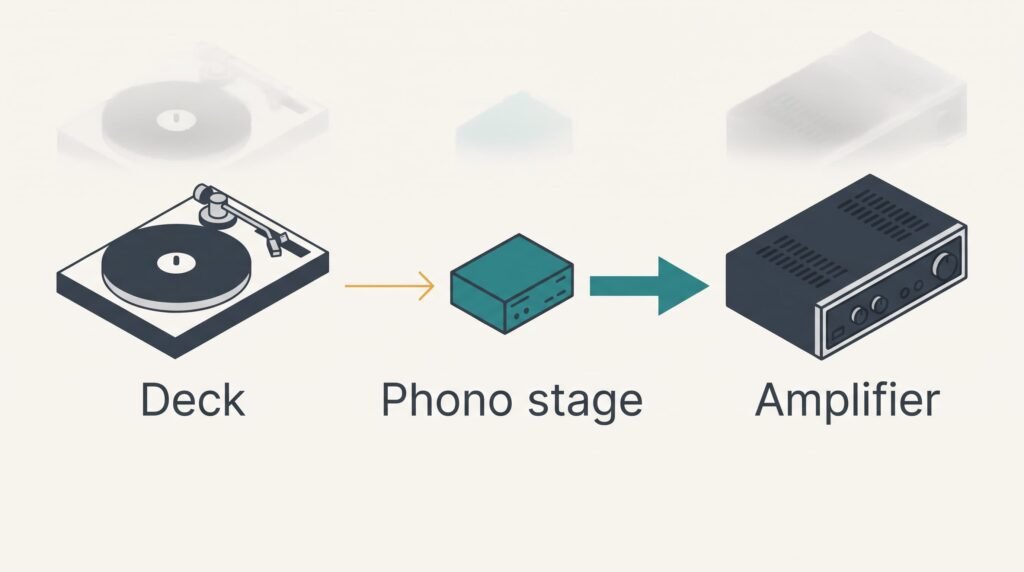
A groove moves the stylus by a tiny amount. The cartridge turns that movement into a signal of about 4 mV, while a socket such as AUX expects about 400 mV. The gap is 100 times. Something has to lift the signal by that factor and rebalance the tone, because records are cut with the bass held back. That something is a phono stage.
Where the phono stage lives decides the purchase, because it can sit in one of three places. It can be built into the turntable. It can sit inside the amplifier behind a PHONO socket. Or it can live in a small box between the two.
Sam’s amplifier has no PHONO socket, which leaves two routes. A turntable with a built-in stage plugs straight into AUX. Otherwise a separate box joins the chain, and that means one more item and one more cable on the shelf.
Four checks in order of priority
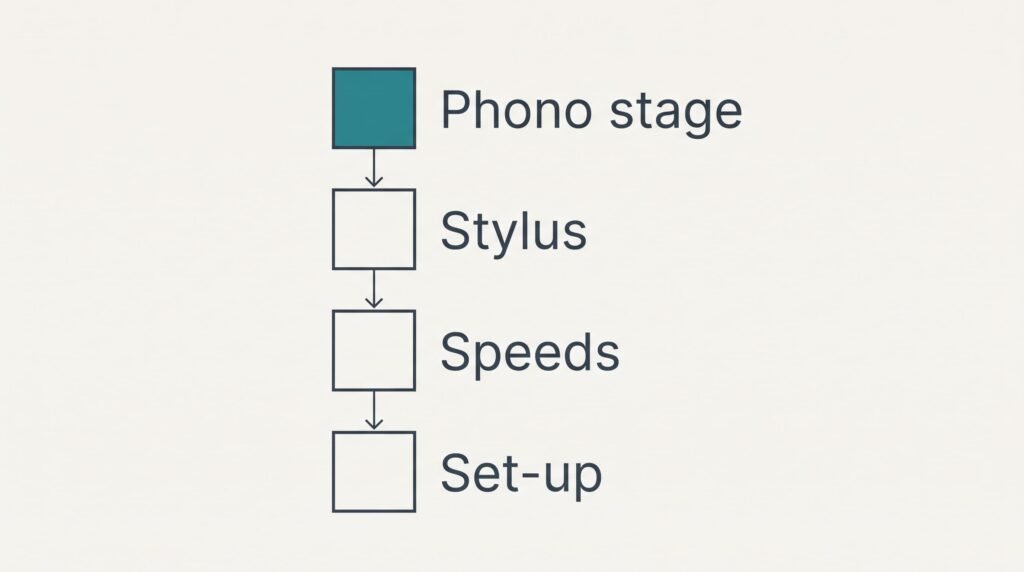
1. Where the phono stage lives. This part lifts the signal by 100 times and rebalances the tone. It decides whether records sound full or faint on the very first evening. Read the labels on your amplifier or powered speakers and look for a socket marked PHONO. Without one, scan the turntable’s description for a built-in stage, often with a switch that turns it on or off. Choose wrongly and the sound stays faint and thin until you add a box or swap the deck.
2. Stylus life and replacement. The stylus is the tiny tip that rides the groove, and it wears with every hour of play. You hear nothing wrong for months, then the sound turns harsh. Before buying a turntable for records you can’t replace, find the cartridge name in the description and search for a tip under that exact name. Most buyers skip this. With a sample life of 600 hours and 5 hours of play a week, the tip lasts 600 ÷ 260 = 2.3 years. A worn tip can damage grooves, and no later purchase repairs them.
3. Speeds offered. Albums spin at 33.3 rpm and most singles at 45 rpm, while a few old discs need 78 rpm. This decides whether a pile of singles plays at all. Find the speeds in the description and hold them against your shelf. Sam owns 74 albums and 6 singles. Two speeds therefore cover everything. A deck with one speed leaves those 6 singles on the shelf.
4. How much set-up the deck needs. Some decks arrive with the cartridge fitted and the arm balanced, and others ask you to set the downward force of the stylus yourself. Look for the words ready to play in the description. Setting that force takes a stylus scale accurate to 0.1 g, and a kitchen scale usually reads whole grams. A wrong setting makes the stylus skip or muffles the sound from the first record.
Specifications that sell more than they help
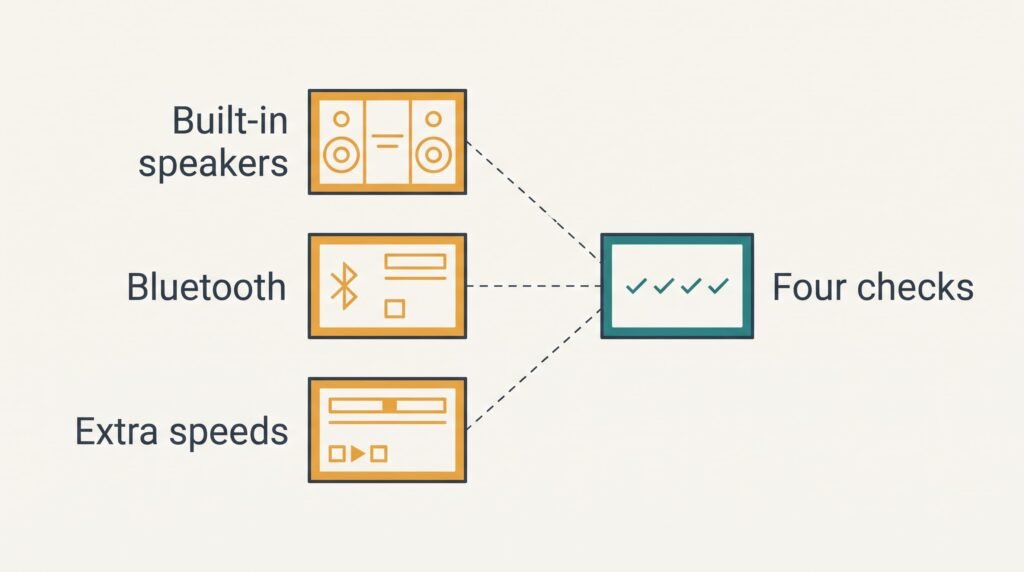
Built-in speakers are promoted hardest when buying a turntable for records, because an all-in-one deck looks like a bargain on a shelf. Small speakers sitting a short distance from the stylus shake the deck, and the stylus can feed that shake back as a low rumble. They also tie you to one small sound, with no route to better speakers later.
A Bluetooth output comes second. It suits wireless headphones, yet a plain cable gives the same result without any pairing, and a wired link doesn’t drop out mid-album.
A long list of speeds comes third. A deck that offers 78 rpm sounds versatile, though old discs need a different stylus, and Sam owns none of them. Match the speeds to your own shelf, as in the third check.
Sellers lead with these features because they read well on a box. Treat them as tie-breakers once the four checks are settled.
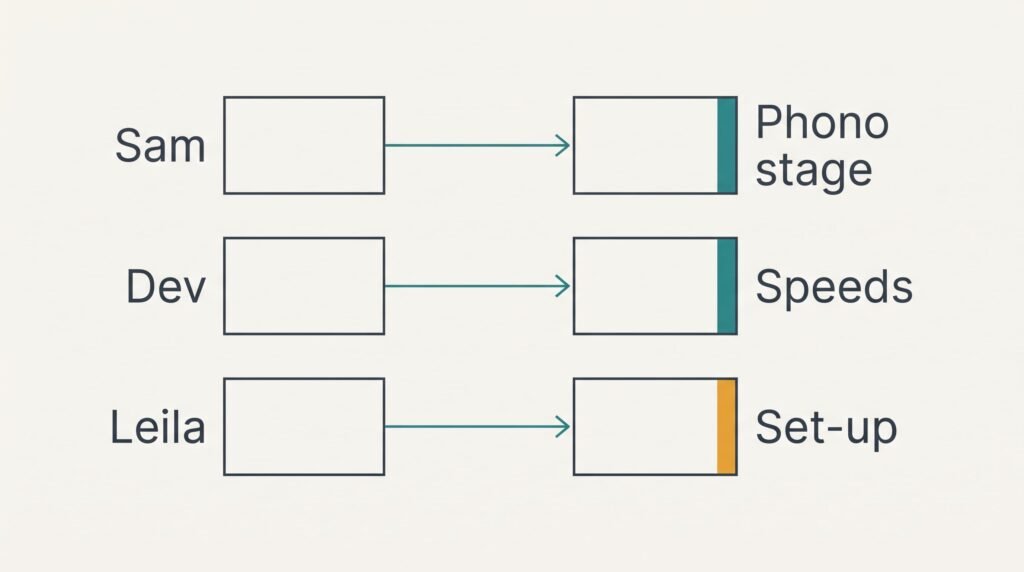
Three buyers and where their priorities move
Sam’s amplifier lacks a PHONO socket. The phono stage therefore stays first for him, and a deck with a built-in stage solves it without another box.
Dev owns powered speakers with a single line input. He needs a built-in stage too, and speeds then decide between decks that have one. His shelf holds 70 albums and 30 singles, which makes 30 of his 100 records singles. He wants 45 rpm named clearly in the description, because a deck that only implies it may not offer it.
Leila rents and moves every year. Set-up moves up for her, because a deck that needs balancing again after each move costs an evening every time. A pre-balanced arm saves that evening and spares her a delicate adjustment after every box is unpacked.
When to walk away from a listing
Walk away when nobody can name the cartridge, because without a name you can’t find a replacement tip, and the tip is what wears out. A seller who says only that it has a needle has told you nothing. Ask for a photo of the printed name as well.
Anyone buying a turntable for records should leave the listing if the tonearm wobbles sideways when nudged, because that play can’t be adjusted away. Leave it too if there’s no way to hear it play before you pay. A demonstration in person or a video of ten turns would do.
Some decks fit a cartridge whose tip can’t be changed alone. The whole cartridge must then be replaced when the tip wears. In our sample that happens at 2.3 years, and the listing should say whether a matching cartridge is sold. A week’s wait for a listing that names its cartridge costs little.
A listing that hides the cartridge hides the running cost.
A two-minute check after buying a turntable for your records
Play one album side on a quiet evening at your usual listening volume. Time ten turns of the platter with a stopwatch, which should take 18 seconds at 33.3 rpm. A reading of 18.5 seconds means the speed is about 3% slow, roughly half a semitone flat. Then let the stylus sit in the lead-in groove before the music starts and raise the volume. A steady hum points to a loose cable or a missing earth lead. Finally read the PHONO label again and confirm the stage is connected or switched on. A failed step means sending the deck back inside the seller’s window.
Rank the checks in the order above. The phono stage decides whether the deck works with your equipment, and the stylus decides how long it keeps working. Copy your amplifier’s labels onto a card before you shop, then hold each listing against it. A deck earns its place when it plays all 80 records cleanly.
Questions and Answers
What does a cartridge’s output figure tell me?
It states the signal strength in millivolts, and a higher figure needs less boost from the phono stage. A sample value is 4 mV. Check that your stage accepts the cartridge type named in the listing, because the two must match. If the listing doesn’t name the type, raise it with the seller before money changes hands.
How much of my budget should the turntable take?
As a sample split, give the deck about 40% of your total. The amplifier and speakers take about 45%, and the remaining 15% buys a spare stylus and a cleaning brush. If your amplifier already has a PHONO socket, the deck can take a larger share, since no extra box is needed.
How long before I regret the choice?
Regret arrives when the stylus wears out and no replacement exists, which in our sample happens after 2.3 years of play. A deck can serve for decades if its tip can be replaced. A missing PHONO socket is the other common regret, and it shows on the first evening.