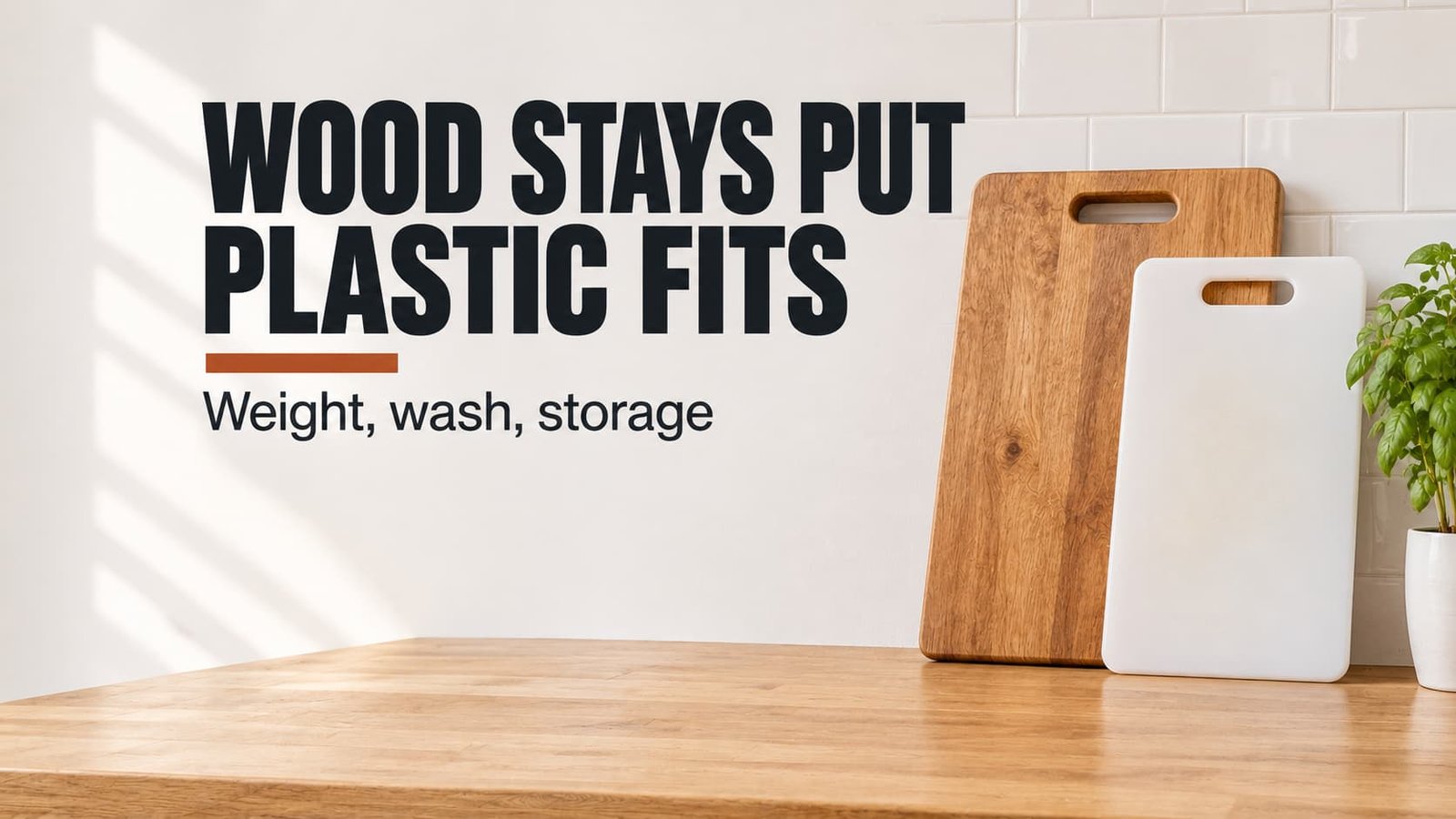
Picking a wooden or a plastic chopping board looks like a matter of taste. In a small kitchen it mostly comes down to weight and wash method, plus the place where the board waits between meals. Wood is heavy and wants a wipe of oil now and then. Plastic is light and often takes a hot cycle in the dishwasher. The flat in this example sits in Utrecht, with a free stretch of worktop 60 cm wide between hob and sink. Each number given here is only a sample. Replace each one with your own measurements and follow the care label that came with the board.
What Separates a Wooden or a Plastic Chopping Board in Daily Use
A board has three jobs to do. First of all it must stay still under the knife. Then it must come through the washing-up in one piece. Last of all it must fit the place where it is stored. Weight and thickness settle the first and the last of these.
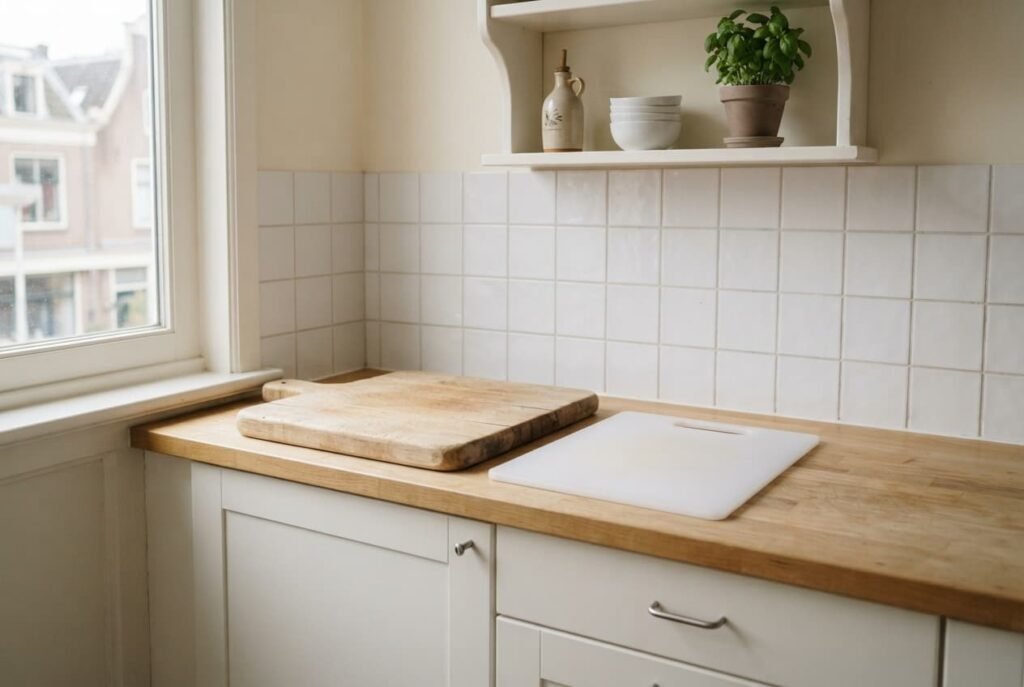
Compare two boards of the same size, 40 × 28 cm. The wooden one is 3 cm thick and the plastic one is 1 cm thick. Each footprint is 40 × 28 = 1,120 cm². Take a worktop stretch measuring 60 cm each way, which gives 3,600 cm² in all. The board covers 31% of it and leaves 10 cm clear on either side. Wood at an assumed 0.7 g/cm³ weighs 3,360 × 0.7 = 2,352 g, or about 2.35 kg. Plastic at an assumed 0.95 g/cm³ weighs 1,120 × 0.95 = 1,064 g, or about 1.06 kg.
The wash decides the second job, and the fairest way to judge a board is to watch how it behaves after being washed across several weeks. Wood takes up water through whichever face is wet. A board left flat on a wet surface can cup. Plastic takes up almost no water, but a thin sheet can bow in a hot cycle.
Wood and Plastic Boards Compared Row by Row
| Point | Wooden board | Plastic board |
|---|---|---|
| Weight and thickness (sample) | about 2.35 kg at 3 cm | about 1.06 kg at 1 cm |
| On a wet worktop | holds its place under its own weight | can slide unless a wrung-out cloth sits underneath |
| Dishwasher | not suited to it | usually fine if the label allows |
| Water and heat | wash by hand then stand it on its edge | rinses freely although a thin sheet can bow in heat |
| Upkeep | a thin coat of food-grade oil each season | none |
| Knife marks | blend into the grain and can be sanded flat | show as pale grooves that hold colour |
| Storage | needs a slot about 5 cm deep | fits a slot 2 cm high |
These values describe the sample boards only, and the care label has the last word wherever a row says usually, because makers differ on heat and water limits. For a wooden or a plastic chopping board the weight row and the dishwasher row split most kitchens most cleanly, which makes them the two to read against your own washing-up habits and your own drawer ahead of the other rows, since a board with no home in a drawer ends up occupying the worktop.
Where Wood Earns Its Weight
Wood suits a cook who washes up by hand and chops most evenings. At 2.35 kg the board stays where you leave it even on a wet worktop. The 10 cm of clear space on either side is enough to sweep scraps into a hand. The surface also gives slightly under the blade, which many cooks find quieter and gentler on the knife edge.
Upkeep is light but regular. A thin coat of food-grade oil each season keeps the grain from drying out. After washing, stand the board on its edge so both faces dry at the same rate. A board that dries on one face alone is the one that cups.
Marks last well. Sanding removes only a thin layer. A scored board can therefore be flattened more than once. Strong smells can linger in the grain between sandings, which some cooks mind.
The one real drawback is the dishwasher ban, together with a slot about 5 cm deep.
Where Plastic Earns Its Place
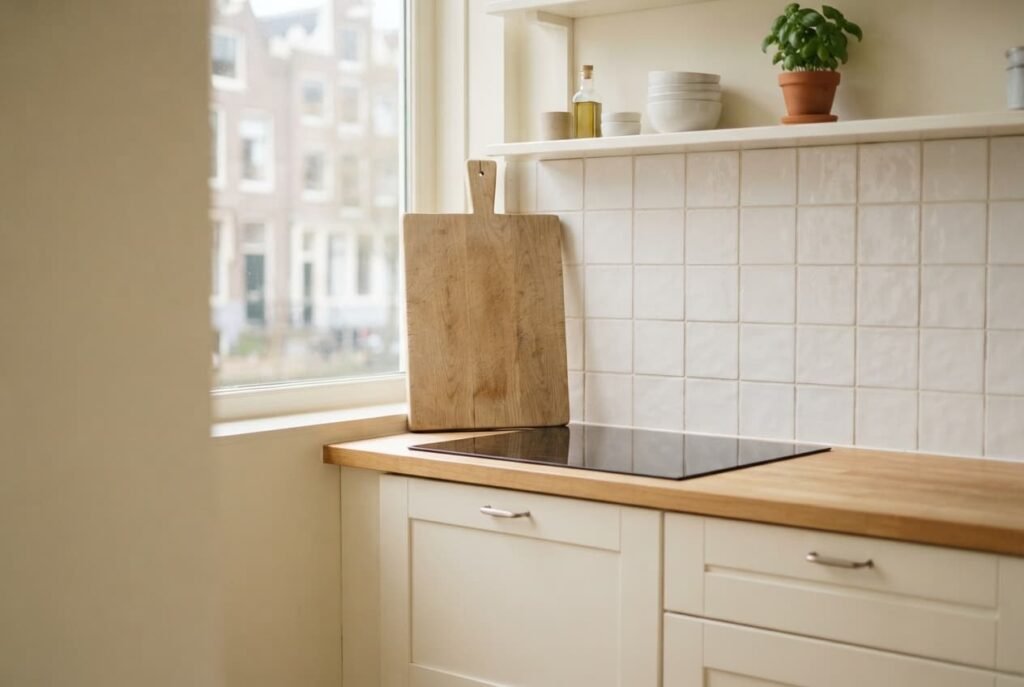
Plastic suits a household that runs the dishwasher daily or keeps its boards in a shallow drawer. At 1 cm thick it fits a slot 2 cm high, and two boards stack to the same 2 cm. A wooden board needs about 5 cm. At 1.06 kg a plastic board travels to the sink in one hand, which matters when your arms are full.
Upkeep is nil, and a rinsed board dries quickly on its edge. Rinse it by hand or run it through a hot cycle if the label allows. Thick sheets resist bowing better than thin ones, and that’s worth a glance in the shop.
The drawbacks come from lightness and softness. On a wet worktop the board can slide. It’s wise to lay a wrung-out cloth under it before cutting. Knife scars show as pale grooves that hold colour from turmeric or tomato. Run a thumbnail across the surface. If the nail catches in the cuts, the board has served its time.
The Board You Already Own
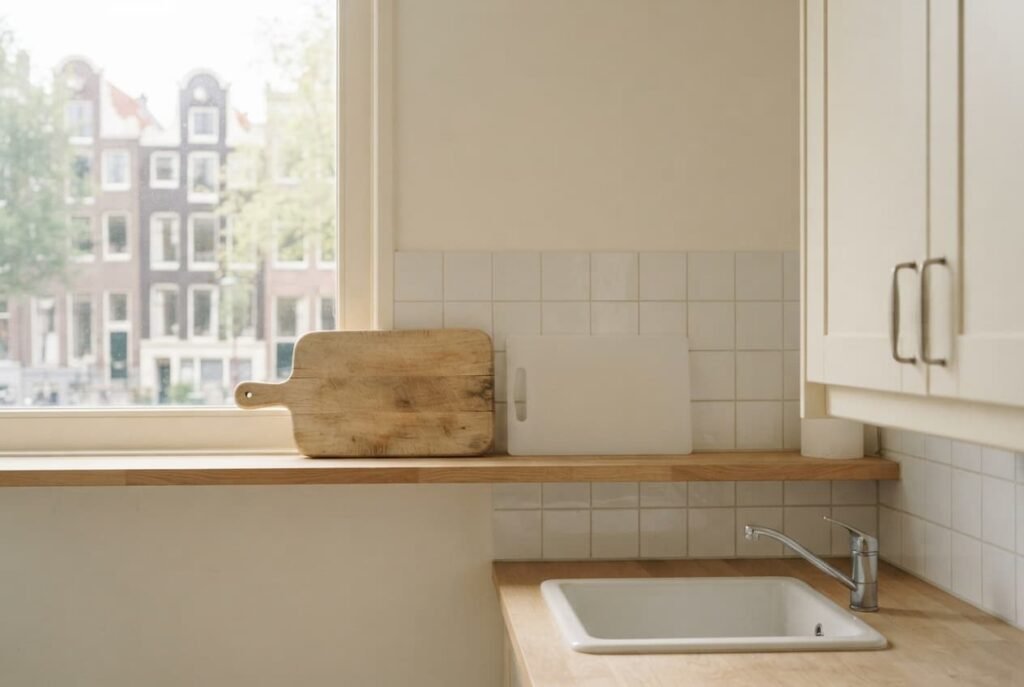
Before buying either one, test the board you have. Lay it on a flat worktop and press each corner in turn. A wooden board that rocks by more than 2 mm has cupped. A pale and dry surface means it wants oil. Run a thumbnail across a plastic board instead, since a catching nail means deep grooves.
Many boards pass this test without any help.
A cupped wooden board can sometimes be coaxed back by laying it concave side down on a wet cloth, wrung out, for a night, though a split won’t close. A grooved plastic board can still serve as a spare for strongly coloured foods such as beetroot or curry. When a wooden or a plastic chopping board you already own passes both tests, keep it and buy nothing new. Replace it only after it fails the same test two weeks running, because a single bad day proves little.
Which to Pick: a Wooden or Plastic Chopping Board
The choice between a wooden or a plastic chopping board carries a cost on each side. You accept that cost when you buy. Name it before you choose.
If you wash by hand most days, pick wood. It stays put at 2.35 kg and its marks can be sanded away. Budget for the oil each season and a drawer about 5 cm deep. It also asks for a habit of drying the board on its edge.
If a dishwasher or a narrow drawer rules, pick plastic. It weighs 1.06 kg and lies flat in a 1 cm slot. Accept the cloth underneath and the day when grooves mean a replacement. It asks for no oil and no special drying.
Borrow one of each for seven days when you can. Cook your usual meals and wash both the way you really do. Write down which board you reached for and which one you avoided, since habits show more than intentions. If one week doesn’t settle it, choose by drawer depth, because storage ends more arguments than taste does. Whichever board you’ll still be reaching for when the week closes is usually the one that fits.
Questions and Answers
How long does each board last?
A hardwood board can last for years when it’s oiled and dried on its edge, and sanding adds more life. A plastic board lasts until its grooves run deep, which with daily use is often a few years. Judge either one by the thumbnail test rather than by its age.
How do I look after each board?
Wash wood by hand in warm soapy water and stand it on its edge to dry. Add a thin coat of food-grade oil each season. Plastic can go in the dishwasher if the label allows. Dry both before storing them. Never leave wood soaking in the sink.
Which suits a small flat with a narrow drawer?
Plastic usually fits better because a 1 cm board lies flat where a 3 cm wooden board won’t. Wood still works in the same flat if the board stands in a gap beside the hob. Measure the slot before buying, since a board that doesn’t fit ends up on the worktop.