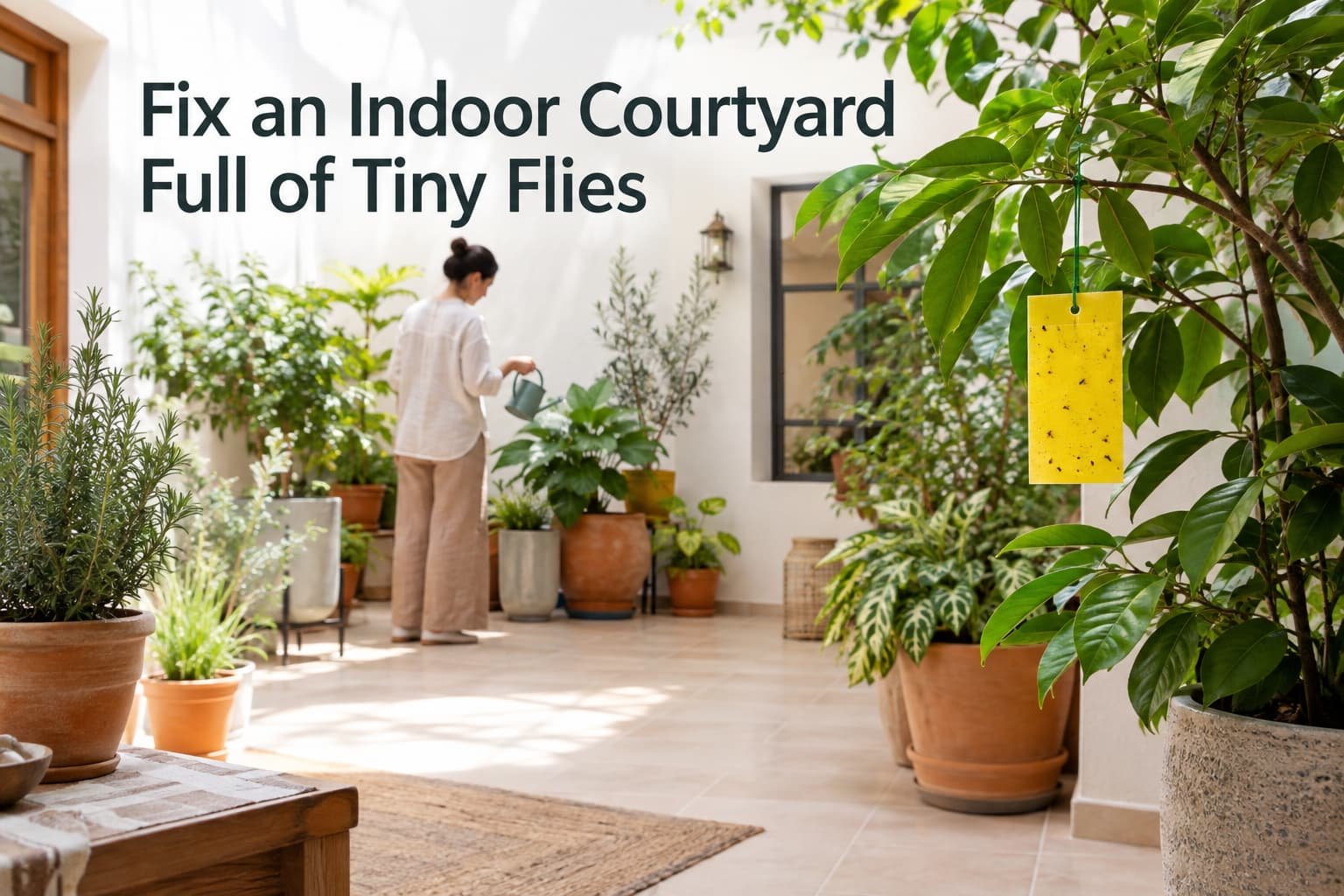
You water the plants, sit down with a coffee, and a small dark cloud lifts off the nearest pot. Tiny flies around indoor plants are one of the most common courtyard annoyances, and they are almost always the same insect: fungus gnats. They do no harm to people, but they are tiresome, and their larvae can damage the roots of young or weak plants. The useful news is that the flies you see are the smaller part of the problem. The source is the soil, and the soil is something you control.
What is actually happening
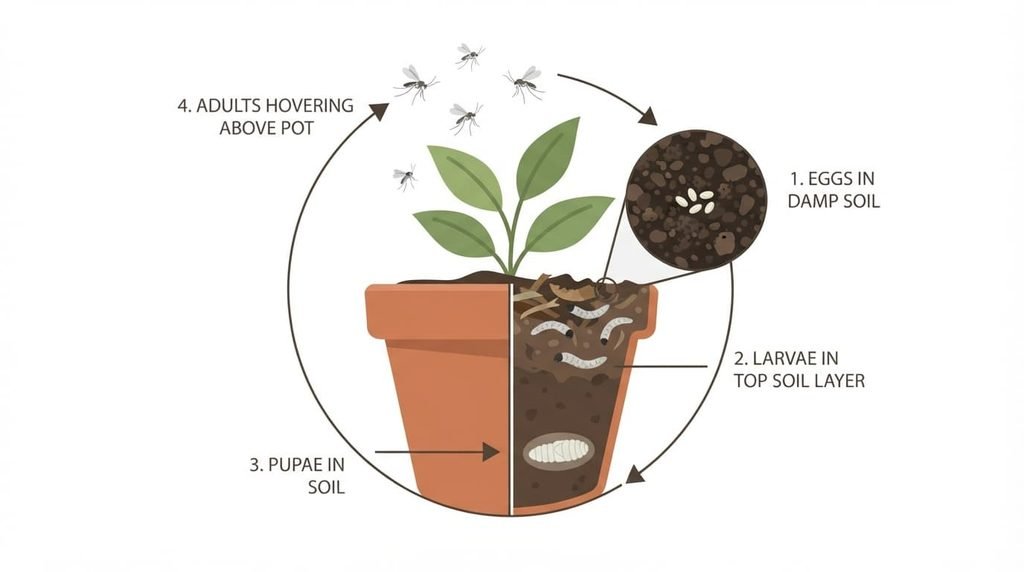
Fungus gnats lay their eggs in damp potting soil. The larvae that hatch feed on decaying organic matter and fine roots near the surface, then become adults, and the adults lay more eggs. The adults are weak fliers that hover around the plant, which is why they seem to rise from the pot when you disturb it.
The cycle only works while the top layer of the soil stays moist. A courtyard makes that easy to achieve: low light and still air slow evaporation, so a pot watered on a fixed schedule often stays wet at the top for days. Swatting or spraying the adults leaves the larvae in the soil, and the next generation arrives within a few weeks.
Confirm which pattern you have
Check three things before you treat anything.
Look at where the flies are. Gnats hover around soil and the base of plants. Flies gathered around fruit, bins or drains are a different insect with a different cause.
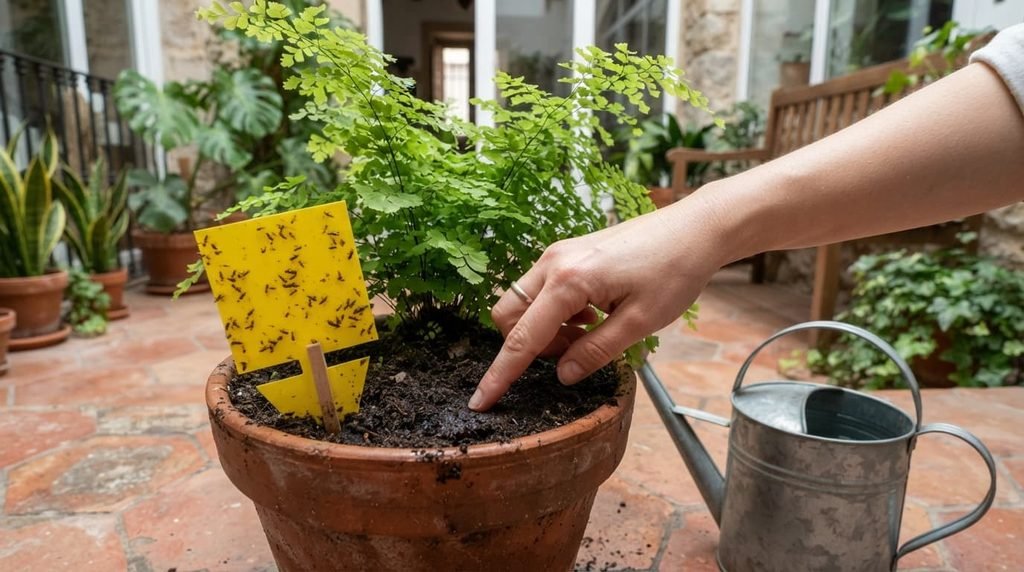
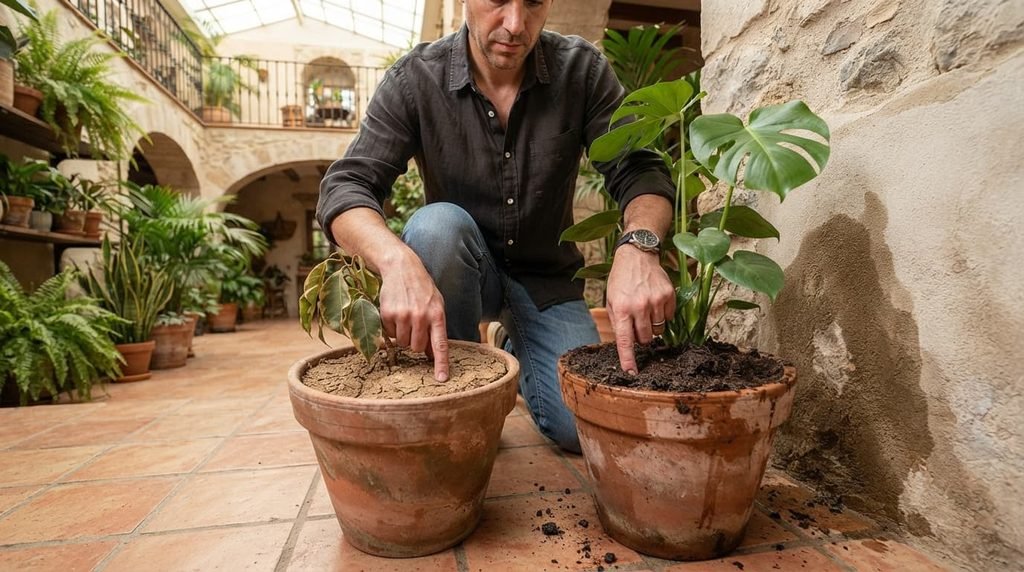
Press a finger into the soil. If the top few centimetres feel damp days after watering, you have found the conditions the gnats need.
Try the potato test. Lay a slice of raw potato flat on the soil of a suspect pot for a couple of days. Lift it and look underneath: tiny pale larvae with dark heads confirm the diagnosis.
The fixes, in order of cost
1. Let the top layer of soil dry between waterings. This costs nothing and breaks the cycle at its weakest point, because eggs and larvae need moisture near the surface. Water when the top few centimetres have dried, not on a fixed day. Plants in a low-light courtyard need less water than the label usually suggests.
2. Empty saucers and improve drainage. Water standing in a saucer keeps the soil wet from below. Tip it out half an hour after watering, make sure pots have drainage holes, and lift decorative outer pots so they do not hold water.
3. Trap the adults with yellow sticky traps. These cost very little. They catch adults, which reduces egg-laying, and they show you whether the population is falling. Place them upright in the soil or hang them near the worst pots.
4. Treat the soil with a biological larvae control. Products based on a bacterium called Bti target the larvae in the soil, and you apply them by watering. Follow the label exactly and keep the product out of reach of children and pets.
5. For dampness that has nothing to do with watering, consult a licensed professional. If the soil in one spot stays wet no matter what you do, or you see damp on a wall or floor near the planting, the moisture may be coming from a leaking pipe, an irrigation line or a drainage problem. That is a job for a licensed plumber or a damp specialist, not a DIY guess.
Water in a way that keeps the surface dry
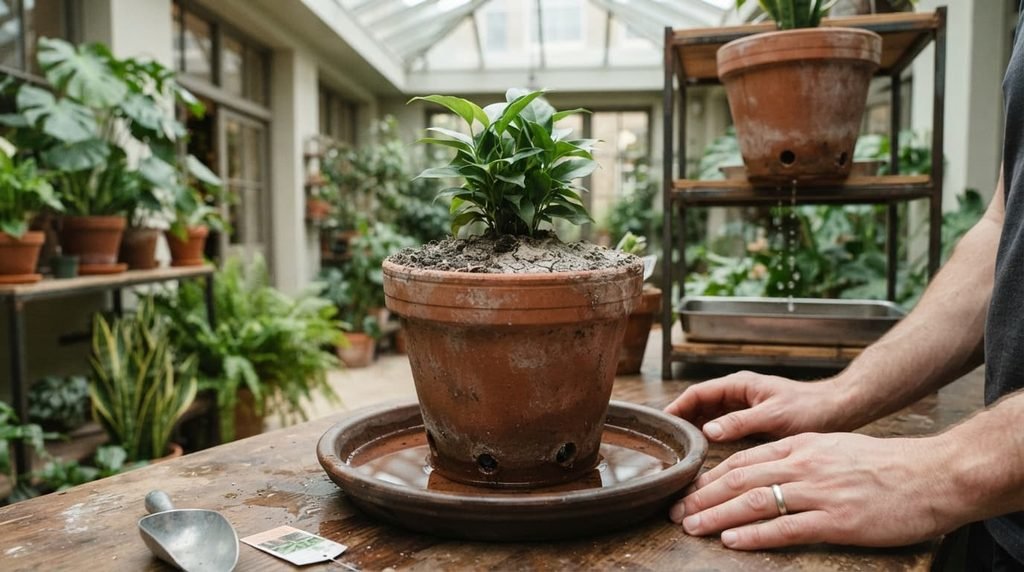
Bottom watering helps because it wets the roots without wetting the top layer where the eggs are laid. Stand the pot in a tray of water for fifteen to twenty minutes, let the soil draw up what it needs, then lift the pot out and let it drain completely before it goes back on its saucer. The surface stays much drier than it would after watering from above, and the roots still get all the water they need. It works best for pots with drainage holes and loose, free-draining soil.
What isn’t worth doing
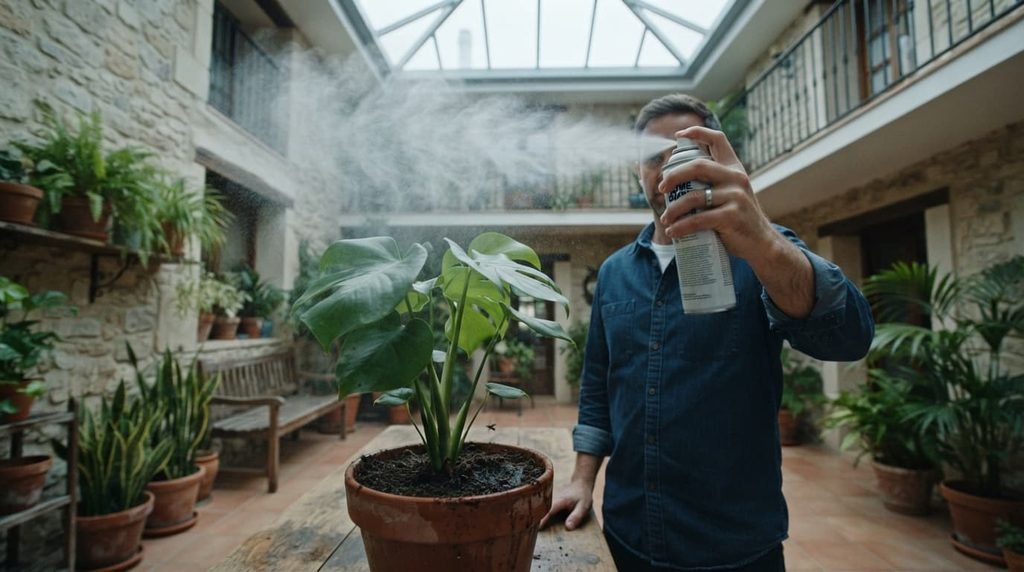
Spraying insecticide into the air or over the leaves isn’t worth doing.
Adults are the visible part of the problem, and they live only a short time. Spraying them leaves the larvae in the soil to produce the next batch, and it fills an enclosed courtyard with a chemical you then have to breathe and sit beside. The effort is better spent on the soil.
What people get wrong
The most common mistake is treating the flies rather than the soil. Killing adults feels satisfying and changes nothing for more than a few days.
The second is watering by the calendar. A courtyard with low light and still air dries slowly, so a schedule that worked in another room keeps these pots wet. Check the soil instead of the date.
The third is reaching for chemicals before trying to dry the soil. The free fix is usually the most effective one.
What changes if your situation is different
If your planting is in beds rather than pots, you cannot lift the container to let it dry. Focus on drainage, water less often but more deeply, and use traps to keep the adults down while the soil improves.
If one plant is badly infested, repot it in fresh, free-draining mix and discard the old soil. Remove loose dead leaves from the surface at the same time, because decaying matter feeds the larvae.
If you bring plants indoors from outside, check the soil before they join the others. Plants that spent the warm months outdoors often arrive with gnats already in the pot, so keep them apart for a couple of weeks and let the soil dry before they go back among the rest.
If children or pets use the courtyard, keep to drying, traps and drainage first, and store any treatment where they cannot reach it.
The one thing to check before you commit
Before buying any treatment, find out whether the moisture is coming from your watering or from somewhere else. Push a finger into the soil of every pot and compare. If only the pots you overwater are damp, the problem is your routine. If one spot is wet whatever you do, the cause is probably a leak or a drain, and that is where a professional should look.
Questions readers keep asking
Are fungus gnats harmful to people?
They do not bite or carry disease, so they are a nuisance rather than a danger. The harm is to plants, because the larvae can damage the fine roots of young or stressed plants.
How long until they go?
Because the cycle lasts a few weeks, expect improvement over a few weeks rather than days. Keep the soil drier and keep the traps up until you stop catching adults.
Does a layer of sand on top of the soil help?
A dry layer of coarse grit can make the surface less welcoming for egg-laying, and many growers use it. It supports the other steps but does not replace letting the soil dry.
Can I stop them coming back?
Mostly, yes. Water by soil dryness, empty the saucers, use free-draining soil and keep an eye on new plants, which often bring the gnats in with their pots.