Picture a UK household that has to be out of bed by 06:45 on weekdays. An alarm that fails does so on the one morning that counts, so this choice deserves a little arithmetic. A separate clock suits fixed hours better and a phone suits mornings that vary, and what decides it is how many other settings can silence the alarm without telling you. A phone alarm or a separate alarm clock will each do the job on a good night. All figures are rounded assumptions. Product names and prices are absent. A missed alarm often costs a train or a meeting, so the stakes justify the care.
The one property that decides a phone alarm or a separate alarm clock
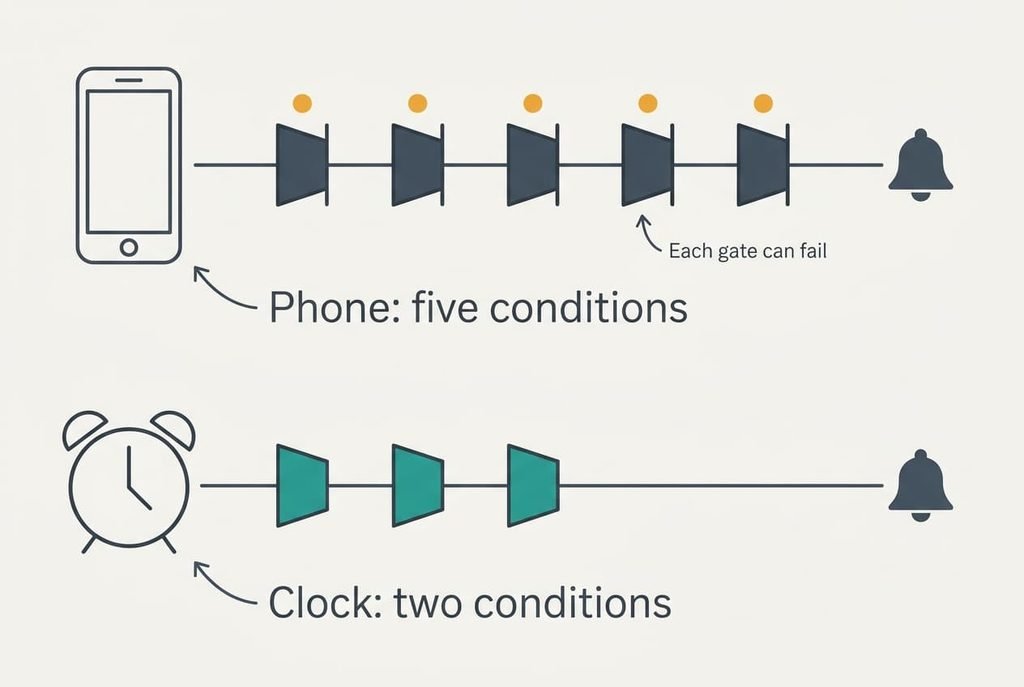
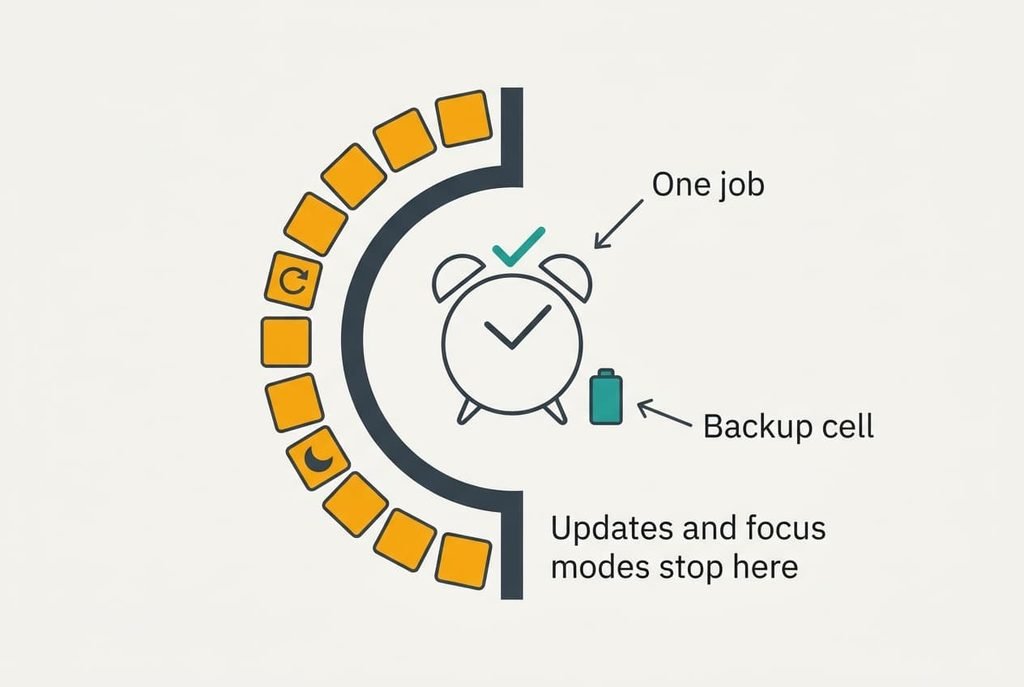
A phone alarm is a promise resting on several unrelated things. The phone must be on and holding charge. The alarm volume has to sit above zero, any focus mode must let alarms through, and the alarm must be switched on for that particular day. That makes five conditions, against just two for a separate clock, which needs power from the mains or a backup cell and an alarm switch that has been armed.
Suppose each condition fails on one night in 200, a rate of 0.5%. These are invented numbers that exist only to show how the sums scale. Five conditions give 1 − 0.995⁵, which is 2.5% or about 9 mornings a year. Two conditions give 1%, or about 4 mornings. A rate that small sounds harmless until you remember that it also lands on the morning of an 08:00 flight.
The count of conditions matters more than the reliability of any one. Phones are dependable machines, yet they carry many other jobs, and each job can alter a setting that touches the alarm. A clock has one purpose and little to interfere with it.
That comparison skips what the clock can’t do, such as travelling with you, and later sections cover it.
How the two compare on an ordinary weekday
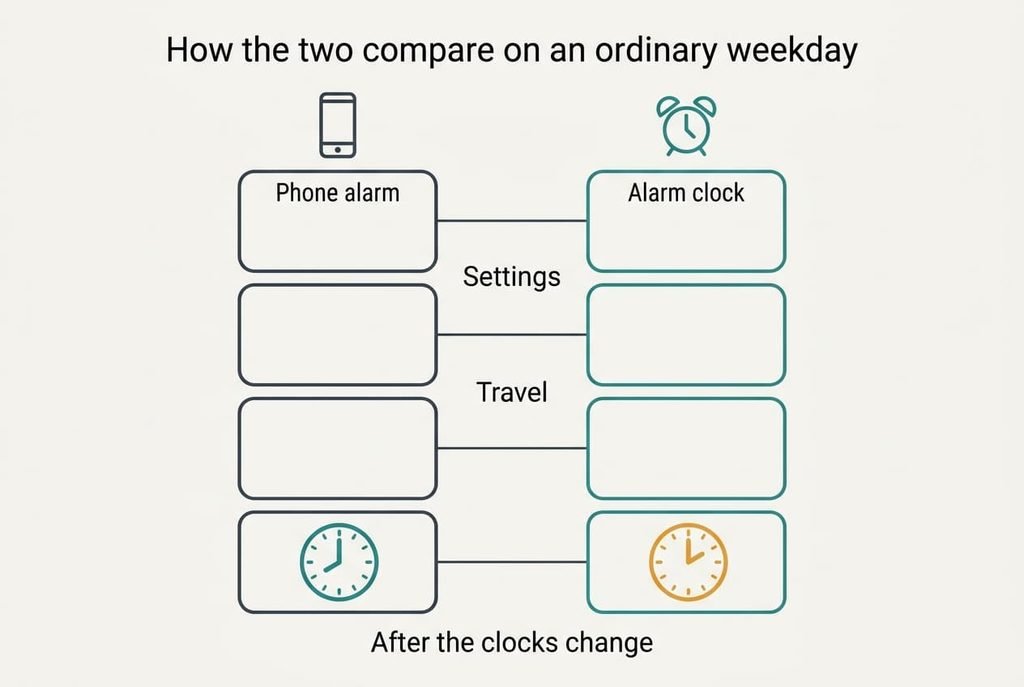
Each row can be verified on a settings screen or a box. Neither option wins them all, and the rows that count depend on how steady your week is.
| Question | Phone alarm | Separate alarm clock |
|---|---|---|
| What shares its settings | Its volume and focus modes | Nothing |
| What can silence it unnoticed | A changed setting or a flat battery | An unplugged lead with no backup cell |
| After the clocks change | Adjusts itself | Plain models need setting by hand |
| When you travel | Comes along and follows the time zone | Stays behind unless it’s a small travel model |
| Number of alarms | Many, each with its own schedule | One or two |
| Stopping it in the morning | A swipe or tap on a lit screen | A button on top |
The clocks-change row is the surprising one. The UK moves its clocks twice a year, and a clock set by hand and then forgotten runs an hour wrong for weeks. Models that take a time signal by radio adjust themselves, so read the box before you lean on this row.
You can also see why the first two rows matter most. They describe what can go wrong without a sound, and silent failure is the kind that makes you late.
Where a phone alarm wins
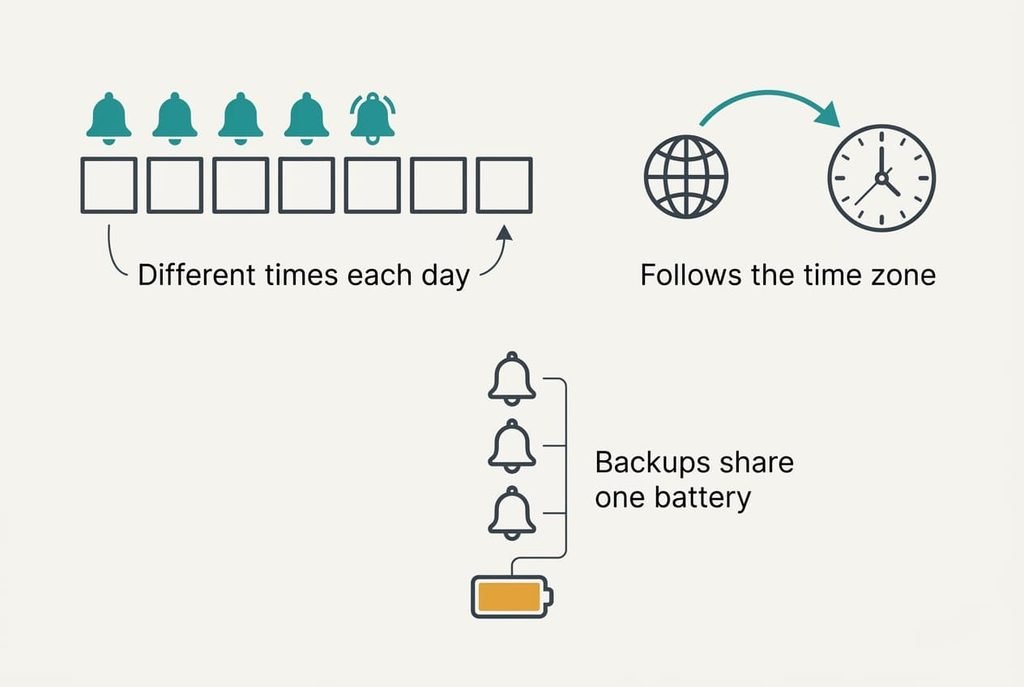
A phone wins when your mornings differ. It can hold a 06:45 alarm for Monday to Thursday and a 08:30 one for Friday, with nothing at weekends. A clock with a single alarm needs a button press for every change.
Travel is the second case. Fly east by an hour and a phone moves its alarm with the local time, so 06:45 still means 06:45 where you land. Nothing on a bedside shelf can do that, and a hotel room seldom has a clock worth trusting.
Backups come free on a phone. A second alarm at 06:55 and a third at 07:05 turn one chance into three. Those three share a battery and a volume, though, so they don’t protect against a flat phone. Choosing a phone alarm or a separate alarm clock for a changing week usually ends here, because flexible schedules are the one thing a basic clock can’t copy.
Volume is a smaller advantage. Many phones raise an alarm gradually over 30 seconds, which some people prefer to a fixed buzz.
Where a separate alarm clock wins
A clock wins when your hours are fixed and the alarm must stand alone. Its settings change only when you press its buttons. A software update can’t reach it, and neither can a battery that ran flat at 03:00.
Failure is easier to spot too. A clock’s display shows the time and an alarm indicator, so you see at bedtime whether it’s armed. A phone buries the same facts in a menu, and a lit screen can still hide a muted volume.
Keeping a clock going costs little. A model with a backup cell carries on when the mains drops out, so a pulled plug doesn’t take the alarm with it. Fit a fresh cell each time the clocks change, and you’ll never wonder how old it is.
Its limits are real. It can’t come on a trip. It holds one or two alarms, and a plain model needs resetting twice a year. For a regular 06:45 start, the question of a phone alarm or a separate alarm clock barely arises, since the clock gives up very little.
When neither is enough
Some mornings can’t rest on a single device, such as a 05:00 start for a flight. Run two alarms from two different sources, ten minutes apart, so no one setting or failure can remove both. A clock on the shelf and a phone on its charger share nothing except the person who sets them.
The habit takes a few seconds each night. Put the phone’s alarm ten minutes after the clock’s, because a second sound at the same moment is easy to mistake for the first.
Check both alarms before the light goes out.
If you’re travelling, the hotel’s own wake-up call can play the second role. Ask the desk for it at check-in, and confirm the time before you go upstairs. At home, a housemate who gets up earlier can fill the same gap, as long as you agree it the evening before and not at 05:00.
Which to choose: a phone alarm or a dedicated clock?
If your hours are fixed and the alarm must always sound, choose the separate clock. You pay with some shelf space and a twice-yearly check, and you gain an alarm that nothing else can reach. Set it once and arm it, then look at the indicator at bedtime. Fit a fresh backup cell whenever the clocks change.
If your mornings change or you travel often, choose the phone. You pay with five conditions that all have to hold, and you gain schedules that follow you abroad. Add a second alarm ten minutes later and confirm the volume before the light goes out.
With a phone alarm or a separate alarm clock still undecided, count the mornings a year that go badly wrong if the alarm fails. A high number points to the clock, while a low one leaves taste to decide. Either choice works once you’ve glanced at the alarm each evening. When two people share a house, repeat the count for each of them, since one person’s missed morning can cost more than the other’s.
Questions readers keep asking
Which is cheaper to run?
The phone alarm costs nothing extra, since the phone gets charged anyway. A separate clock sips a trickle from the mains or an occasional battery. Over a year the gap is a few pence at most, so reliability should settle the matter rather than running cost.
How often should I check the alarm?
Look at it every night as a ten-second habit, and look harder after anything changes. A software update or the clocks changing can each move a setting. Checking each evening catches a fault while you still have time to fix it.
Which suits someone who shares a room?
A clock with a quiet tone and a single alarm suits a shared room, because it wakes one person. The buzz of a phone can carry across the room. Starting the phone at a low volume matches that, so both work, provided you test the sound beforehand.